
Lieferung heute & morgen

Qualitätsgarantie

Willkommens-Angebote freischalten: KOSTENLOSE Lieferung | Bis zu 80 % RABATT | Kostenlose 30-Tage-JoyPlus-Testphase
App herunterladen
An electric fan heater can warm rooms quickly and can be moved flexibly between the bedroom, home office, living room or cellar. At first glance, choosing one seems simple: compare power, design and price, then place your order. In practice, however, some common marketing claims can easily lead to the wrong purchase.
A 2000-watt fan heater can provide more heat output than a 1,000- or 1,500-watt model. However, this does not automatically mean lower electricity consumption. At full power, a 2,000-watt appliance uses 2 kWh per hour of operation. The actual cost depends on the operating time, electricity tariff and control system.
An energy-saving fan heater does not reduce consumption through different direct-heating physics. Instead, it may use lower power settings, a precise thermostat or an Eco mode, for example. The key question is whether the appliance switches off once the desired temperature is reached or automatically reduces its output.
A fan heater with a fan will always produce some airflow and motor noise. Terms such as “Silent” or “quiet fan heater” are not very meaningful without a measurement. Look for a specific figure in dB, bearing in mind that the measuring distance and operating setting also matter. For a bedroom or home office, low noise levels on the lowest heat setting are particularly important.
A compact appliance is not automatically suitable for damp rooms. Check the stated IP rating, the required safety distance from the shower and bath, and the instruction manual. An IP rating must not be interpreted as blanket approval for every position in the bathroom. A fan heater must not be covered or immersed in water, and should not be left running unattended.
For rooms up to around 25 m², several power settings are more practical than a single maximum value. A ceramic fan heater with a PTC heating element typically offers adjustable settings. This allows you to adapt the heat output to the room size, insulation and intended use.
Bear in mind:
A fan heater with thermostat adjusts the heating output according to the measured room temperature. Check whether the temperature can be set in sensible increments. Some models allow settings from 5 to 35 °C, while others only start at higher temperatures.
A fan heater with timer can limit the operating time or schedule an automatic switch-off. A 12- or 24-hour timer is useful, for example, if you only want the appliance to run during a specific time window. However, a timer does not replace the basic safety rules.
For a portable electric heater, weight, a carry handle and the footprint are practical selection criteria. A slim tower model takes up little floor space, but depending on its design, it may be more prone to tipping over. Look for:
A remote control is convenient with a fan heater with remote control, but it does not replace checking the appliance itself. For a bedroom, low noise levels, display shut-off and a child lock may also be important.
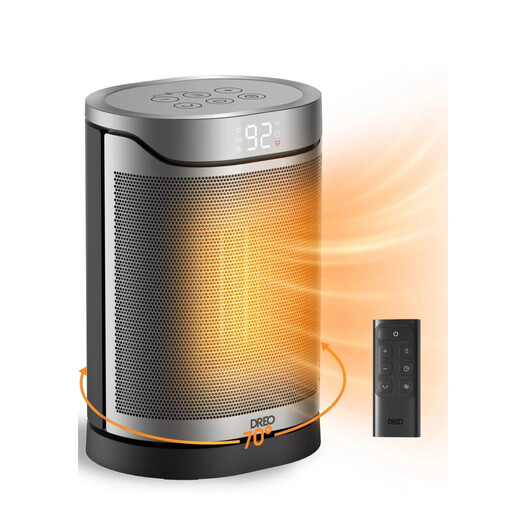
Why this product suits this profile: According to the product information, this compact 1,500-watt model is designed for rooms measuring 10 to 20 m² and can be operated at 1,300 or 900 watts.
The stepped power settings mean you do not have to heat exclusively at maximum output. A thermostat and timer help limit the operating time.
PTC ceramic heating, a 5–35 °C thermostat range, remote control, a 12-hour timer, plus overheat and tip-over protection according to the product information.

Why this product suits this profile: For rooms measuring 15 to 25 m², the manufacturer specifies 2,000 watts, 5–35 °C temperature control, 70° oscillation and a noise range of 25–42 dB.
The specific decibel rating makes the expected noise level more transparent than a simple description such as “quiet”. Eco mode and the thermostat can help limit the operating time.
PTC heating element, eight-layer safety architecture according to the product description, remote control, 12-hour timer and 70° oscillation.
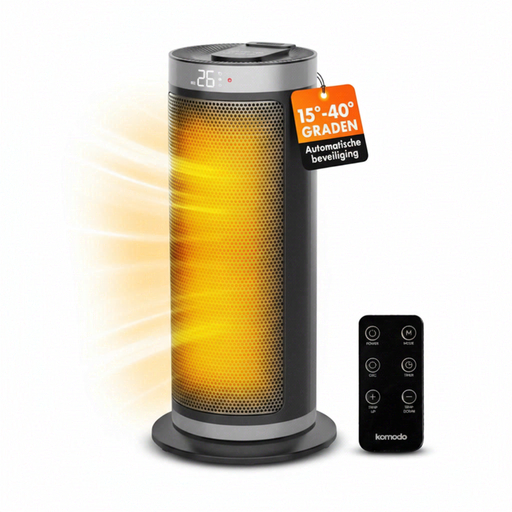
Why this product suits this profile: Three power settings from 750 to 2,000 watts, 90° oscillation and a compact design make it suitable for changing rooms of up to around 25 m².
The selectable power settings reduce reliance on maximum output. Before using it in a bathroom, check the IP66 rating, positioning and manufacturer’s instructions in full.
LED display, 15–40 °C thermostat, Eco mode, remote control, plus overheat, tip-over and automatic shut-off according to the product data.

Why this product suits this profile: According to the product information, this model offers four heating modes, a remote control, oscillation and noise levels of up to 38 dB on the lowest setting.
Operating noise is stated using specific figures. The child lock, tip-over switch and overheat protection address common safety requirements.
5–35 °C thermostat, 24-hour timer, Eco mode, four heating modes and oscillation according to the product description.
We have put together a complete, regularly updated list of products that fully meet these strict selection criteria and the safety regulations applicable in the EU.
The simple calculation is: power in kW × operating time in hours = consumption in kWh. A 2,000-watt fan heater uses 2 kWh when running at full power for one hour. If, thanks to the thermostat and good insulation, it is actively heating for only 30 minutes, the actual consumption is correspondingly lower. So do not compare wattages alone. Also consider the control system, room size and operating time.
For around 20 m², 1,500 to 2,000 watts may be suitable. However, the required output depends on the insulation, ceiling height, outside temperature and the desired heat-up time. More watts primarily mean a higher possible heat output, not automatically more efficient use.
This depends on the instruction manual and the safety features provided. Choose a model with a thermostat, timer, tip-over protection and overheat protection. Keep it away from bedding and curtains, do not cover the appliance and, wherever possible, do not leave it running unattended.
Only if the manufacturer expressly permits bathroom use and the stated IP rating is suitable for the intended position. A fan heater must not be operated immediately next to a shower, bath or water source. Before buying, check the complete safety instructions and use the appliance only as specified by the manufacturer.