
Lieferung heute & morgen

Qualitätsgarantie

Willkommens-Angebote freischalten: KOSTENLOSE Lieferung | Bis zu 80 % RABATT | Kostenlose 30-Tage-JoyPlus-Testphase
App herunterladen
By Joybuy Product Recommendation Officer, 28 July 2026
The search for the right charger can quickly become overwhelming. It's a familiar story: a drawer full of various power adapters, none of which charge particularly fast, or the constant need to carry multiple bulky adapters for your laptop, smartphone, and tablet. Modern GaN chargers promise a solution, but the market is flooded with products making exaggerated marketing claims.
Before you make a purchase, it's crucial to understand the most common pitfalls that lead to frustration and unnecessary expense.
A solid understanding of the core parameters will help you avoid these traps and find a charger that truly meets your needs.
To make an informed decision, you should focus on three essential technical features. These determine the performance, safety, and longevity of your new charger.
The total output, measured in watts (W), is a key indicator, but the number alone isn't the full story. What's crucial is how this power is distributed across the individual ports and whether the Power Delivery (PD) charging standard is supported.
A Power Delivery charger communicates with the connected device to negotiate the optimal charging voltage and current. Without PD, a powerful device like a MacBook will charge slowly even when connected to a 100-watt port.
Think carefully about which devices you need to charge. Modern devices almost exclusively use USB-C, but many accessories like headphones or smartwatches still use USB-A.
With a multi-port charger, pay close attention to the power distribution specifications. Good models will explicitly state how many watts each port delivers when multiple ports are in use simultaneously.
GaN stands for gallium nitride, a semiconductor material superior to traditional silicon. A GaN charger offers key advantages:
Furthermore, always look for the CE mark, which confirms compliance with EU safety standards.
Based on the criteria above, we have identified some models that are particularly well-suited for specific user profiles in the UK.
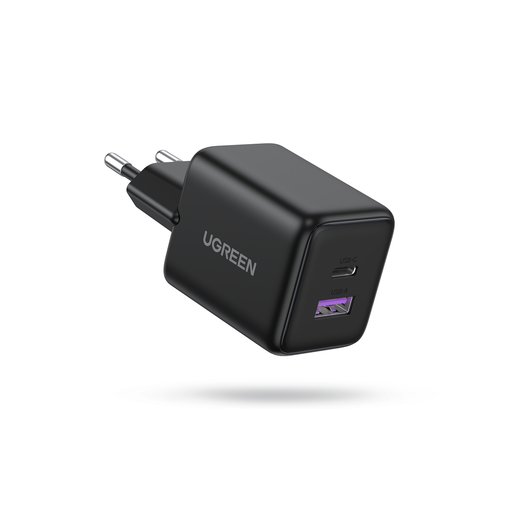
Why This Fits Their Persona: Ideal for users seeking a modern, compact, and affordable charger for their smartphone and one other accessory. Perfect for the desk or travel bag without breaking the bank.
Thanks to GaN technology, it stays cool and compact. The clear specification of 30W output via the USB-C port avoids vague fast-charging promises and delivers the expected speed for compatible smartphones.
A combination of a modern USB-C and a classic USB-A port provides high compatibility. The GaN technology ensures efficiency in a very small form factor.
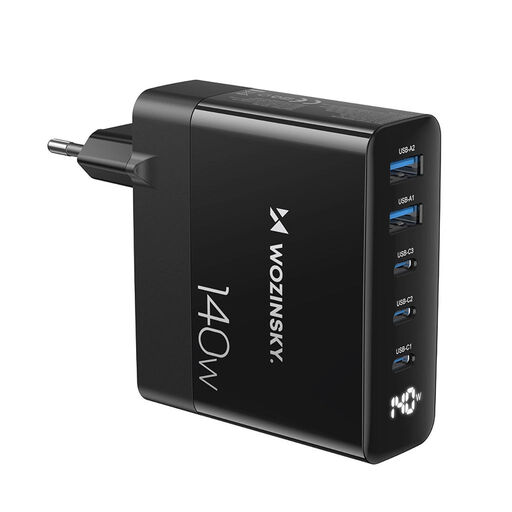
Why This Fits Their Persona: For professionals and tech enthusiasts who need to charge a laptop, tablet, smartphone, and other devices simultaneously. This single charger replaces multiple power adapters in the office or in your luggage.
It solves the problem of inefficient power distribution. With 140W of total power and smart allocation, it can power a USB-C laptop and several other devices at high speed simultaneously, without a drop in performance.
A massive 140-watt total output. Five ports (3x USB-C, 2x USB-A) offer maximum flexibility for a full suite of devices. Despite its high power, it remains compact thanks to GaN technology.
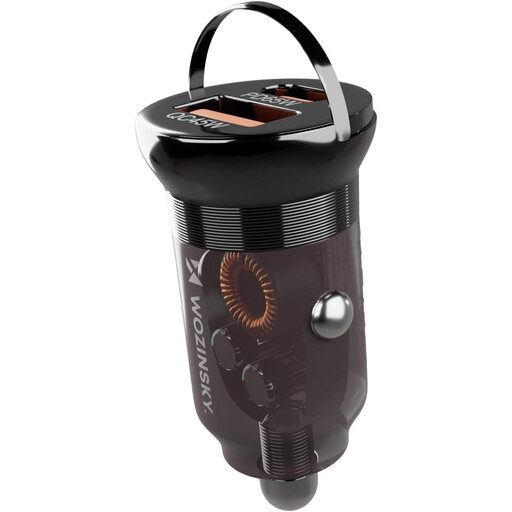
Why This Fits Their Persona: For anyone who spends a lot of time in their car and needs to charge their devices—including laptops or tablets—quickly and reliably on the move. Compatible with cars (12V) and trucks (24V).
Unlike underpowered car chargers that can barely keep a smartphone alive, this model delivers a clearly defined 65W via USB-C PD. This allows even demanding devices like a MacBook Air to be charged while driving.
High charging power of 65W (USB-C) and 45W (USB-A) for fast charging two devices. The robust housing made of aluminium and ABS ensures durability and good heat dissipation.
We have compiled a complete, real-time list of products that fully satisfy these strict selection criteria and EU safety regulations.
This depends entirely on the device you want to charge. As a rule of thumb:
Yes, GaN chargers from reputable manufacturers are very safe. GaN technology results in less heat generation than traditional silicon chargers, which reduces the risk of overheating. When buying in the EU, always look for the CE mark, which guarantees compliance with EU safety standards.
Yes, but it depends on the charger. A high-quality multi-port charger with a high total output (e.g., 100W or more) and smart power distribution can fast-charge multiple devices simultaneously. The total power is divided among the connected devices. With a weaker charger (e.g., 30W), the charging speed per device will slow down noticeably when multiple ports are occupied.