
Lieferung heute & morgen

Qualitätsgarantie

Willkommens-Angebote freischalten: KOSTENLOSE Lieferung | Bis zu 80 % RABATT | Kostenlose 30-Tage-JoyPlus-Testphase
App herunterladen
Glass food storage containers with lids are practical for leftovers, prepared meals and keeping the fridge neatly organised. However, product claims do not always lead to the right purchase decision. Capacity and appearance are important, but so are the seal, temperature limits, lid material and suitability for everyday use.
A container may be described as airtight or leak-proof without explaining how the closure works. For soups, dressings or sauces, multi-sided locking mechanisms, a removable silicone seal and a well-fitting lid are important. Also check whether the seal can be cleaned separately. Otherwise, residue in the grooves could affect everyday hygiene.
For many glass containers, the temperature specification applies only to the glass container. Plastic lids and seals generally must not be placed in the oven. Depending on the model, the microwave may also require an open steam valve or the lid to be removed completely. The specific manufacturer’s instructions take precedence over general advertising claims.
Even heat-resistant borosilicate glass is not indestructible. A container taken from the freezer should not be placed straight into a very hot, preheated oven. Likewise, hot glass should not be placed on a cold stone surface or directly into cold water. Such temperature changes can cause thermal shock and cracks.
Borosilicate glass is often used for food storage containers because it is designed to withstand comparatively high temperature ranges. However, the precise maximum temperature varies by model. For example, the products mentioned here specify temperatures of up to 400 °C or 420 °C for the glass container without the lid.
The lid is usually made from polypropylene, Tritan or a similar plastic. Terms such as BPA-free food storage containers often refer to the lids or seals and should be clearly explained in the product description. BPA-free does not automatically mean that every lid is suitable for oven use.
For transport, airtight glass containers with silicone seals are a sensible choice. A four-sided clip closure distributes pressure evenly and can be beneficial when storing liquids. With glass food storage containers, the seal should be removable. This allows the lid, ring and container to be cleaned separately and dried thoroughly.
Look for the statement “dishwasher-safe” and check whether it applies to all components. Some lids should only be cleaned in the top rack of the dishwasher.
For individual snacks, 180 to 380 ml is sufficient. Portions for the office or meal prep are often between 630 and 1,040 ml. For family meals or larger quantities, glass food containers with capacities of 1.3 or 2 litres may be more suitable.
Square or rectangular shapes generally make more efficient use of shelves and fridge space than round models. A raised lid edge or special stacking rim supports stackable food storage containers. Even so, you should check the external dimensions: a high-capacity container may take up more space than expected because of wide clips.
The following glass storage containers differ in capacity, closure and intended use. The temperature and leak-proofing specifications correspond to the respective suppliers’ product information.
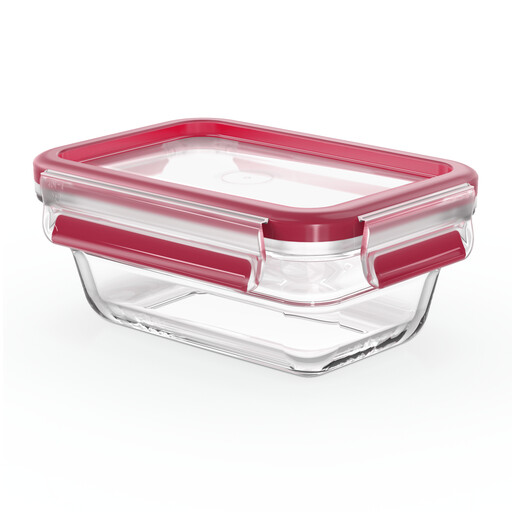
Why this product suits this profile: The compact capacity is suitable for small portions, side dishes and leftovers. According to the product information, the container is stackable, dishwasher-safe and suitable for the freezer, microwave and oven without the lid.
The special stacking rim and reinforced edge help prevent containers of the same size from slipping. The product description identifies the leak-proofing as a manufacturer’s specification.
0.45-litre capacity; temperature rating of up to 420 °C for the glass container without the lid and down to -40 °C according to the product information.
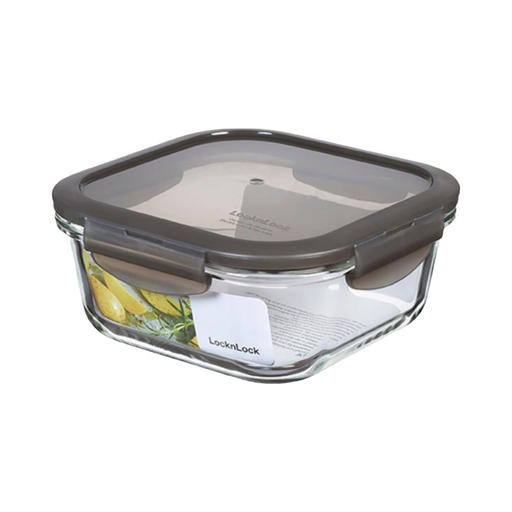
Why this product suits this profile: The square borosilicate glass container is designed for meal prep, office portions and liquids. The four-sided locking mechanism with removable silicone seal supports separate cleaning.
The product description explicitly states that the seal is airtight and watertight. For oven and microwave use, the lid must be removed completely.
750 ml capacity; borosilicate glass up to 400 °C according to the product information; lid and seal can be removed separately.
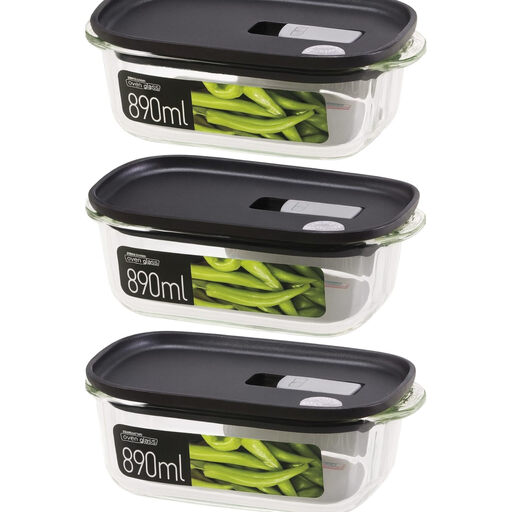
Why this product suits this profile: Three containers of the same size make it easier to prepare several meals. The set is designed for storage, transport, reheating and freezing, making it well suited to regular meal prep.
According to the product information, the containers have steam-release valves for reheating. The plastic lid must be removed in the oven; before buying, check that you have enough space for each container’s dimensions of 21 × 13 × 7.6 cm.
Three containers of 890 ml each; BPA-free polypropylene lids according to the product description; stackable, dishwasher-safe and suitable for the freezer, microwave and oven without the lid.
We have put together a complete, regularly updated list of products that fully meet these strict selection criteria and the safety regulations applicable in the EU.
Many models are designed for this, but generally only without the plastic lid in the oven. The microwave may require a valve to be opened. The instructions provided by the respective manufacturer are authoritative.
Their lifespan depends on use, cleaning and temperature changes. Glass can be damaged by impacts or thermal shock. Seals can wear out over time and should be replaced if they become misshapen, cracked or less effective, provided replacement parts are available.
Yes, provided the capacity, shape and temperature limits suit your meal plan. A glass container set with uniform dimensions is a practical choice for several prepared portions. Leave enough room in the freezer for the contents to expand and avoid moving the containers directly from extreme cold to high heat.