Breakfast fans keeping an eye on fibre
You want to compare fibre content per 100 g and are also considering muesli if its stated fibre content matters more to you than baked granola.


If you’d like baked granola with a stated fibre content for Sunday breakfast, Kölln Granola Klassik and Früchte are options to consider: their nutritional information at REWE lists 8.3 and 8.5 g of fibre per 100 g, respectively. If a higher stated fibre content matters more to you than granola’s texture, you could instead look at the Alnatura and Seitenbacher mueslis mentioned here. Compare sugar and ingredients separately from the fibre content, and check the labelling on the specific pack if you have any intolerances.
You want to compare fibre content per 100 g and are also considering muesli if its stated fibre content matters more to you than baked granola.
You want granola with yoghurt or milk, but you also want to check the ‘of which sugars’ line and the ingredients, as well as the texture.
You need a particular label, such as gluten-free or vegan, or need to check specific ingredients and may-contain information on the current pack.
First decide whether you want baked granola or would also consider muesli. Then compare the nutritional information on the same basis and check that the specific variety has any labels you need.
| Criteria | What to check when buying | Who it matters to |
|---|---|---|
| Fibre content | Compare fibre per 100 g. Under the EU regulation on nutrition claims, ‘high fibre’ requires at least 6 g per 100 g or 3 g per 100 kcal. | When comparing granola and muesli, I want to be able to check the fibre content rather than relying on ‘wholegrain’. Around 31% of consumers put this first. |
| Texture and sugar | Look at the product type, ‘of which sugars’ per 100 g and sweetening ingredients together. | For breakfast, I want crunchy granola without losing sight of the sugar content. Around 31% of consumers prioritise this balance. |
| Labelling and allergens | If needed, check whether the specific variety is labelled gluten-free or vegan, and read the ingredients and may-contain information on the current pack. | If I need to avoid certain ingredients, the labelling on the individual product matters more to me than the brand. This is the main concern for around 23% of consumers. |
| How you’ll serve it for breakfast | Consider whether the texture will work as a topping or in a bowl of muesli with yoghurt, milk or a plant-based drink, and factor in how much you’ll use. | At the Sunday breakfast table, I mainly want a texture that suits the bowl I have in mind. Around 15% of consumers put this use first. |
These labels don’t tell you the fibre content. Under the EU regulation, a product can only be labelled ‘high fibre’ if it contains at least 6 g of fibre per 100 g or 3 g per 100 kcal.
Check the nutritional information for the specific product before choosing it on the basis of this claim.
According to the Verbraucherzentrale, honey, syrup, fruit juice and dried fruit can also contribute to the sugar content. So the name of an ingredient is no substitute for checking the nutritional information.
Compare ‘of which sugars’ per 100 g and check the ingredients list too. REWE lists 8 g of sugar per 100 g for Kölln Granola Klassik and 9.8 g for Granola Früchte.
A product labelled gluten-free may still carry warnings about other allergens. For REWE frei von Bio Hafer Crunchy glutenfrei, REWE lists possible traces of, among other things, egg, milk protein, sesame, soya, nuts and lupin.
If you have an allergy, check the ingredients and may-contain information on the current pack for the specific substances you need to avoid.
If you use granola as a topping, you may eat a different amount from the serving size shown on the pack. Other ingredients also count towards the meal.
Compare nutritional values per 100 g and take into account how much you actually use with yoghurt, milk or fruit.
The information below applies to the specific varieties or ranges mentioned, not to every product from each brand.
Kölln Granola Klassik and Granola Früchte are two granola varieties for anyone who wants a baked texture at Sunday breakfast.
The muesli ‘Die geröstete Ballaststoffquelle #477’ is an alternative if a stated fibre content matters more to you than choosing granola.
Basis-Müsli could work for a breakfast where you’d prefer a muesli base to baked granola.
At REWE, you can compare granola and crunchy muesli varieties using the information for each product.
EDEKA24’s muesli and cereal range includes EDEKA Herzstücke crunchy mueslis alongside products from other brands.
These products are crunchy or fruity mueslis for Sunday breakfast. If you specifically want baked granola, check the product type before buying. For a fibre-focused choice, also check the nutritional information on the relevant pack.
 No image available
An option if you’re looking for crunchy muesli for breakfast rather than a product specifically described as granola. Compare fibre and sugar using the latest nutritional information; if you have allergies, check the labelling for gluten, soya, milk and nuts.
 No image available
For a breakfast with crunchy oat muesli rather than baked granola. Check the fibre and sugar content per 100 g separately; if you need to avoid allergens, also check for gluten and read the may-contain information on the pack.
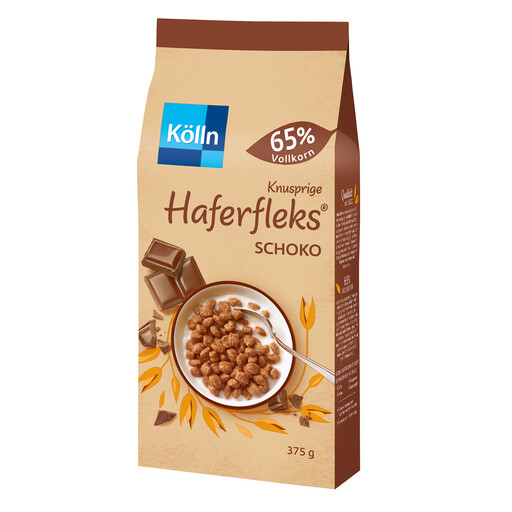 No image available
A chocolatey, crunchy muesli option if you’re not set on baked granola. Check the sugar content on the current pack and, if relevant, look for information about gluten and possible traces of pecans.
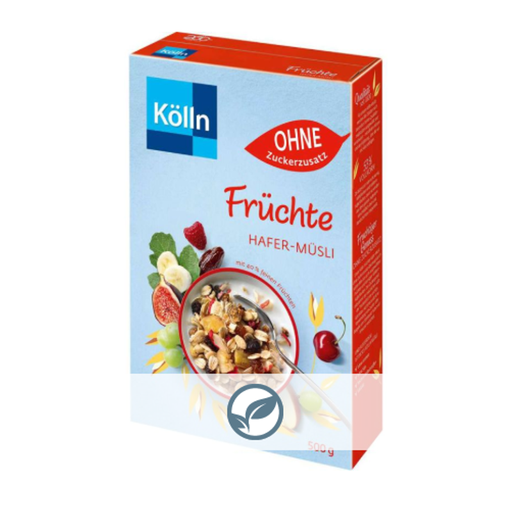 No image available
A fruit muesli for anyone considering muesli instead of granola; don’t expect it to have the texture of baked granola. The product name is no substitute for checking ‘of which sugars’ per 100 g. If you have allergies, check the ingredients and may-contain information on the current pack.
For this nutrition claim, the relevant EU regulation requires a product to contain at least 6 g of fibre per 100 g or at least 3 g per 100 kcal. On its own, the claim doesn’t tell you about sugar, ingredients or allergens.
No, you can’t tell the sugar content from the claim alone. Compare ‘of which sugars’ per 100 g; according to the Verbraucherzentrale, ingredients such as honey, syrup, fruit juice and dried fruit can also contribute to the sugar content.
No. If you need a gluten-free variety, look for an explicit gluten-free label on the specific product. REWE frei von Bio Hafer Crunchy is labelled this way, but also lists possible traces of other allergens, so check the ingredients and may-contain information too.
For the Kölln granolas mentioned here, the storage instructions say to keep them in a cool, dry place and close the inner bag tightly after opening. For other varieties, follow the instructions on their packaging.