
Lieferung heute & morgen

Qualitätsgarantie

Willkommens-Angebote freischalten: KOSTENLOSE Lieferung | Bis zu 80 % RABATT | Kostenlose 30-Tage-JoyPlus-Testphase
App herunterladen
A kettle is a daily essential in many British households. Yet when buying one, unnecessary extra costs often arise: a large appliance is bought for a single-person household, a stylish casing hides a hard-to-read water gauge, or the stated wattage is assumed to guarantee a short boiling time.
The main pitfalls usually fall into three areas:
If you check these points before buying, you can choose an electric kettle that better matches your own usage habits.
For families, shared houses and regular tea or coffee rounds, a 1.7-litre kettle offers enough volume for several cups. It's important that both a minimum mark and a clearly readable maximum mark are present. Too little water can trigger the boil-dry protection; overfilling can cause hot water to escape when boiling.
For small kitchens, offices or single people, a 1-litre kettle can be more practical. It takes up less worktop space and reduces the temptation to regularly heat more water than you need. If you're looking for a compact model, you'll find more options in the category 1l kettle small.
A fast kettle usually has a wattage between 1,600 and 2,200 watts. A higher wattage generally means greater heating power, but doesn't automatically guarantee a specific boiling time. For energy consumption, what matters most is how much water you heat. A half-filled kettle uses less energy than a completely full one.
So the practical approach is: only fill the amount you need, pay attention to the markings, and don't leave the appliance running unnecessarily after boiling. For products used in British homes, the electrical specification should match your mains supply. Ratings such as 220–240 volts and 50/60 Hz are relevant here.
A stainless steel kettle is usually robust and looks durable, but can get very hot on the outside. A glass kettle lets you see the water level and the boiling process. However, glass casings need more careful handling and limescale deposits are often very visible.
A retro kettle puts the emphasis on design. Still, check that the handle, lid opening and water level indicator are easy to use in daily life. A kettle with a limescale filter can trap particles when you pour. The filter should be removable and washable.
Essential features include:
The 360° base doesn't make the appliance cordless in the technical sense: the power cable stays attached to the base. Only the jug can be lifted off the base without a cord.
The following models differ in volume, material, design and features. The details refer to the respective product data.
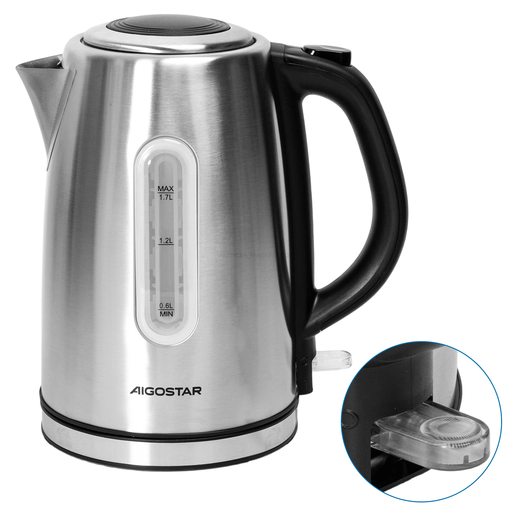
Why this product fits the profile: This model combines a 1.7-litre capacity with a stated wattage of 1,850 to 2,200 watts, making it suitable for several cups around the home.
The visible min and max markings help with measuring. Boil-dry protection and automatic shut-off are listed as safety features.
Food-grade stainless steel interior, 1.7-litre capacity and a cordless jug with a separate base.
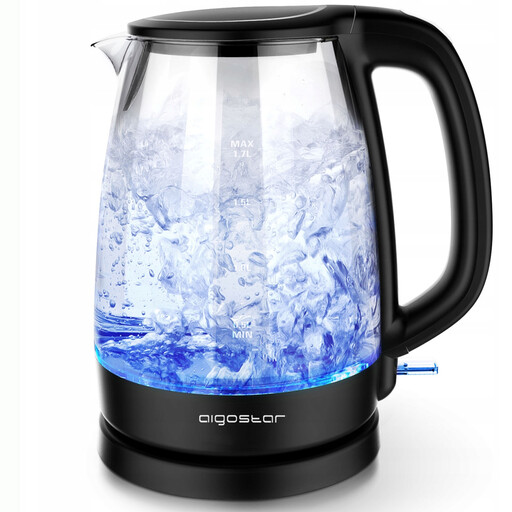
Why this product fits the profile: The borosilicate glass body makes the water level and boiling process visible. This suits users who prioritise material and control over an opaque casing.
The visible water level reduces inaccurate filling. Boil-dry protection and automatic shut-off are explicitly listed as features.
Heat-resistant borosilicate glass, SUS304 stainless steel heating plate, 1,850–2,200 watts and a removable 360° base.
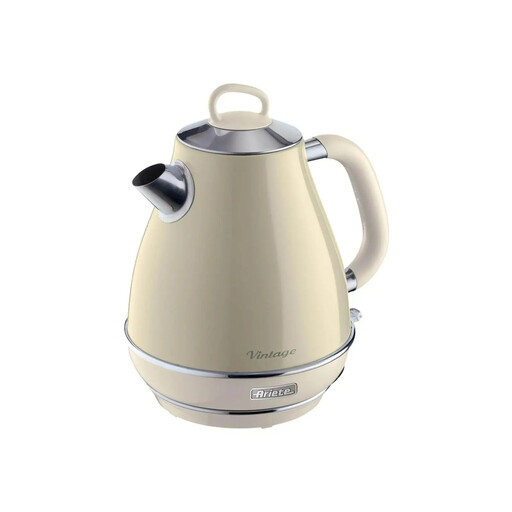
Why this product fits the profile: This retro model is aimed at households where the kettle sits visibly on the worktop and design matters as much as function.
The external water level indicator prevents the design from making measuring difficult. An anti-limescale system and automatic shut-off complement daily use.
1.7-litre capacity, 2,000 watts, 360° base, visible water level indicator and automatic shut-off.
Before first use, fill the kettle with water according to the manufacturer's instructions, boil it once and then rinse it out. For daily use, follow a few simple rules:
Limescale doesn't just affect appearance. Deposits can lengthen the heating time and alter the taste of tea or coffee. How often you need to descale depends on the water hardness in your area and how frequently you use the kettle.
We've put together a complete, regularly updated list of products that fully meet these strict selection criteria and the safety regulations in force in the EU.
Ideally, only fill the amount you actually need. The fill level must be between the minimum and maximum marks. For several cups, a 1.7-litre kettle can be useful; for a single cup, a smaller model is often sufficient.
Glass makes it easier to see the water level and shows limescale quickly. Stainless steel is resistant to knocks and suits many kitchens. With both materials, a comfortable handle, a clearly readable water level indicator and easy cleaning matter more than appearance alone.
There's no standard lifespan to quote. It depends on factors including water hardness, descaling frequency, how often you use it and how you treat the cable. Regular cleaning, correct filling and following the manufacturer's instructions can help maintain its usability.