
Lieferung heute & morgen

Qualitätsgarantie

Willkommens-Angebote freischalten: KOSTENLOSE Lieferung | Bis zu 80 % RABATT | Kostenlose 30-Tage-JoyPlus-Testphase
App herunterladen
A kitchen strainer is one of the most frequently used kitchen tools: it washes fruit and vegetables, separates liquids from pasta and helps you sift flour. Even so, unclear product information and unsuitable designs often lead to disappointing purchases. If you are looking for a kitchen strainer, you should therefore consider more than just the price or an attractive photo.
A fine-mesh strainer is suitable for flour, icing sugar or fine liquids. However, it may drain more slowly when used with large quantities of pasta. A coarsely perforated pasta colander lets water drain quickly, but it cannot reliably retain small grains or fine residue.
The term “multifunctional strainer” alone says very little. The important factors are mesh size, hole size and intended use. For soya milk or very fine particles, for example, you need a nylon or fine-mesh strainer with a high mesh count. A 200-mesh strainer indicates a dense filter fabric, but it does not automatically replace a sturdy household colander for pasta.
A small kitchen strainer measuring around 15 to 16 cm in diameter is easy to store and suitable for individual ingredients or baking ingredients. However, it may not offer enough capacity for family-sized portions. A draining colander with a diameter of 22 to 24 cm is more practical for pasta, vegetables and fruit, but requires more storage space.
For small kitchens, a foldable kitchen strainer can be a sensible choice. Before buying, check whether its length when unfolded fits your sink and whether the handles rest securely on the rim.
“Stainless steel” is useful information, but it is not always enough. With a stainless-steel strainer, for example, the precise grade of stainless steel, the frame and any plastic components are all relevant. On some models, plastic frames may be more sensitive to heat than the metal mesh.
The statement “dishwasher-safe” should also be considered in relation to the construction. With a strainer featuring a plastic frame, frequent washing at high temperatures may affect the frame’s service life. A kitchen strainer made entirely from stainless steel is often more straightforward in this respect, provided the manufacturer expressly approves cleaning it in the dishwasher.
For a flour sifter, an even, fine mesh structure is important. A pasta colander, on the other hand, needs sufficiently large openings and a sturdy bowl so that water can drain quickly.
Three measurements are particularly important for everyday use:
An extendable strainer can be placed across sinks of different widths. With small sinks, however, a compact kitchen strainer model is often easier to handle.
Stainless steel 304 or 18/10 is frequently used for kitchen utensils. However, its precise suitability depends on the overall construction and the manufacturer’s specifications. A plastic frame should not be exposed to boiling-hot liquids if its heat resistance is limited.
You should also look for:
When handling very hot liquids, follow the product’s relevant safety instructions. A strainer should not be overloaded with knives, bones or unusually heavy food.
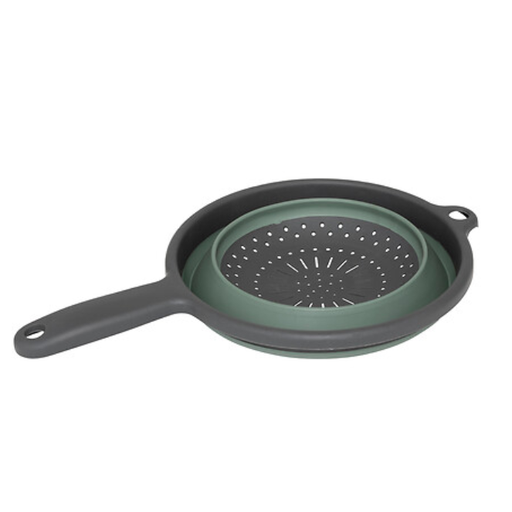
Why this product suits this profile: The extendable mini strainer can be used for fruit, vegetables and smaller portions, and stored in a space-saving way. It measures 22,5 × 36,5 × 3,5 cm and weighs 0,155 kg.
The extendable design reduces storage issues and makes the dimensions more flexible for different sinks.
TPE, TPR and PP components; collapsible or extendable construction for small kitchens or use on the go.
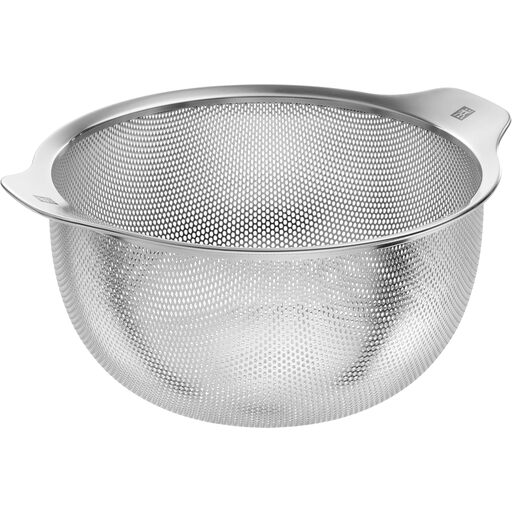
Why this product suits this profile: Its 24 cm diameter, integrated side handles and raised base are designed for larger quantities of pasta and vegetables.
The large bowl shape and stable base address common problems when preparing family-sized portions and draining over the sink.
18/10 stainless steel, perforated base and sides; dishwasher-safe according to the product information.
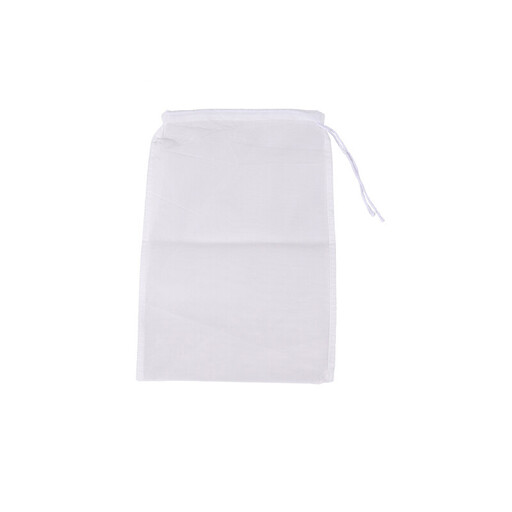
Why this product suits this profile: The 200-mesh nylon filter fabric and 30 × 40 cm format are intended for making and filtering soya milk, as well as other fine liquids.
The specific mesh specification makes the fineness of the filter easier to assess than a general description such as “extra fine”.
Two filter cloths in the set; large format for use over bowls or containers.
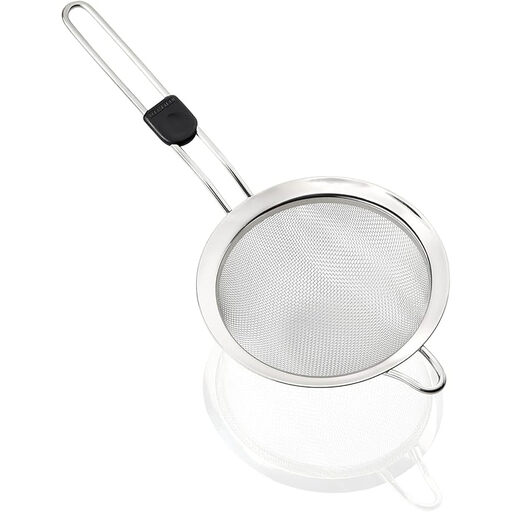
Why this product suits this profile: Its 16 cm diameter and specified 1,5 mm mesh opening are designed for flour, icing sugar and smaller sifting tasks.
The specific opening size means your choice is not based solely on a promotional description such as “fine mesh”.
Stainless steel, thumb rest, hanging loop and dishwasher suitability according to the product information.
We have put together a complete, regularly updated list of products that fully meet these strict selection criteria and the safety regulations applicable in the EU.
Before using the strainer for the first time, clean it with warm water and mild washing-up liquid. With a fine-mesh strainer or flour sifter, thorough drying afterwards is recommended to prevent residue from remaining in the mesh.
Follow these basic rules for a longer service life:
For Asian dishes, hotpot or fondue, a slotted spoon or spaghetti server with a long handle may be more practical than a traditional colander. For example, a small skimmer with a 7 cm strainer head is intended more for lifting individual ingredients out than for draining the contents of a pan.
For flour and small quantities, 15 to 16 cm is usually sufficient. For pasta, vegetables and fruit, 22 to 24 cm is often more practical. Family households may benefit from a model with a larger capacity, while owners of small kitchens should check the storage dimensions and whether the design is foldable.
A fine-mesh strainer has a smaller mesh size and retains smaller particles. It is suitable for flour, icing sugar or fine liquids. A pasta colander has larger openings or perforations so that cooking water can drain quickly. One model can only sensibly perform both tasks if its mesh size and capacity suit the intended use.
Its service life depends on the material, workmanship, level of use and care. With proper cleaning, a stainless-steel strainer can be used for a long time. Plastic frames, fine nets and moving extensions should be handled particularly carefully and checked regularly for cracks, deformation or damaged mesh.