
Lieferung heute & morgen

Qualitätsgarantie

Willkommens-Angebote freischalten: KOSTENLOSE Lieferung | Bis zu 80 % RABATT | Kostenlose 30-Tage-JoyPlus-Testphase
App herunterladen
A stainless steel kitchen strainer is one of the most versatile kitchen tools: it drains pasta, washes vegetables, rinses rice, filters liquids and can also be used for sifting flour when baking. However, the wide choice does not automatically guarantee the right model. Some strainers have openings that are too large for fine ingredients, others are unstable or awkward to clean after use.
The most important buying decisions are not based on decorative product promises, but on material, mesh or hole size, capacity and ease of use.
A pasta strainer with larger holes is suitable for spaghetti, vegetables or filled pasta. However, it may not be suitable for rice, quinoa, berries or fine particles. Small grains can slip through, while water does not always drain evenly.
If you are looking for a fine-mesh kitchen strainer for flour, icing sugar, juices or plant-based drinks, pay attention to the mesh size or at least to the description “fine mesh”. A dense filter surface is not automatically suitable for large quantities of pasta, as it can drain liquid more slowly.
“Stainless steel” is a general material description. More meaningful specifications include 304 stainless steel or 18/8 and 18/10 stainless steel, where these are stated by the supplier. It is also important to check whether the surface is coated, whether the edges are neatly finished and whether the handle is made from stainless steel, wood or plastic.
A stainless steel colander with a plastic frame may be dishwasher-safe, but according to the product information it may not be suitable for use with boiling liquids. Even with a fully metal model, always follow the manufacturer’s instructions regarding heat and naked flames.
A small strainer is easy to store, but may not be large enough for family portions. A large colander, on the other hand, takes up space in the cupboard and must sit securely in the sink or a bowl. Useful features include:
For regular use, uncoated stainless steel surfaces are practical because they do not absorb food odours and can be cleaned with mild washing-up liquid. Models made from 304 stainless steel, 18/8 or 18/10 should be assessed according to the relevant product description. A specific stainless steel grade is more useful than a general description such as “particularly robust”.
Also look for rolled or polished edges. Fine metal mesh can be sharp around the edges. A handle should be firmly attached to the strainer body and should not feel loose where it meets a wooden or plastic component.
For pasta, potatoes and blanched vegetables, a perforated kitchen colander is usually sufficient. For rice, small berries or very fine ingredients, closely spaced openings or fine mesh are more suitable. A rice strainer should retain small grains while still allowing enough water to drain away.
A classic flour sieve, on the other hand, uses a finer mesh. It is suitable for sifting flour, cocoa or icing sugar, but is not necessarily the right choice for draining large quantities of pasta.
For individual portions, a diameter of around 12 to 16 cm may be sufficient. Families and frequent users will often benefit from a model measuring around 24 to 27 cm in diameter. The height affects how much vegetables, fruit or pasta the strainer can hold.
An extendable sink strainer is particularly useful in small kitchens or with sinks of different widths. Before buying, compare the minimum and maximum length with the internal dimensions of your sink. Even a telescopic model should be resting securely before heavy foods are added.
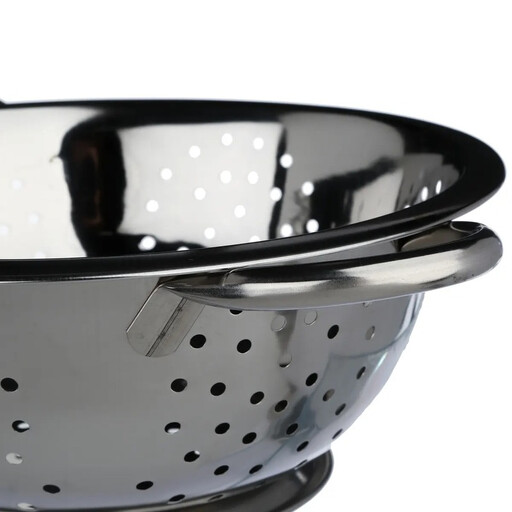
Why this product suits this profile: Measuring 24 cm in diameter and 12 cm in height, this stainless steel colander covers typical household tasks, including draining pasta, washing vegetables and rinsing fruit.
The clearly stated dimensions make it easier to assess the capacity. This means your choice is less dependent on vague size descriptions.
24 cm diameter, 12 cm height and stainless steel construction for a range of everyday kitchen tasks.
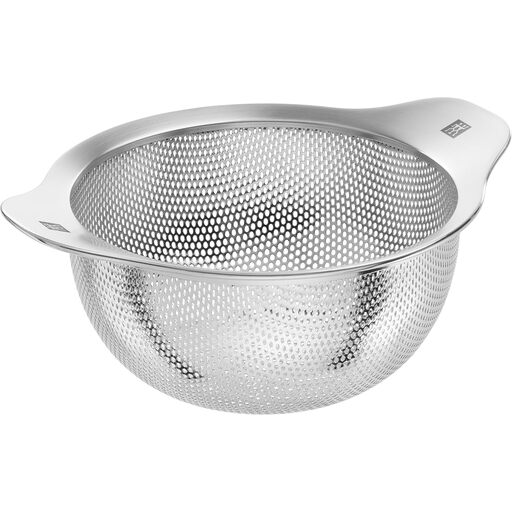
Why this product suits this profile: This 16 cm model made from 18/10 stainless steel combines a strainer, draining dish and bowl in a compact design.
The flattened base helps provide a stable position. The integrated side handles eliminate the need to hold the rim precariously.
18/10 stainless steel, satin finish, flat stable base and stated dishwasher suitability.
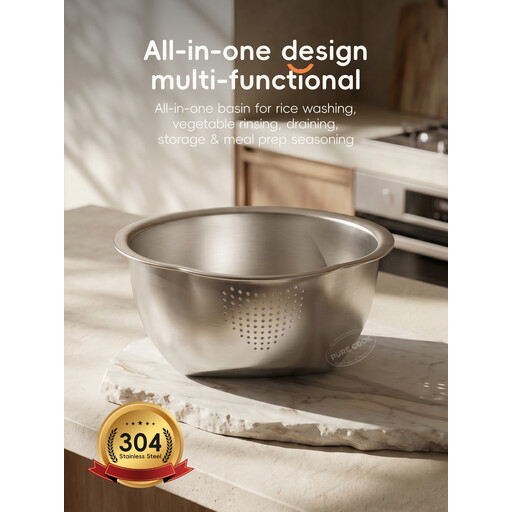
Why this product suits this profile: This 27 cm model with side handles is designed for rice, vegetables, fruit, washing dishes and larger food preparation tasks.
The evenly distributed drainage openings and stated material grade make its intended use as a rice strainer and vegetable basket clear.
304 stainless steel, 27 cm diameter, polished edges, side handles and stated dishwasher suitability.
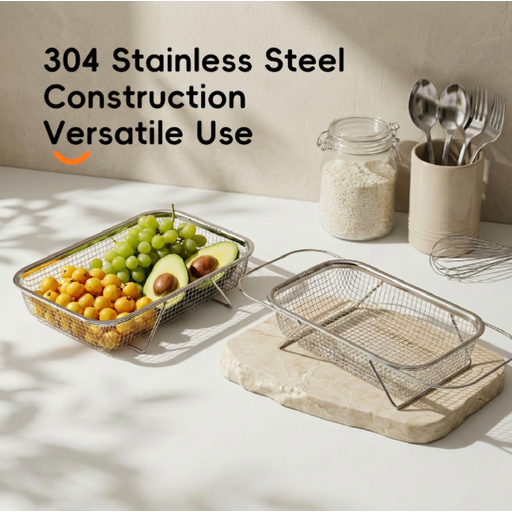
Why this product suits this profile: This extendable sink strainer can be adjusted to fit different sinks and stored compactly when storage space is limited.
The adjustable length reduces the risk of buying a rigid strainer that is the wrong width. Check that it is resting securely before use.
304 stainless steel, extendable design, closely spaced drainage openings and dimensions of 29.5 × 6.9 cm.
We have put together a complete, regularly updated list of products that fully meet these strict selection criteria and the safety regulations applicable in the EU.
A dishwasher-safe strainer should only be placed in the dishwasher when this is expressly stated in the product information. For stainless steel, mild cleaning products and a soft sponge are usually sufficient. Plastic frames, wooden handles and satin finishes may be subject to greater wear when exposed to frequent high-temperature programmes.
Also bear the following in mind:
A kitchen strainer for pasta, vegetables or rice should be cleaned before first use. For juices, stock or homemade soya drinks, a separate stainless steel sieve with fine filter mesh is often more suitable than a coarsely perforated colander.
For individual portions, a diameter of 16 to 20 cm is often sufficient. Family households will generally choose a model measuring around 24 cm or more. A stable base and handles that can be held securely even when the strainer is full are also important.
Many models are dishwasher-safe according to the product description. However, this does not automatically apply to every stainless steel model. With wooden handles, plastic frames or delicate surfaces, hand washing may be the more suitable care method. The relevant manufacturer’s instructions are the deciding factor.
Its service life depends on the material thickness, construction, level of use and care. An uncoated model with sturdy connections can serve you for many years when used correctly. Abrasive cleaners, distortion and use over direct heat can damage the surface or the strainer mesh.