
Lieferung heute & morgen

Qualitätsgarantie

Willkommens-Angebote freischalten: KOSTENLOSE Lieferung | Bis zu 80 % RABATT | Kostenlose 30-Tage-JoyPlus-Testphase
App herunterladen
A modular shoe rack can keep shoes neatly organised while adapting to different rooms. In practice, however, certain purchasing decisions can leave you with a system that is too small, unstable or impractical. Households with changing storage needs should therefore consider more than just the number of compartments, paying attention to the design, materials and dimensions as well.
‘For 10 pairs of shoes’ does not automatically mean that every type of footwear will fit comfortably. Trainers and flat everyday shoes need less height than boots or shoes with high shafts. Storage can also become tight if slippers, sandals or seasonal footwear are to be kept in the hallway too.
If you are choosing between a shoe rack for 10 to 20 pairs of shoes, consider your current collection and how much it is likely to grow. An extendable system gives you more flexibility than a fixed-size piece of furniture.
A stackable shoe rack can be adjusted in height or width, but every connection must be properly secured. When several elements are stacked, a missing fastener can affect stability. Information about the maximum load per compartment is therefore more important than purely promotional claims about flexibility.
A shoe cabinet with doors keeps its contents out of sight and can create a tidier look in the entrance area. However, doors require additional space in front of the furniture. Hooks are practical for keys, bags or umbrellas, but should not be overloaded with heavy items.
With a plastic shoe rack, the panel thickness, connectors and ease of cleaning are also important. Plastic panels with a water-repellent surface can be wiped clean easily in everyday use. For consistently heavy loads, a combination of a metal frame and sturdy connectors may be a sensible choice.
Measure the available recess in the hallway, bedroom or dressing room in three directions: width, height and depth. Skirting boards, doors and walkways can restrict the usable space. A shoe rack for hallways and cloakrooms should not be so deep that it blocks doors or passageways.
Also check the clear compartment height. If the dividers can be removed, some systems provide space for boots, bags or other larger items. This makes a DIY shoe rack more practical for everyday use.
A stackable shoe rack made up of individual modules can be assembled vertically, horizontally or as several cubes. This design is suitable for rented homes and rooms whose use may change over time. Check whether additional elements are genuinely supported or whether only one fixed assembly is possible.
An extendable shoe rack is particularly useful if the household is growing or seasonal footwear needs to be stored separately. Clearly defined connection points, easy-to-follow instructions and, where necessary, an anti-tip device are key considerations.
When choosing a model, look for specific details such as material, maximum load per compartment, empty weight and fixing method. PP panels are water-repellent and easy to clean. ABS connectors can provide secure joints in modular designs. A metal frame increases structural stability in certain models.
Assemble the rack on a level surface and check all clips or connectors. For tall structures, use the supplied anti-tip device. Small connecting parts and a rubber mallet should be kept out of children’s reach during assembly. A shoe rack is not designed for climbing or sitting on.
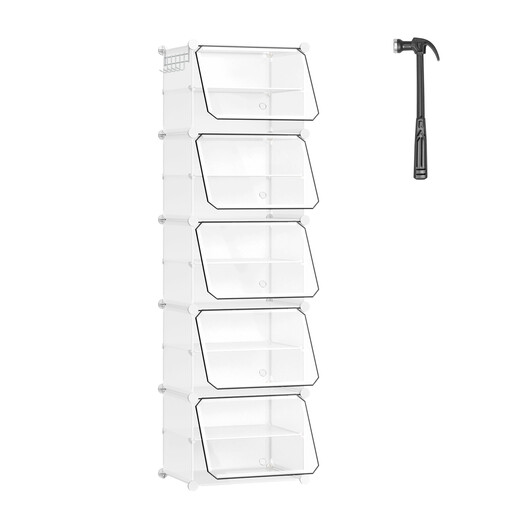
Why this product suits this profile: This model offers ten separate compartments for up to ten pairs of shoes, making it suitable for smaller households, a compact hallway or anyone starting out with a modular storage system.
The closed doors conceal shoes left out in the open. According to the product details, PP panels are easy to clean; assembly is carried out using the supplied connecting parts and a rubber mallet.
Ten compartments, doors, side hooks and a modular design with white PP panels.
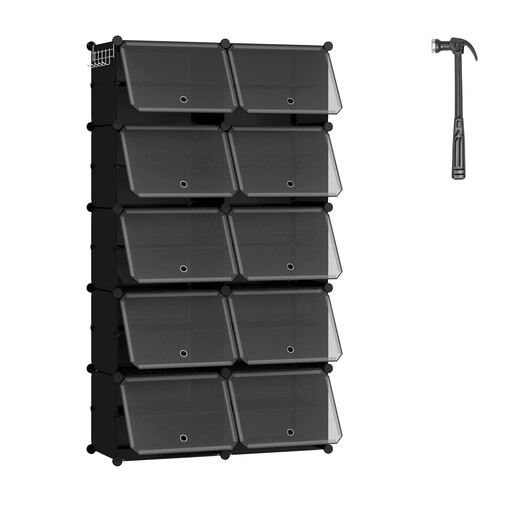
Why this product suits this profile: The 20-compartment version is designed for families or households with a larger shoe collection. According to the product details, it measures 80 × 150 × 30 cm and can also be reconfigured to store other items.
According to the description, the dividers can be removed when you need to store larger items. An anti-tip device and cable clips are provided for installation.
20 compartments, five side hooks, PP panels, a metal frame and ABS connectors.
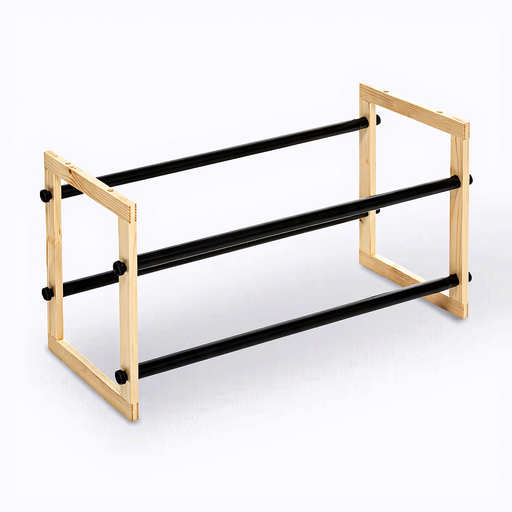
Why this product suits this profile: The extendable two-tier model is ideal for anyone who needs compact storage and wants to adjust the width to fit the available space.
The extendable design can be adjusted to suit different available widths. This means you do not have to choose an unnecessarily large piece of furniture for a small recess.
Steel shelves, pinewood frame, two tiers, extendable design and dimensions of 60 × 20 × 30 cm.
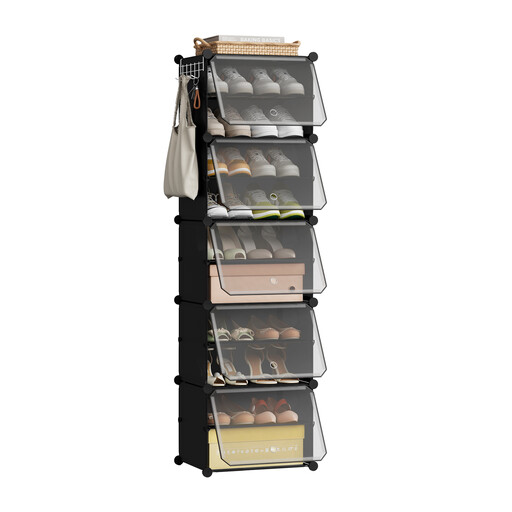
Why this product suits this profile: Standing 150 cm tall, this ten-compartment system makes good use of vertical space and provides five side hooks for bags, keys or umbrellas.
According to the product details, the design includes an anti-tip device. Removable dividers can create larger compartments for boots or other items.
Ten compartments, five hooks, metal frame, water-repellent PP panels and a stated load capacity of up to 5 kg per compartment.
We have put together a complete, regularly updated list of products that fully meet these strict selection criteria and the safety regulations applicable in the EU.
A modular system should be assembled on a level floor. Place frequently worn shoes in easily accessible compartments and store seasonal footwear higher up. With a shoe rack featuring hooks, distribute smaller items evenly to prevent uneven strain on one side.
Wipe plastic and coated surfaces with a slightly damp cloth. Wet shoes should be allowed to dry thoroughly before being stored. After assembly and whenever the rack is repositioned, check that all connections are firmly secured. If you notice visible cracks, bent parts or loose connectors, do not continue loading the rack.
This depends on the number of compartments and the shape of the footwear. Models with ten compartments are designed for around ten pairs of flat to medium-sized shoes. For families or larger collections, a 20-compartment system may be more suitable. Boots often need a compartment without an additional divider.
Yes, provided its depth, height and stability are suitable for the hallway. Measure the passageway and take doors and skirting boards into account. An anti-tip device should be used with tall structures. Doors can conceal shoes, but they require additional space when opened.
There is no universal lifespan. It depends on the material, load, assembly, moisture and how often the rack is reconfigured. Evenly distributing the weight, securing the connectors correctly and following the manufacturer’s instructions can help maintain its usability.