
Lieferung heute & morgen

Qualitätsgarantie

Willkommens-Angebote freischalten: KOSTENLOSE Lieferung | Bis zu 80 % RABATT | Kostenlose 30-Tage-JoyPlus-Testphase
App herunterladen
An outdoor wall light with a motion sensor is designed to reliably illuminate your entrance, garage or pathway without needing to be switched on permanently. However, when choosing one, it’s not just about lumens and design. The location, ingress protection rating, power supply and how the sensor actually works are all crucial factors.
Many poor purchases come down to three typical marketing pitfalls:
Luminous flux is given in lumens (lm). For a small entrance light, 300 lm may be sufficient. Larger areas like driveways, courtyards or garden paths need more light, depending on the mounting height and light distribution.
The wattage indicates energy consumption, not directly the brightness. An LED outdoor light with a motion sensor is usually more efficient than older bulbs, but you should still consider the consumption per activation.
Colour temperature is given in Kelvin:
The IP rating consists of two digits. The first describes protection against solid objects, the second against water. IP44 means protection against solid objects larger than 1 mm and against splashing water from any direction.
For a covered patio, a house entrance or a carport, IP44 may be suitable depending on the installation situation. On an exposed façade subject to direct driving rain, you should carefully check the manufacturer’s specified mounting environment. Screws and fixing materials must be suitable for outdoor use and corrosion-resistant.
For permanently connected 230-volt lights and sensors: electrical installation must only be carried out by a suitably qualified person. Always disconnect the power supply before working on the wiring.
Pay attention to details on detection angle, range, duration and sensitivity. Not every motion sensor can be adjusted to the same extent. For a short entrance path, a compact detection area is often sufficient. For courtyard lighting, a wider angle can be useful.
Several power supply options are available:
The following models differ in brightness, mounting and power supply. The details are based on the respective product information and should be checked against the technical manual before installation.
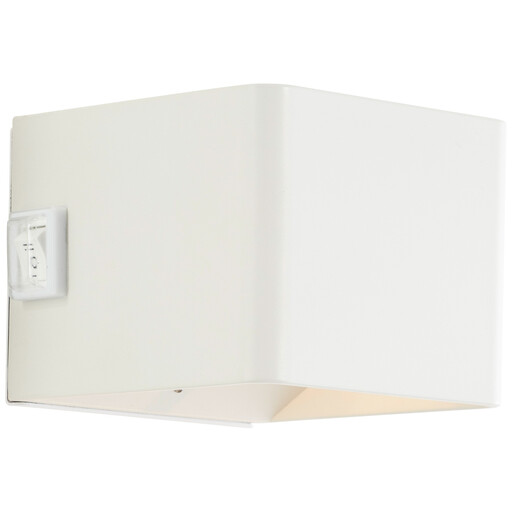
Why this product fits the profile: This compact model works with an integrated battery and USB connection. It is ideal for rented flats, small patios or entrance areas without a hardwired power supply.
The product data states 300 lm, 4 W, 3,000 K and IP44. This allows you to assess the brightness and application area more precisely than with a vague term like “weatherproof”.
Integrated battery, USB charging cable, magnetic mount, toggle switch, 300 lm and warm white 3,000 K.
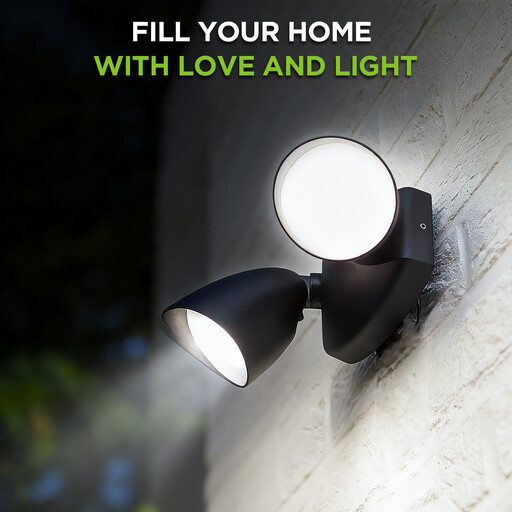
Why this product fits the profile: Two light heads and 1,800 lm are designed for larger areas like courtyards, gardens or driveways. The stated colour temperature of 4,000 K supports functional outdoor lighting.
The separate light heads can distribute the light more precisely across the area. However, you should still check the mounting height, alignment and the specific IP rating in the manual before buying.
20 W, 1,800 lm, 4,000 K, dual-head design and metal housing according to the product name.
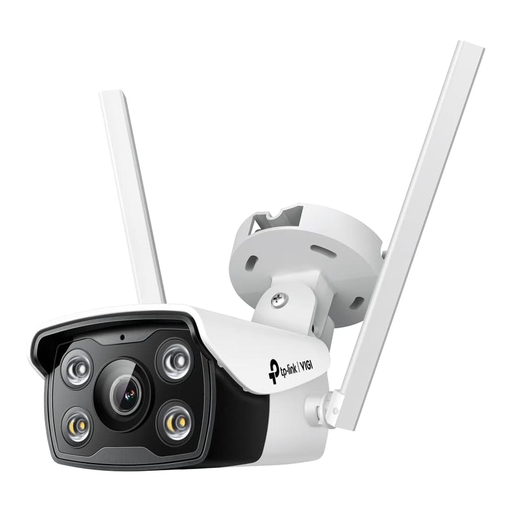
Why this product fits the profile: For users who want to supplement outdoor lighting with sensor-based surveillance, this camera offers a separate solution for wall or ceiling mounting.
The camera and light are not advertised as having identical functions. This solution is intended for surveillance and should be planned separately alongside a suitable light.
2,560 × 1,440 pixels according to the product name, Wi-Fi support, motion sensor, infrared night vision up to 30 m and wall mounting.
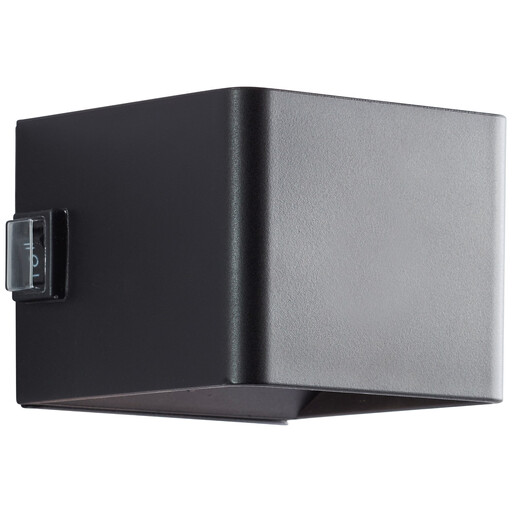
Why this product fits the profile: The black battery-powered variant is designed for flexible garden lighting with a motion sensor, balcony, patio or a small passageway without a mains connection.
The stated 300 lm, 3,000 K and IP44 make it clear that this model is intended for limited areas rather than large-scale courtyard lighting.
Integrated battery, USB port, magnet, motion sensor, 4 W and warm white 3,000 K.
We have put together a complete, regularly updated list of products that fully meet these strict selection criteria and the safety regulations in force in the EU.
Before ordering, you should decide on the final position. For entrance lighting, mounting above or to the side of the door is common. The sensor should cover the area where people actually arrive. For paths and driveways, a sideways alignment is often more effective than pointing it directly at the direction of movement.
You should also check:
For rented properties, battery or USB models are often simpler as no structural changes are needed. Hardwired lights, on the other hand, offer a permanent solution but must be installed by a professional.
The optimal height depends on the detection angle and the manufacturer’s instructions. Mounting is often in the range of about 1.8 to 2.5 metres. What matters is that the sensor covers the access area and is not blocked by projections. Always follow the installation manual.
Consumption depends on the power and the time it is switched on. A 4 W model running for ten minutes a day uses roughly 0.67 kWh per year. With more powerful 20 W lights, consumption increases accordingly. A correctly adjusted sensor limits unnecessary activation times.
IP44 protects against splashing water and is suitable for covered outdoor areas depending on the installation location. For exposed façades, heavy driving rain or direct water jets, a higher protection rating may be necessary. Always check the mounting specifications of the specific model.