
Lieferung heute & morgen

Qualitätsgarantie

Willkommens-Angebote freischalten: KOSTENLOSE Lieferung | Bis zu 80 % RABATT | Kostenlose 30-Tage-JoyPlus-Testphase
App herunterladen
A STAEDTLER Lumocolor Permanent Marker should write reliably on glass, plastic, metal, wood and film. In practice, however, the result depends on more than just the brand. The right tip, the condition of the surface and the properties of the ink are all crucial. If you only look for “waterproof” or “for almost all surfaces”, you may overlook important differences.
A marker with a fine tip is ideal for small labels, technical sketches and narrow lines. For cardboard boxes, crates or large headings, however, this type of permanent marker is often too narrow. A chisel tip measuring 2–5 mm offers several line widths, but requires a controlled grip.
The designations “F” and “S” are also relevant: on the Lumocolor, F stands for a fine line width of approximately 0.6 mm, while S indicates a superfine tip of approximately 0.4 mm. These specifications are not interchangeable.
Permanent ink adheres to many smooth materials, but can be difficult to remove from porous surfaces such as paper, textiles, untreated wood or wallpaper. Depending on the material and cleaning product used, markings on plastic, glass or metal may sometimes be removed. The ink should therefore be tested on an inconspicuous area before first use.
A waterproof marker remains resistant to water once dry. This does not automatically mean that the lettering is permanently protected against solvents, UV radiation, friction or major temperature fluctuations.
DRY SAFE is useful if the marker is left uncapped during a break in work. According to STAEDTLER, a suitable Lumocolor marker can remain uncapped for several days without immediately drying out, based on ISO-554 testing. Even so, the cap should click firmly into place after use. This extends the product’s service life and helps keep the colour intensity as consistent as possible.
A refillable permanent marker also reduces the need for replacement pens. According to the product information, the 487 17 refill station is intended for the fine Lumocolor models; selected chisel-tip versions use the 488 50 station.
A fine synthetic tip is a sensible choice when you want your writing to look even and controlled. A chisel tip is more versatile for wide and narrow lines, but requires a little more practice.
According to STAEDTLER, a Lumocolor marker is designed for almost all smooth surfaces. These include glass, plastic, metal, wood, stone and film. Dust, grease or moisture can affect adhesion. The surface should therefore be clean and dry before labelling. For specialist materials such as optical glass, coated surfaces or laboratory vessels, a quick test is recommended.
Fast-drying ink can be beneficial when writing with your left hand, as your hand is less likely to pass over the fresh marking. According to STAEDTLER, selected Lumocolor variants are smudge- and water-resistant once dry, as well as virtually odourless. These properties depend on the surface, drying time and surrounding conditions. On sensitive materials, allow the marking to dry completely before touching or cleaning it.
The following selection categorises various STAEDTLER models according to typical requirements. Product details relating to line width, DRY SAFE, refillability and surfaces are based on the respective manufacturer’s information.
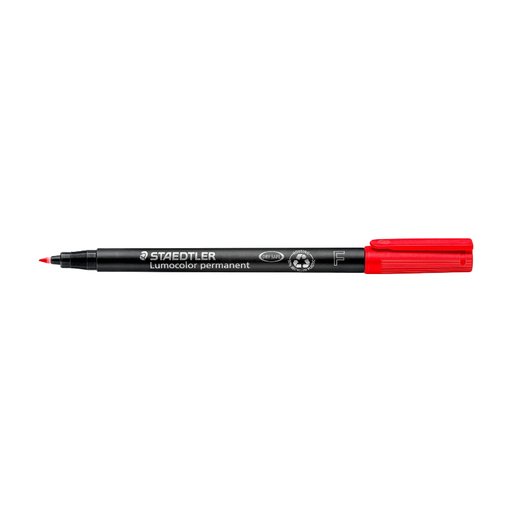
Why this product suits this profile: The approximately 0.6 mm F tip is suitable for standard labelling, colour coding and smaller markings. The red colour is easy to identify in the office, at university and in the workshop.
The clearly stated line width helps prevent you from buying a marker that is too broad for small text. According to STAEDTLER, the ink dries quickly, is smudge-resistant and is designed for almost all surfaces.
Fine synthetic tip, virtually odourless permanent ink, DRY SAFE and, according to STAEDTLER, compatible with refill station 487 17.
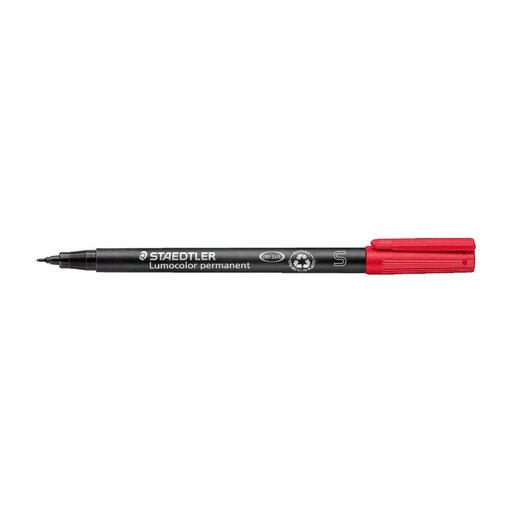
Why this product suits this profile: The superfine tip of approximately 0.4 mm supports precise labelling on film, glass and other smooth materials. This model is appealing to users who prefer narrow lines to broad markings.
The S designation makes the fine tip clear. According to STAEDTLER, the ink dries quickly and is resistant to friction and water once dry.
0.4 mm synthetic tip, DRY SAFE, automatic pressure equalisation for air travel and refill capability with 487 17, according to the product information.
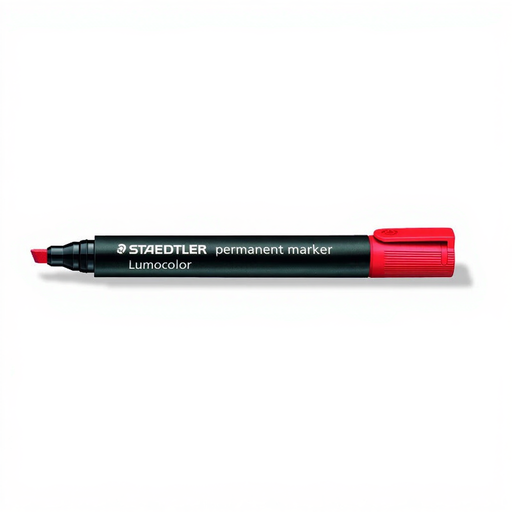
Why this product suits this profile: The chisel tip enables broad markings and narrower lines by using different sides of the tip. This makes it suitable for warehouse staff, tradespeople, industrial applications and creative projects.
The stated 2–5 mm range prevents the mistaken expectation of exclusively fine writing. For small details, an F or S tip remains the more suitable choice.
Chisel tip for variable line widths, DRY SAFE according to STAEDTLER and refillable with station 488 50 according to the product description.
We have put together a complete, regularly updated list of products that fully meet these strict selection criteria and the safety regulations applicable in the EU.
When using a permanent marker, you should follow a few basic rules:
According to STAEDTLER, selected Lumocolor variants are water- and smudge-resistant once dry. The result depends on the surface, drying time and subsequent use. If the marking will be in prolonged contact with cleaning products or solvents, preliminary testing is recommended.
Its service life depends on writing pressure, frequency of use, line width and storage. With the right refill station, a refillable permanent marker can be used for longer than a disposable model. The cap should still be closed after every use; storing the marker horizontally helps maintain an even flow of ink.
For very narrow lines, the Lumocolor S with approximately 0.4 mm is suitable. For clearly legible standard text, we recommend a Lumocolor F with approximately 0.6 mm. If you want to label large surfaces, cardboard boxes or storage containers, choose a marker with a 2–5 mm chisel tip instead.