
Lieferung heute & morgen

Qualitätsgarantie

Willkommens-Angebote freischalten: KOSTENLOSE Lieferung | Bis zu 80 % RABATT | Kostenlose 30-Tage-JoyPlus-Testphase
App herunterladen
A STAEDTLER Lumocolor permanent marker can provide reliable labelling in the office, workshop, on building sites or for creative projects. However, the wide choice of tips, colours and ink types often leads to unsuitable purchases. A marker that writes cleanly on glass is not automatically suitable for damp wood or porous cardboard.
The description permanent marker for all surfaces generally indicates broad material suitability, not identical durability under every condition. Ink adheres differently to glass, metal or plastic than it does to untreated wood, masonry or paper. Dust, oil and moisture can also affect line quality.
Classic Lumocolor markers with permanent ink are suitable for smooth, non-porous surfaces. For wet, dark or rough materials, a wax-based marking crayon such as the Omnigraph may be more practical.
A fine permanent marker with a tip of around 0.4 or 0.6 mm allows you to add small labels, technical notes and detailed sketches. A medium permanent marker with an approximately 1.0 mm tip is easier to read in everyday use and covers a wider range of applications. Broad chisel tips are suitable for headings, boxes or highly visible markings, but are impractical for small labels.
A water-resistant permanent marker is designed for lasting markings. By contrast, water-soluble non-permanent ink can be removed from smooth surfaces with a damp cloth. Both versions may dry quickly, but they serve different purposes. For transparencies, laminated plans and changeable labelling, the non-permanent version is usually more suitable.
First, consider whether the marking should be permanent or removable:
With permanent ink, test an inconspicuous area before the first large-scale application. Porous materials, textiles and skin can absorb the colour permanently.
The designations S, F, M and B help with your initial selection:
For industrial markers and building applications, grip is also important. A hexagonal Omnigraph is less likely to roll away on sloping work surfaces than a round pen.
A refillable permanent marker can reduce the need to replace individual pens when used regularly. Several Lumocolor models are designed for the STAEDTLER 487 17 refill station; depending on the version, non-permanent variants use refill station 487 15. Compatibility with 488 50 is specified for the broader permanent marker.
The cap should click audibly into place after writing. According to the product information, the Dry-Safe technology used in certain models allows the pen to remain uncapped for several days without drying out immediately. This does not replace careful storage, however. Storing the marker at room temperature and, depending on the model, in a horizontal position helps maintain an even ink flow.
The following recommendations categorise specific models according to their intended use and technical features. The selection is based on the stated line widths, ink types, surfaces and refill options.
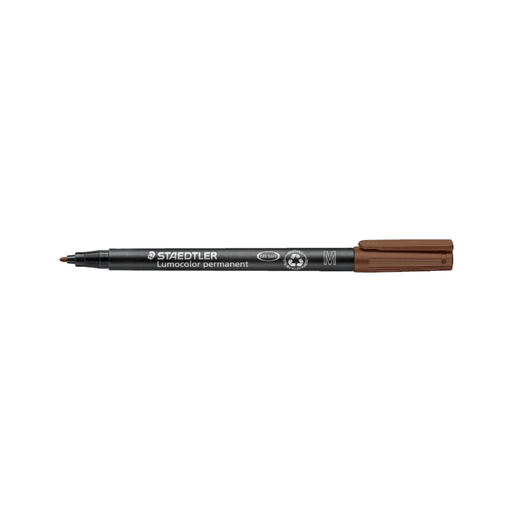
Why this product suits the profile: The medium line width is versatile for office organisation, labelling and general craft projects. The permanent ink is suitable for almost all smooth surfaces.
The 1.0 mm tip avoids the impractical combination of hard-to-read fine writing and markings that are too broad.
Permanent, virtually odourless, quick-drying and, according to the product information, compatible with refill station 487 17.
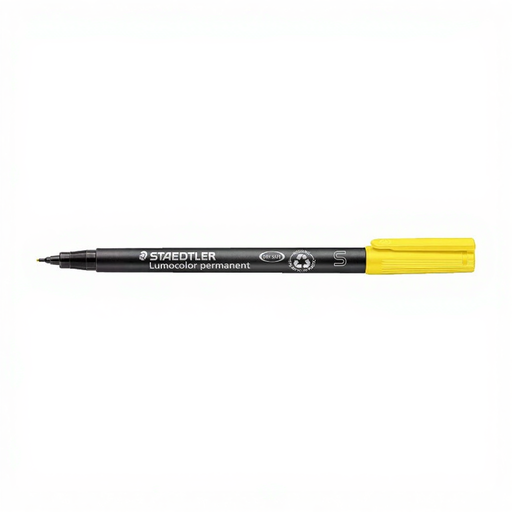
Why this product suits the profile: The very fine tip supports precise labelling on transparencies, glass, metal and plastic where space is limited.
The specified 0.4 mm line width provides control for small lettering instead of using a broad tip for detailed work.
Synthetic fine tip, permanent ink, Dry-Safe technology and refillable with 487 17 according to the product information.
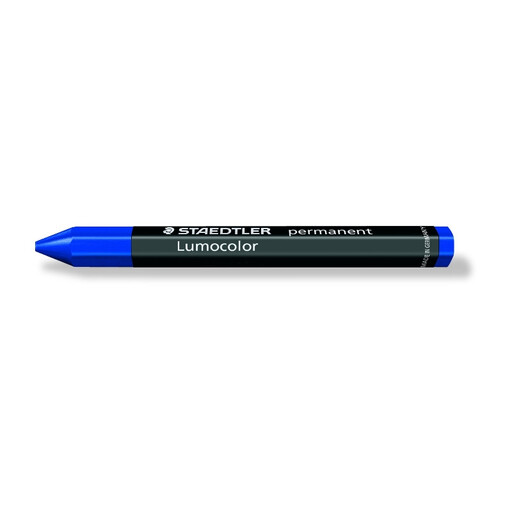
Why this product suits the profile: The wax-based marking crayon is designed for building, trade and industrial applications, including use on damp, dusty or oily surfaces.
The Omnigraph marking crayon does not rely on a liquid ink line, so it may be more suitable for wet wood or dark workpieces.
Water-resistant, lightfast and odourless wax core with a diameter of 12 mm; the paper casing can be peeled back as required.
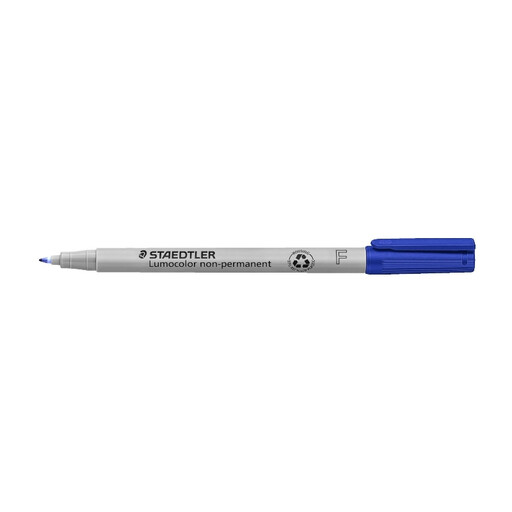
Why this product suits the profile: For presentation transparencies, laminated timetables and transparent plastic folders, precise, wipeable marking is highly practical.
The water-soluble ink reduces the risk of accidentally marking a surface intended to remain permanent in an irreversible way. It can be removed with a damp cloth.
Fine 0.6 mm tip, quick drying and refillable with station 487 15 according to the product description.
We have put together a complete, regularly updated list of products that fully meet these strict selection criteria and the safety regulations applicable in the EU.
Many permanent Lumocolor models are described as having smudge- and water-resistant ink. However, actual durability depends on the surface, drying time, friction and weather conditions. For damp wood or rough materials, an Omnigraph marking crayon may be more suitable.
Models with an S tip and approximately 0.4 mm or an F tip and approximately 0.6 mm are designed for small lettering. For larger, highly visible markings, an M marker with an approximately 1.0 mm tip offers greater readability.
With regular use, a refill station can extend the marker’s service life. Before buying, check whether the specific model is compatible with 487 17, 487 15 or 488 50. For occasional use, however, the purchase price and the appropriate ink type often matter more than the refill option.