
Lieferung heute & morgen

Qualitätsgarantie

Willkommens-Angebote freischalten: KOSTENLOSE Lieferung | Bis zu 80 % RABATT | Kostenlose 30-Tage-JoyPlus-Testphase
App herunterladen
Temporary labelling on transparencies, glass or plastic seems straightforward – until the ink smudges, cannot be removed completely or the writing is barely legible during a presentation. When buying a STAEDTLER Lumocolor Non-Permanent Marker, specific features matter more than eye-catching marketing claims: line width, surface compatibility, removability and refillability.
This buying guide is aimed at office workers, teachers, students, laboratory and technical users, as well as anyone who wants to label smooth surfaces temporarily.
A non-permanent marker with water-soluble ink can generally be removed from smooth, non-absorbent surfaces with a damp cloth. This is not the same as a whiteboard marker, whose writing is usually wiped away dry. If you want to work exclusively with a dry cloth, check the product type carefully.
According to the product information, Lumocolor models can be wiped from transparencies and other smooth surfaces with a damp cloth. On paper, textiles, untreated wood or wallpaper, however, the ink may leave permanent marks.
A 0.4 mm nib is suitable for small labels and technical details. A 0.6 mm nib offers slightly better visibility while still providing precise lines. For headings, markings viewed from a greater distance or colourful presentation surfaces, 1.0 mm or a chisel tip measuring 1.0/2.5 mm is more practical.
Choosing the line width based solely on the colour can therefore easily result in buying a marker that is unsuitable for your intended use.
Water-soluble ink is useful for temporary notes. At the same time, moisture can dissolve the writing again. On glass, plastic or transparencies, the marking should therefore not come into contact with wet hands or water if it needs to remain legible until you are ready to remove it.
A marker for glass and plastic should be designed for non-porous materials. According to the product information provided, the STAEDTLER Lumocolor Non-Permanent range is designed for smooth surfaces such as glass, plastic, metal, transparencies and, in some cases, whiteboards. Before first use, it is advisable to test the marker on an inconspicuous area, particularly on coated plastics.
Oily fingerprints can affect ink application. The surface should therefore be clean and dry. On suitable surfaces, a soft, slightly damp cloth is all you need for removal.
The designations help you make your initial choice:
A 0.4 mm Lumocolor marker is not automatically suitable for every presentation: from a greater distance, a finely drawn line may be less distinct. For overhead transparencies viewed from further away, an M or B model may be more suitable.
According to the product information, the range’s water-soluble ink dries quickly on the surface and can be wiped away with a damp cloth on suitable materials. The variants are available in several colours, including blue, green, black, brown, orange, yellow, red and violet.
A refillable marker can reduce the number of pens thrown away when used regularly. The STAEDTLER refill station 487 15 is specified for several models; some product details also mention 487 17. Check compatibility with the specific model before buying.
The stated automatic pressure regulation is also relevant for air travel. This type of air-travel-safe marker is designed to cope with pressure changes on an aircraft and is intended to reduce the risk of leakage. The cap should still be kept securely closed.
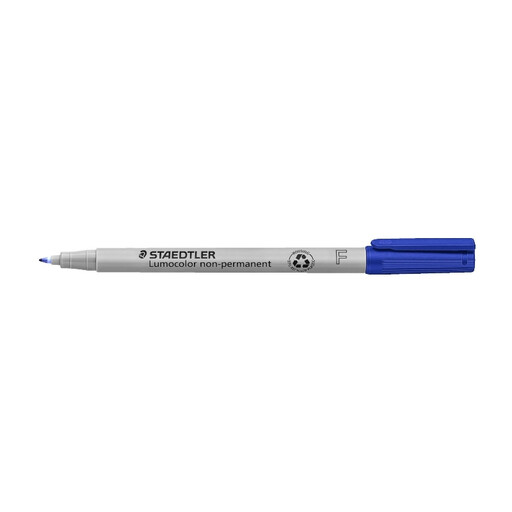
Why this product suits this profile: The fine blue nib combines precise labelling with a clearly visible colour, making it suitable for transparencies, plastic folders or laminated overviews.
The approximately 0.6 mm line width sits between highly detailed work and broad presentation writing. The water-soluble ink can be removed from smooth surfaces with a damp cloth.
Synthetic fibre nib, water-soluble ink and the option to refill using the STAEDTLER 487 15 station.
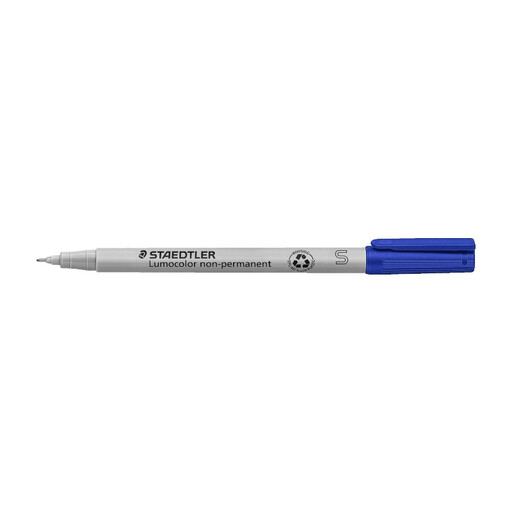
Why this product suits this profile: The superfine nib is designed for precise notes on transparencies, technical drawings and small labelling areas in the office, at university or in the laboratory.
The 0.4 mm nib reduces the risk of small text or diagrams appearing too broad. The marking remains temporary and can be corrected on smooth surfaces with a damp cloth.
Synthetic precision nib, vibrant colour and stated refillability with the 487 15 station.
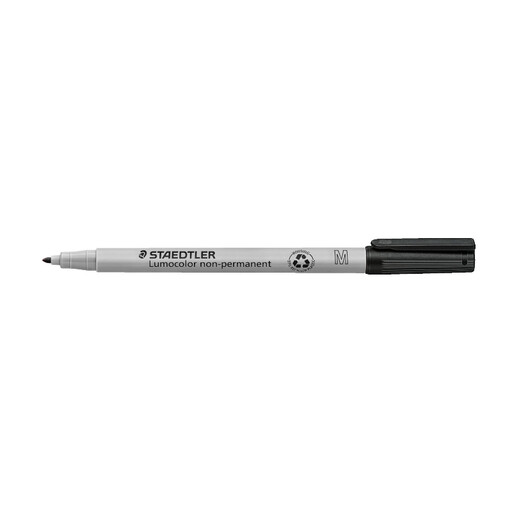
Why this product suits this profile: The black M nib is suitable for clearly visible notes on transparencies, glass, plastic and whiteboards when information needs to be changed regularly.
The medium line width is more visible for general labelling than a superfine nib. At the same time, the ink remains wipeable with a damp cloth on suitable smooth surfaces.
Black ink with high colour brilliance, a PP barrel and compatibility with a STAEDTLER refill station.
We have put together a complete, regularly updated list of products that fully meet these strict selection criteria and the safety regulations applicable in the EU.
Usually not reliably. The water-soluble ink is intended to be wiped away with a damp cloth from smooth, non-absorbent surfaces. A dry whiteboard eraser may leave residue or simply smudge the marking.
A 0.4 mm marker is suitable for small details and technical labelling. A 0.6 mm transparency marker for an overhead projector offers slightly better visibility while maintaining precise lines. For headings or clearly visible markings, 1.0 mm or 1.0/2.5 mm are suitable options.
The service life depends on the amount of writing, storage conditions, whether the cap is closed and the surface used. A refillable model can be topped up using the appropriate STAEDTLER refill station. The key points are to close the cap tightly and check that the refill station is compatible with the relevant model.