
Lieferung heute & morgen

Qualitätsgarantie

Willkommens-Angebote freischalten: KOSTENLOSE Lieferung | Bis zu 80 % RABATT | Kostenlose 30-Tage-JoyPlus-Testphase
App herunterladen
A waterproof permanent marker should remain legible, dry quickly and adhere to the surface you want to mark. In practice, however, problems often arise: the nib is too broad for the intended use, the ink smudges when touched or the marker dries out even though it has only been used a few times. The term “waterproof” alone also says little about how the ink will perform on glass, plastic, metal, wood or porous materials.
This buying guide from the Joybuy Product Recommendation Officer will help you put marketing terms into context and choose a marker based on objective criteria.
A marker may adhere well to smooth glass or metal, while textiles, untreated wood or porous stone absorb the ink. In these cases, it can often be difficult to remove. You should therefore test the marker on an inconspicuous area before using it over a larger surface. A waterproof marker for glass and plastic is not automatically suitable for every delicate coating.
A purple permanent marker, red permanent marker or orange permanent marker can be useful for sorting and labelling. However, a broad chisel tip is unsuitable for small labels. Conversely, fine tips are less visible on large boxes or warning signs. The key factors are the tip shape and line width, not just the colour intensity.
A quick-drying permanent pen can be practical for left-handed users and office use, as there is less time for the hand to smudge the writing. “Low-odour”, on the other hand, does not mean odour-free. Good ventilation is recommended when using alcohol-based inks. The ink should also not be used on the skin or for cosmetic purposes.
For markers for metal and wood, as well as for glass, plastic and stone, a permanent ink with strong adhesion is important. Smooth surfaces should be clean, dry and as grease-free as possible. Waterproofing mainly describes how the ink behaves after drying; abrasion, exposure to UV light and the nature of the surface can also affect legibility.
You should also be aware of the difference between a permanent marker and an acrylic marker: acrylic markers can create an opaque layer of colour on dark surfaces, but they are formulated for different applications. Gel pens measuring 0.5 or 0.7 mm, by contrast, are primarily intended for paper and are not suitable substitutes for a permanent marker.
For precise labelling, a fine permanent marker with a line width of around 0.6 mm or less is suitable. A round tip produces an even line. A chisel tip measuring 2–5 mm, on the other hand, allows you to create several line widths: the narrow edge is suitable for smaller notes, while the broad side is ideal for clear markings on boxes, plastic containers or workshop materials.
Pay attention to the actual line width, rather than just the descriptions “fine” or “broad”. Depending on the version, for example, the STAEDTLER Lumocolor Permanent Marker is available with an F or S tip for fine markings, as well as with a 2–5 mm chisel tip.
A DRY SAFE function can reduce the risk of a marker drying out immediately if the cap is removed briefly. Nevertheless, the cap should be replaced firmly after use. A refillable permanent marker can be more economical for regular use, provided that a compatible refill station is available.
According to STAEDTLER manufacturer information, selected Lumocolor models feature DRY SAFE, automatic pressure regulation and refill options. The individual product details should be checked before purchase, as the tip, colour and refill system vary depending on the model.
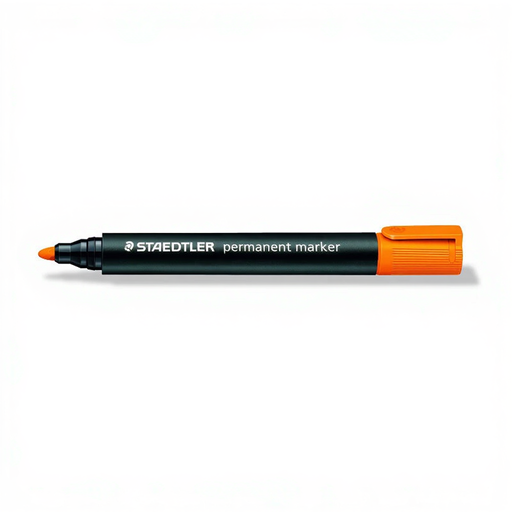
Why this product suits the profile: The 2 mm round tip is ideal for clearly legible labelling around the home, in the office or hobby room, and for colour-coded sorting.
The clearly specified round tip prevents a chisel tip that is too broad from making small labels unnecessarily large. The orange colour makes markings easier to see.
DRY SAFE according to the product description, waterproof ink once dry, and suitable for use on glass, metal, plastic, wood and stone.
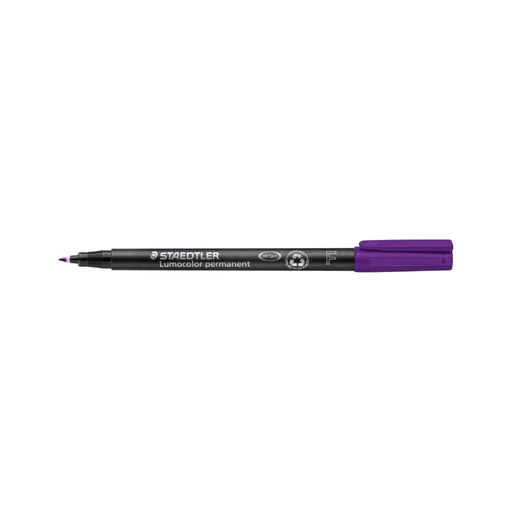
Why this product suits the profile: The fine purple tip is designed for technical labelling, colour-coding systems and small labelling areas.
The specified line width of around 0.6 mm reduces the risk of fine notes running or smudging. The cap should nevertheless be replaced after every use.
Fine synthetic tip, virtually low-odour ink according to the product details, DRY SAFE and compatibility with the STAEDTLER 487 17 refill station.
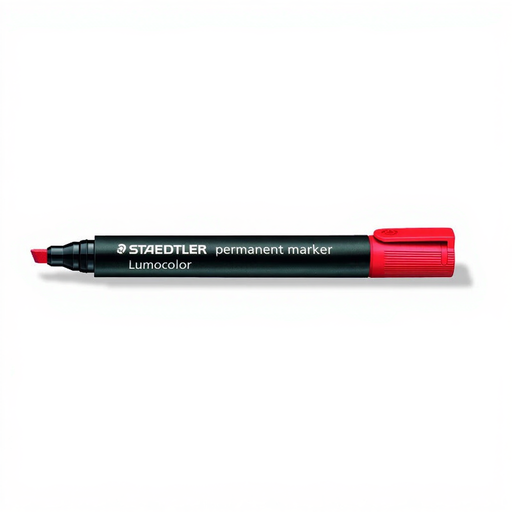
Why this product suits the profile: The variable line width is useful for warehouses, workshops, classrooms and creative projects requiring different lettering sizes.
Instead of offering a fixed width, the chisel tip provides a narrow and a broad writing edge. This means one marker can be used for several marking tasks.
2–5 mm line width, quick-drying ink according to the product description, DRY SAFE and refillable via station 488 50.
We have put together a complete, regularly updated list of products that fully meet these strict selection criteria and the safety regulations applicable in the EU.
Many permanent markers are suitable for glass according to the product details. The surface should be clean and dry. Whether the labelling remains permanent when exposed to rubbing or constant moisture depends on the ink, surface and intended use. The manufacturer’s guidance should be followed for drinking vessels or surfaces that come into contact with food.
A quick-drying permanent pen can be practical for left-handed users, as there is less time for the hand to smudge fresh ink. A fine tip is also helpful for small labels. For larger markings, a 2–5 mm chisel tip may be more suitable.
Its service life depends on the line width, writing pressure, frequency of use and surface. A refillable permanent marker can continue to be used if the tip and barrel are intact and a suitable refill station is available. To maximise its lifespan, close the cap and store the marker according to the manufacturer’s instructions.