
Lieferung heute & morgen

Qualitätsgarantie

Willkommens-Angebote freischalten: KOSTENLOSE Lieferung | Bis zu 80 % RABATT | Kostenlose 30-Tage-JoyPlus-Testphase
App herunterladen
A STAEDTLER Lumocolor marker may be suitable for paper, films, glass, plastic or metal. However, the key factor is not just the brand, but the specific type of marker. If you buy a permanent marker for a presentation film that you intend to reuse later, you risk leaving permanent stains. Conversely, a water-soluble marker may be unsuitable for a storage box if the label needs to remain in place for longer.
A Lumocolor Permanent Marker uses ink that, once dry, is resistant to smudging and water on many smooth surfaces. This is useful for cable labelling, plastic containers or permanent markings. However, on paper, textiles or untreated wood, the marking may remain permanently visible.
A Lumocolor Non-Permanent Marker, on the other hand, contains water-soluble ink. On smooth, non-porous surfaces, it can often be removed with a damp cloth. This makes it suitable for OHP films, glass, whiteboards or reusable planning documents. Even so, you should test the surface in an inconspicuous area before first use.
The line width determines how easy text, technical sketches or markings are to read. A 0.4 mm fine marker is suitable for small labels and fine lines. 0.6 mm offers a balance for notes and diagrams. A 1.0 mm marker produces a more prominent line and is suitable for headings, labels and presentation materials.
For marking larger areas, a chisel tip of around 2–5 mm may be more practical. Depending on how you hold it, it allows you to create narrower or broader strokes. For very small labels, however, it is less precise than an S or F tip.
For regular use, refill systems affect ongoing costs and waste. According to the product information, several Lumocolor models are compatible with a STAEDTLER refill station, including stations 487 15 or 487 17, depending on the type of ink. Before buying, check which station is suitable for the model in question.
Dry-Safe technology also depends on the model. On suitably designated permanent markers, it is designed to prevent the tip from drying out if the cap is left off for an extended period. Nevertheless, it does not replace carefully replacing the cap after use.
“Permanent” does not mean that the ink adheres identically to every surface. Likewise, “non-permanent” ink cannot always be reliably removed from porous materials. Paper, textiles and untreated wood absorb ink differently from glass or plastic.
For many STAEDTLER Lumocolor models, the designations S, F and M indicate different tip widths:
The barrels and caps of the models mentioned are made from polypropylene (PP). This material helps protect the ink during storage and is designed for everyday use at school, in the office and in the workshop. For an even flow of ink, horizontal storage or storage with the tip pointing downwards is recommended, provided this is specified in the product description.
Before writing on smooth surfaces, remove dust, moisture and finger grease. With permanent ink, testing it in an inconspicuous area is particularly important. The caps contain small parts and should be kept away from young children.
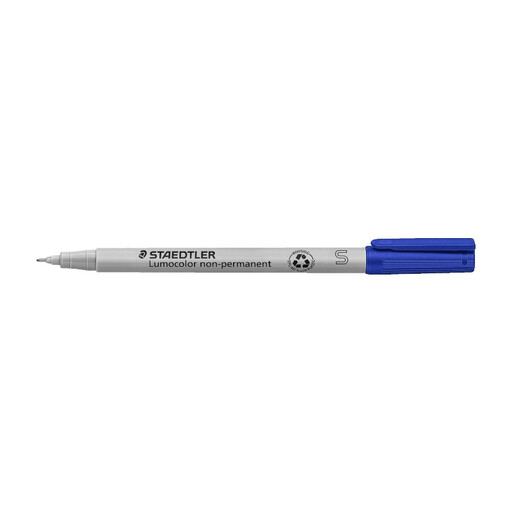
Why this product suits this profile: The water-soluble blue ink and slim S tip are ideal for learners who want to label films, glass or other smooth surfaces precisely and temporarily.
The Non-Permanent label makes its intended erasable use clearer than a general-purpose description.
Ultra-fine tip of approx. 0.4 mm; water-soluble ink for smooth films and other non-porous surfaces.
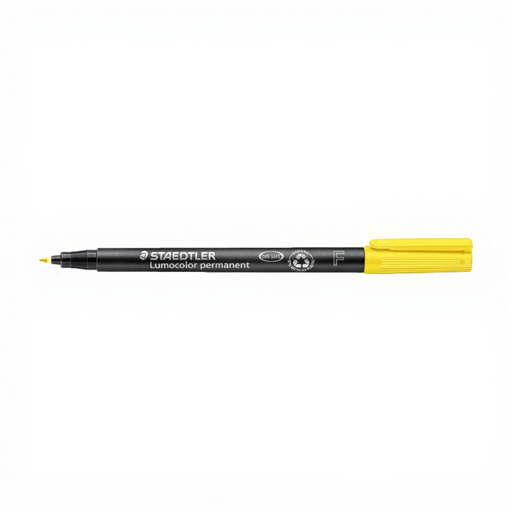
Why this product suits this profile: The permanent yellow ink and F tip combine highly visible markings with controlled line flow for laboratory, office and technical documents.
The specific “Permanent” designation prevents you from choosing an erasable version for permanent labelling.
Fine line width of approx. 0.6 mm; according to the product information, fast-drying, water- and smudge-resistant ink on suitable surfaces.
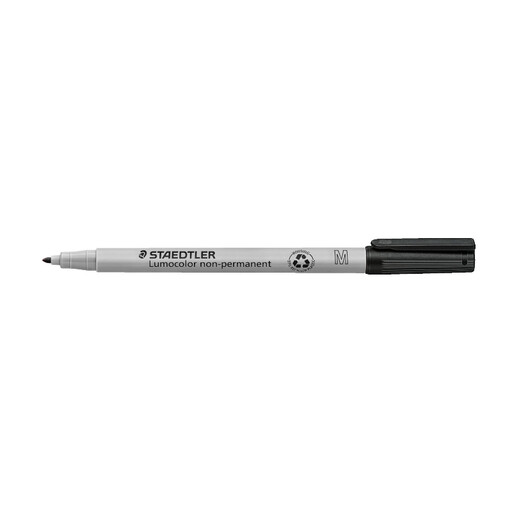
Why this product suits this profile: For teachers, offices and users who frequently change labels, the medium line offers good readability on films, glass and plastic.
The water-soluble ink reduces the risk of accidentally leaving changing notes permanently on smooth media.
Medium line width of approx. 1.0 mm; according to the product information, refillable with station 487 15.
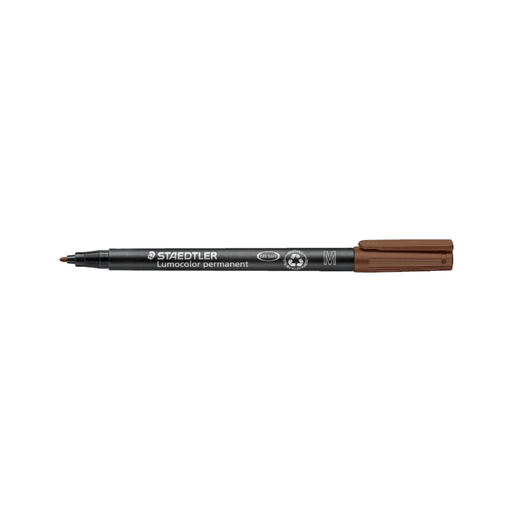
Why this product suits this profile: The medium tip is suitable for regular labelling tasks where markings need to remain permanently legible on different materials.
The permanent version is clearly separated from erasable variants; testing it on the intended surface before labelling a whole series is still advisable.
Approx. 1.0 mm line width; according to the product description, refillable with station 487 17 and equipped with Dry-Safe technology.
We have compiled a complete, regularly updated list of products that fully meet these strict selection criteria and the safety regulations applicable in the EU.
According to the product information, many Lumocolor models are intended for glass, plastic, metal and films. The specific type of ink determines whether the marking is permanent or erasable. A clean, dry surface and a quick test in an inconspicuous area are recommended.
Its lifespan depends on the line width, writing pressure, frequency of use, storage and cap. A refillable marker can continue to be used after refilling, provided the tip and ink flow system are still intact. Replace the cap firmly after every use and use the refill system specified by the manufacturer.
According to the relevant product description, a Dry-Safe marker is designed not to dry out immediately if left uncapped for a certain period. The exact duration depends on the model. For consistently smooth writing performance, the marker should still be capped straight after use and stored correctly.