
Lieferung heute & morgen

Qualitätsgarantie

Willkommens-Angebote freischalten: KOSTENLOSE Lieferung | Bis zu 80 % RABATT | Kostenlose 30-Tage-JoyPlus-Testphase
App herunterladen
A STAEDTLER Lumocolor Non-Permanent Marker is designed for situations where markings need to remain visible but be removable. This includes OHP transparencies, glass, plastic, laminated plans, CDs, DVDs and smooth whiteboards. However, for pupils, students, teachers, offices and presentation professionals, choosing the right marker involves more than simply selecting a colour.
Anyone who focuses only on the term ‘erasable’ could end up buying the wrong marker for the surface in question. Three common pitfalls are particularly important:
The Lumocolor Non-Permanent uses water-soluble, water-based ink. According to the available product information, the pen is suitable for almost all surfaces, particularly OHP transparencies and other smooth materials. On transparencies and non-porous surfaces, the writing can be removed with a damp cloth.
A universal pen for smooth surfaces is therefore a suitable choice for:
Before using the pen for the first time, it is advisable to test it on an inconspicuous area. Grease, dust or moisture can affect the appearance of the writing. On absorbent materials, an OHP marker or transparency pen is not automatically removable.
The model designations provide a practical guide:
A Lumocolor Non-Permanent F 0.6 mm is a sensible choice when lots of information needs to fit into a limited space. The Lumocolor Non-Permanent M 1.0 mm offers a well-balanced compromise between the space required and readability. For headings, markings and clearly visible presentation notes, a Lumocolor Non-Permanent B 1.0/2.5 mm offers greater flexibility.
A refillable marker can reduce the need to replace individual pens when used regularly. According to the product information, the Lumocolor models listed here are compatible with the STAEDTLER refill station 487 15. Some product information also refers to model 487 17. The compatibility of the specific model should therefore be checked before purchasing a refill station.
After use, the cap should click firmly into place. Several models’ product information recommends storing the pens horizontally. Direct sunlight, intense heat and leaving the caps off for extended periods can affect the flow of the ink.
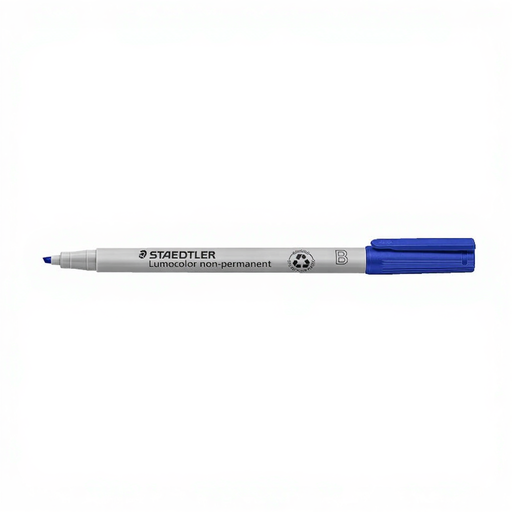
Why this product suits this profile: The blue chisel tip is suitable for school, university and straightforward presentation tasks where both narrow and more prominent lines are required.
The variable line width means you do not need a separate pen for every marking size. The ink is designed to be wiped off smooth surfaces.
Chisel tip with approx. 1.0/2.5 mm line widths, water-soluble ink and refillable with station 487 15.
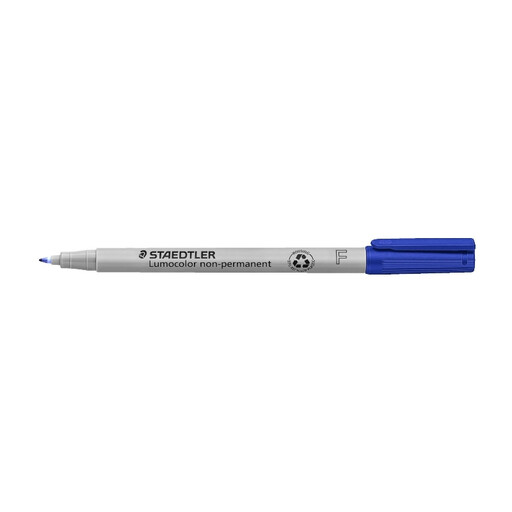
Why this product suits this profile: The fine synthetic tip supports detailed labelling on transparencies, plastic folders and small planning fields.
The defined F tip reduces the risk of fine notes becoming illegible because of markings that are too broad. A damp cloth is used for removal.
Fine 0.6 mm line width, water-soluble ink and refillable design.
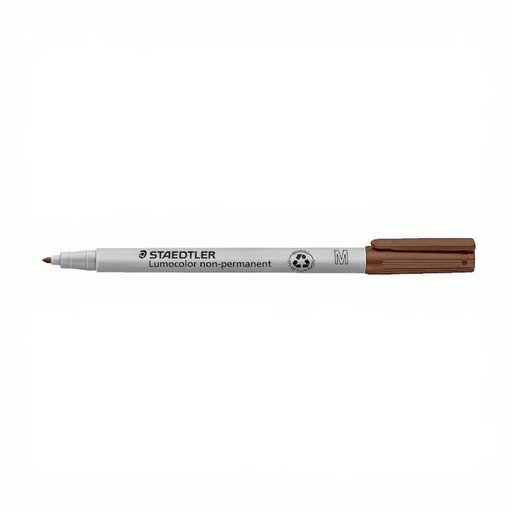
Why this product suits this profile: The medium brown tip is suitable for colour-coded diagrams, teaching materials, laminated calendars and regular office applications.
The medium tip avoids the common mistake of buying a pen that is too fine for clear, easy-to-read notes. The writing can be removed from smooth surfaces with a damp cloth.
Approx. 1.0 mm synthetic tip, brown water-soluble ink and compatibility with refill station 487 15.
We have put together a complete, regularly updated list of products that fully meet these strict selection criteria and the safety regulations applicable in the EU.
For consistent-looking writing, the surface should be dry and free from fingerprints. With a chisel tip, the line width can be varied by changing the angle to the surface. After writing, the cap should be closed completely.
It is also important to distinguish between a wipeable marker and an erasable gel pen: a Lumocolor Non-Permanent Marker is designed for smooth surfaces. It is not intended to replace a writing pen on paper. Contact with textiles, open-grain wood or unsealed surfaces should be avoided, as these may retain stains.
The product information for several models mentions an automatic pressure equalisation system for air travel. This feature may be useful for travelling teachers and presentation professionals. However, it does not replace securely closing the cap and storing the pen correctly.
According to the product information, the water-soluble ink can be wiped off smooth, non-porous surfaces with a damp cloth. Coated or sensitive plastics should be tested on an inconspicuous area first.
The Lumocolor Non-Permanent F 0,6 mm is suitable for small planning fields, notes on transparencies and detailed drawings. The Lumocolor Non-Permanent M 1,0 mm is a suitable option for more visible standard labelling. With line widths of approximately 1.0 and 2.5 mm, the B chisel tip offers greater versatility.
The cap should be closed firmly after every use. Storing the pen horizontally can support a consistent ink flow. If the ink begins to run low, the marker can be refilled with the compatible STAEDTLER refill station, provided the specific model is designed for this. The exact station number should be checked against the product description before refilling.