
Lieferung heute & morgen

Qualitätsgarantie

Willkommens-Angebote freischalten: KOSTENLOSE Lieferung | Bis zu 80 % RABATT | Kostenlose 30-Tage-JoyPlus-Testphase
App herunterladen
A stainless steel kitchen colander should be suitable for draining pasta, rinsing rice, washing vegetables or sifting flour. In practice, however, differences often only become apparent after repeated use: the colander sits unstably in the sink, small foods fall through the openings or cleaning becomes unnecessarily time-consuming because of hard-to-reach edges.
That is why it is worth looking at the actual design features before buying, rather than relying on general advertising claims. The following criteria help households, home cooks, keen bakers and professional kitchen users make an informed choice.
A pasta colander needs to drain water quickly while securely retaining the pasta being used. Larger perforations are usually practical for spaghetti, penne or vegetables. For rice, quinoa, berries or fine dry ingredients, however, a fine-mesh kitchen sieve or a model with closely spaced small openings is more suitable.
A colander with holes that are too large is unsuitable for rice and small foods. A very fine-mesh model may drain large quantities of pasta more slowly.
The diameter alone does not indicate how much the colander can actually hold. Height, interior shape and usable base area are also important. A compact kitchen sieve with handle is suitable for small quantities, while a 22 to 27-centimetre model is better suited to family portions and larger quantities of vegetables.
For an expandable sink colander, the span is also important. Before buying, check that the handles will sit securely on the rim of your sink.
A colander made entirely from stainless steel is usually easy to clean. However, if the product contains plastic, wood or TPE, these components may have different limits in terms of heat and cleaning. A product may be described as dishwasher-safe by the manufacturer, while hand washing is still recommended to help protect its surfaces or frame for longer.
Specifications such as 18/10 stainless steel refer to an alloy containing around 18 per cent chromium and 10 per cent nickel. 304 stainless steel is also commonly referred to as 18/8. Both material specifications are widely used for kitchen colanders and provide more information than the general term ‘stainless steel’.
The following features are also important:
‘Rust-resistant’ or ‘corrosion-resistant’ should always be understood as a product feature within the respective listing, not as a guarantee for every use case. Salt, acids, harsh cleaning products and prolonged moisture can affect surfaces.
A flat, stable base makes it easier to place the colander on the worktop. Side handles are useful when lifting a full pasta colander out of the sink. A long handle with a hook, on the other hand, can be practical when draining directly from a saucepan.
For small quantities of flour, icing sugar or liquids, a handy stainless steel sieve is often sufficient. Anyone who regularly prepares pasta, vegetables and fruit should look for a larger bowl-shaped model with sufficient depth.
A dishwasher-safe sieve saves time, provided the manufacturer’s instructions are clear. Fine mesh should be checked after cleaning, as flour, fruit fibres or rice residue can become trapped. Soft brushes or a sponge are generally more suitable than steel wool or abrasive cleaners.
Nesting sizes in a kitchen sieve set save space. A hanging hook is practical for small hand sieves, while an expandable model can be stored flat in a cupboard.
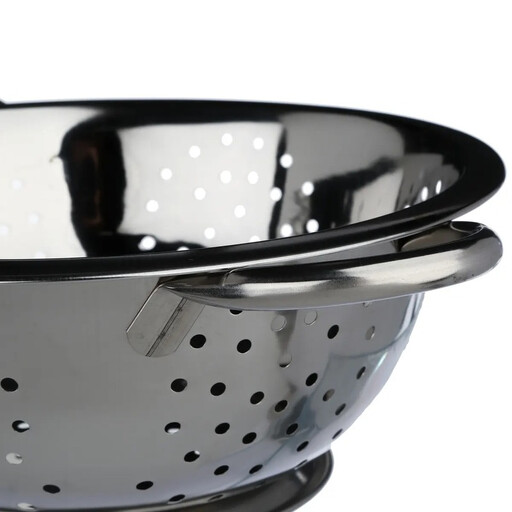
Why this product suits this profile: With a diameter of 24 cm and a height of 12 cm, this colander handles everyday tasks such as draining pasta, washing vegetables and rinsing fruit without the need for several specialist models.
The stated dimensions make the capacity easier to understand than a simple size claim. The straightforward stainless steel construction avoids an additional plastic frame.
24 cm diameter, 12 cm height and versatile use for pasta, vegetables, fruit and dry ingredients.
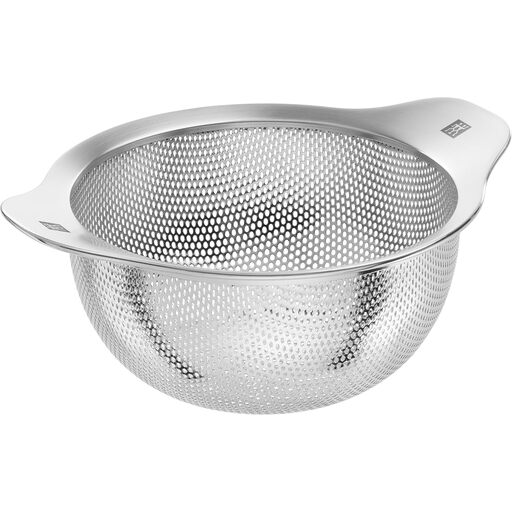
Why this product suits this profile: According to the product information, this model is made from 18/10 stainless steel and combines a sieve, colander and bowl in one compact design.
The flattened base addresses the problem of unstable colanders. The product information also states that it is suitable for dishwashers; hand washing is recommended to protect the satin finish.
18/10 stainless steel, two handles, a flat base and available sizes of 16, 20 and 24 cm.
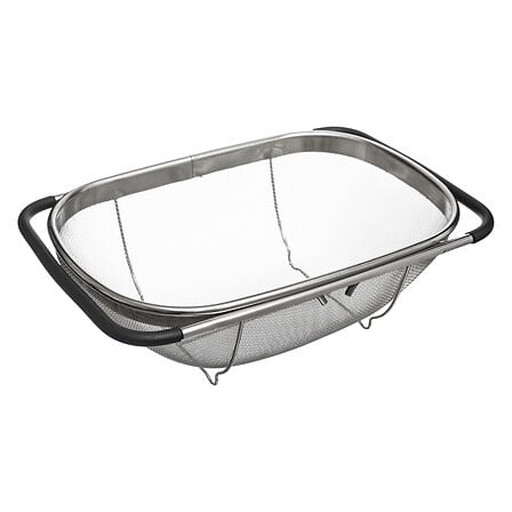
Why this product suits this profile: The expandable design is intended for sinks of different widths and offers a 3.6-litre capacity for larger quantities.
Before buying, you can compare the stated length of 53.5 cm with your own sink. This reduces the risk of an unsuitable fit.
3.6-litre capacity, expandable support, stainless steel construction and ergonomic handle.
We have put together a complete, regularly updated list of products that fully meet these strict selection criteria and the safety regulations applicable in the EU.
For rice, a rice sieve with small, evenly distributed openings is a sensible choice. A pasta colander with coarse perforations may let individual grains through. The mesh or hole size and sufficient depth are crucial to prevent the rice from spilling over the edge while it is being rinsed.
Many models are described as dishwasher-safe in the product information. For sieves with wooden handles, plastic frames or special finishes, follow the relevant care instructions. Hand washing with a mild detergent and thorough drying can help protect the visible surface.
Its service life depends on the material thickness, construction, level of use and care. A sieve should not be handled with sharp objects or overloaded by force. After cleaning, check for bent edges, damaged mesh or loose handles. If there is visible damage, it should no longer be used for food.