Shoppers who prioritise fibre
You want to choose sweet cereals and check their stated fibre content, rather than relying on terms such as wholegrain alone.


For a sweet breakfast with high-fibre cereals, it’s worth checking both fibre and sugar per 100 g. Under EU Regulation (EC) No 1924/2006, at least 6 g of fibre per 100 g meets the relevant criterion. The stated values for Nestlé FITNESS, CINI MINIS and Kellogg’s Choco Krispies Chocos reach this amount, but their sugar content varies. Unsweetened cornflakes leave more room to add sweetness yourself; check the fibre value on the individual pack to see whether they are also high in fibre.
You want to choose sweet cereals and check their stated fibre content, rather than relying on terms such as wholegrain alone.
You enjoy cornflakes for breakfast, but compare the sugar content per 100 g and want to decide for yourself whether to add sweet toppings.
You’re looking for a particular flavour and want to see how much sugar the cereals contain and whether their fibre content meets your buying criteria.
When comparing sweet breakfast cereals, start by checking fibre and sugar per 100 g. You can then use flavour, ingredients and allergen information to choose between suitable varieties.
| Criterion | What to check | Who is it important for? |
|---|---|---|
| Fibre content | Check the fibre per 100 g. Under EU Regulation (EC) No 1924/2006, at least 6 g per 100 g meets the relevant criterion for “high fibre”. | I want fibre to be the deciding factor when choosing a sweet breakfast, so I need a figure on the pack. For around 42% of shoppers, this verifiable content comes first. |
| Sugar content | Compare sugar per 100 g across varieties; if a serving size is given, check that too. | If I’d rather control the sweetness myself with toppings, the sugar content is a key factor in my choice. Around 33% of shoppers put controlling sweetness first. |
| Cinnamon or chocolate flavour | Choose your preferred variety, checking its sugar, fibre and ingredients together. | I specifically want cinnamon or chocolate cereals without losing sight of my fibre criteria. Around 25% of shoppers prioritise this flavour when choosing. |
Wholegrain content doesn’t replace the fibre figure. Among other requirements, EU Regulation (EC) No 1924/2006 sets a minimum of 6 g of fibre per 100 g for the claim “high fibre”.
Check the nutritional information on the pack you’ve chosen before assessing it against this criterion.
Manufacturer information gives the sugar content per 100 g as 8.8 g for Nestlé FITNESS, 24 g for CINI MINIS and 22 g for Kellogg’s Choco Krispies Chocos. Meeting the fibre criterion doesn’t make the sugar content irrelevant to your choice.
Compare both values per 100 g and choose your preferred level of sweetness.
“Unsweetened” doesn’t tell you how much fibre a product contains. If you’re considering EDEKA Bio unsweetened cornflakes, check the fibre information on the specific pack if it’s important to your choice.
Use cornflakes like these as a base if you want to add sweetness yourself; the stated fibre value is what counts for the “high fibre” criterion.
The recipes described contain wheat, among other ingredients. For Nestlé FITNESS and CINI MINIS, the manufacturer also mentions possible traces of milk and nuts. If you have an intolerance, always refer to the pack you’re actually buying.
Before buying, read the current ingredients list and allergen information for your chosen variety.
A wholegrain cereal for anyone who wants to compare fibre and sugar first when choosing a sweet breakfast.
Cinnamon cereals for shoppers who care about flavour but still want to compare the nutritional values.
Chocolate cereals for shoppers who want to weigh up a bold flavour against the fibre content.
Unsweetened cornflakes could be a good base if you want to decide for yourself how sweet your breakfast will be.
This selection features a wholegrain cereal for a sweet breakfast. If fibre is your main priority, check the nutritional information on the current pack of the Fitness Original variety available.
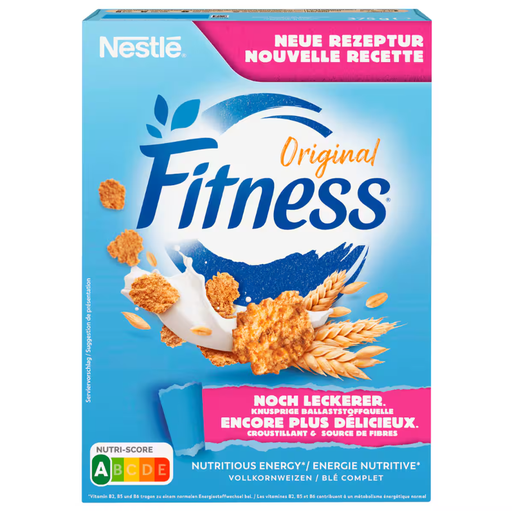 No image available
A sweet breakfast with wholegrain cereals, for when you want to choose based on fibre and sugar using the latest nutritional information.
Pack size: 375 g. Check the fibre content of this variety on the pack before classifying it as “high fibre”.
Under EU Regulation (EC) No 1924/2006, this claim requires, among other things, at least 6 g of fibre per 100 g. Check the nutritional information on the specific pack; a wholegrain claim alone doesn’t replace the fibre figure.
According to the respective manufacturers, Nestlé FITNESS contains 9.4 g, Nestlé CINI MINIS 6.4 g and Kellogg’s Choco Krispies Chocos 6.0 g of fibre per 100 g. These figures apply to the products described; check the current pack if you’re buying a different variety.
Not necessarily: “unsweetened” doesn’t tell you whether cornflakes meet the fibre criterion. If you’re considering EDEKA Bio unsweetened cornflakes for this reason, check the fibre content on the pack.
Check the ingredients and allergen information for the variety you’re actually buying. The Nestlé FITNESS and CINI MINIS products described contain wheat; Nestlé also mentions possible traces of milk and nuts in both. Wheat is also included in the recipe described for Kellogg’s Choco Krispies Chocos.