
Lieferung heute & morgen

Qualitätsgarantie

Willkommens-Angebote freischalten: KOSTENLOSE Lieferung | Bis zu 80 % RABATT | Kostenlose 30-Tage-JoyPlus-Testphase
App herunterladen
A tension pole for the wardrobe can create extra storage space in rented homes, small bedrooms or walk-in wardrobes. Many models can be adjusted in width and height and do not require permanent wall mounting. However, telescopic systems vary considerably in terms of load capacity, dimensions and storage space.
Anyone who focuses solely on product photos or advertising claims such as “extra sturdy” may overlook important details. Before buying, you should therefore check at least three common pitfalls.
An extendable clothes rail is only reliable if the available space falls within the stated adjustment range. It is not just the width and height that matter, but also:
A tension-pole construction fitted between the floor and ceiling also requires firm, load-bearing contact surfaces wherever possible. For suspended ceilings, delicate wallpaper or unstable floor coverings, you should follow the assembly instructions for the relevant model particularly carefully.
The stated maximum load generally refers to the entire construction or to a specific distribution of weight. Winter coats, heavy jackets and filled bags place more strain on a clothes rail than lightweight shirts.
It is therefore important to distinguish between:
The actual load limit must not be exceeded. For a narrow bedroom clothes stand, a lower load capacity may be perfectly suitable if it will mainly be used for hanging lightweight clothing.
A telescopic clothes stand is often clamped between the floor and ceiling. Wall-mounted systems, on the other hand, require suitable wall plugs and screws. According to the product details, the mounting hardware is not included with the MyGift model. It is therefore not suitable as a no-drill clothes rail.
Even with a tension pole, you should check whether the contact surfaces are sufficiently stable. Protective caps can reduce pressure marks, but they do not replace a suitable mounting surface. After assembly, check that the pole is vertical and that the tension is adequate.
An adjustable clothes rail should fit the intended space without being operated permanently at the very edge of its adjustment range. The available models range, for example, from compact dimensions with a 75–126 cm width to wide systems measuring 209–311 cm.
For small alcoves, narrow solutions measuring around 52–80 cm in width are worth considering. In a room with a sloping ceiling or high ceiling, a height range of up to 295 cm may be relevant. The depth determines whether hangers can hang freely or knock against a wall or piece of furniture.
The systems described here are primarily made from metal or steel tubes with plastic connectors. Metal provides a sturdy frame structure, while the connectors are crucial for achieving a good fit and maintaining tension.
Before buying, check that information about the materials, connection method and care is available. Regularly checking the connections is advisable, particularly if clothing is frequently removed or rearranged.
An open wardrobe with several levels can create more order than a single rail. Depending on the model, features may include:
A clothes stand with shelves makes better use of vertical space, but requires weight to be distributed evenly. For accessories, a hanging wardrobe organiser can be a useful addition.
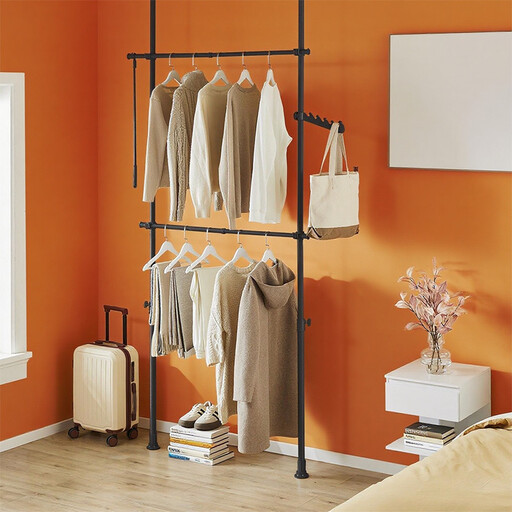
Why this product suits this profile: Its width of 75–126 cm is suitable for smaller rooms, narrow alcoves and a manageable wardrobe.
The stated adjustment range and maximum load capacity of up to 25 kg make its usage limits clear. This helps prevent it from being used incorrectly as a heavy-duty system.
2 adjustable telescopic poles, 2 clothes rails and a side hook; height 200–295 cm.
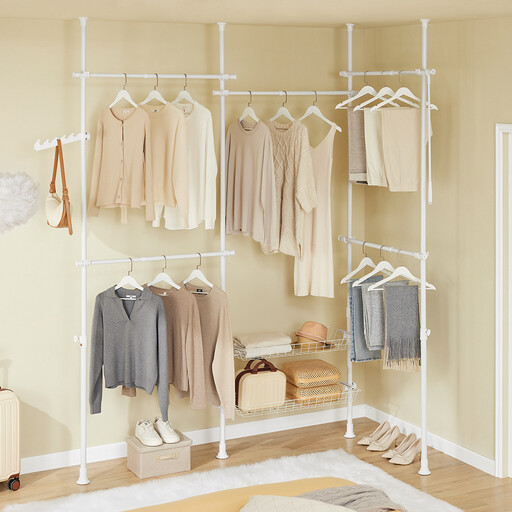
Why this product suits this profile: This wide system is designed for larger wall sections, extensive clothing collections or an open wardrobe in a dressing room.
The dimensions of 209–311 cm in width and 200–295 cm in height, together with the stated load capacity of up to 65 kg, provide specific planning figures rather than a vague claim of stability.
4 adjustable poles, 5 clothes rails and 2 baskets; metal tubes and plastic connectors.
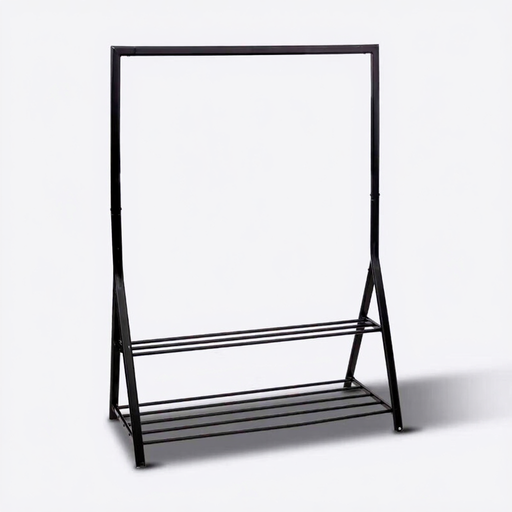
Why this product suits this profile: As a freestanding clothes stand with shelves, this model is suitable for anyone who does not want a tension-mounted system between the floor and ceiling.
The construction does not rely on pressure against the ceiling or wall. At the same time, the product data specifies the dimensions, materials and maximum load capacity of 90 kg.
Steel frame, 2 shelves, 1 clothes rail and 2 castors; dimensions 121 × 56,5 × 167 cm.
We have put together a complete, regularly updated list of products that fully meet these strict selection criteria and the safety regulations applicable in the EU.
Before assembly, the floor and ceiling should be clean, dry and as level as possible. Align and clamp the poles according to the instructions. Start by hanging a light load. Only once the system remains stable should you gradually increase the load.
For long-lasting use, we recommend:
A wall-mounted system such as the MyGift set should only be installed using fixings suitable for the wall. According to the product details, the mounting hardware is not included with this product.
This depends on the construction, tension, contact surfaces and load. A firm, level ceiling and a stable floor are important prerequisites. The maximum load capacity of the relevant model must not be exceeded.
Yes, provided that the width, height and depth suit the room. Narrow models with a width of 75–126 cm or systems measuring 52–80 cm in width can make use of alcoves. Before buying, take doors, radiators and available movement space into account.
A tension-mounted wardrobe makes use of the room’s height and usually does not require drilled holes. A freestanding clothes stand, on the other hand, can be repositioned more easily and puts neither the ceiling nor the floor under pressure from tension. The right choice depends on the room, rental conditions, required load capacity and whether you need shelves or baskets.