
Lieferung heute & morgen

Qualitätsgarantie

Willkommens-Angebote freischalten: KOSTENLOSE Lieferung | Bis zu 80 % RABATT | Kostenlose 30-Tage-JoyPlus-Testphase
App herunterladen
A tyre pressure monitoring system for motorhomes and trailers can display pressure and temperature readings while you’re on the move. Monitoring is particularly useful on long vehicle combinations, with heavy loads and across multiple axles. But the number of sensors and how prominent the display looks aren’t the only things that matter. Range, measurement limits, installation and warning logic all determine whether a TPMS for a motorhome, caravan, lorry or trailer is right for the job.
A set with four sensors may be enough for a typical two-axle caravan. But a motorhome with a spare wheel, tandem axle or additional trailer may need six, eight or ten sensors. Before buying, count all the wheels you want to monitor and take spare or replacement tyres into account.
Also check whether you can expand the system later. Some models support up to 24 tyres according to the product description, although the initial set only comes with the stated number of sensors.
A radio signal needs to travel from the sensor on the trailer’s furthest wheel to the display in the cab. Metal components, the vehicle body and the length of the combination can all affect reception. A TPMS with a signal booster is therefore worth considering for articulated lorries, long trailers and large motorhomes.
A system without a repeater may be enough for shorter vehicles. However, suitability depends on the vehicle’s design, the display’s position and the surrounding environment. A general range claim is no substitute for checking the length of your vehicle.
A high PSI figure may look impressive at first, but it’s only useful if it suits the recommended tyre pressure. You’ll find the correct pressure in your vehicle documents, in the manufacturer’s pressure specifications or on the tyre or vehicle information label. A TPMS doesn’t replace a manual check with a suitable pressure gauge.
For the GUTA systems described here, product specifications list the measurement range as 0–188 PSI in some cases and 0–14 bar or up to 203 PSI in others. Check the current product page and instruction manual to clarify this discrepancy before buying.
As a general guide, choose between a TPMS with 4, 6, 8 or 10 sensors based on the following scenarios:
With twin wheels, both the inner and outer wheels should be monitored with a suitable sensor. Also check that external sensors will fit your existing valves. The manufacturer recommends fitting GUTA models to metal valves to help ensure a secure and stable fit.
A tyre pressure and temperature monitoring system can alert you to high temperatures as well as pressure loss. Key points to look for include:
GUTA systems specify a pressure deviation of less than 2 PSI. According to the product description, warning thresholds are set after automatic calibration of the baseline pressure, at -15 % for low pressure and +25 % for high pressure. These are relative settings and should be checked against the vehicle manufacturer’s recommendations.
Tyre pressure sensors with a display are a good choice if you want to check readings without using a smartphone app. Check that the display is easy to read in daylight and at night, and whether warnings are visual, audible or both.
With external sensors, battery replacement, theft protection and water resistance are all important considerations. The GUTA sensors listed use CR2032 batteries, which the manufacturer says last around four years. Depending on the model, the display has a built-in rechargeable battery and an energy-saving mode. You’ll still need to check the sensors and valves regularly.
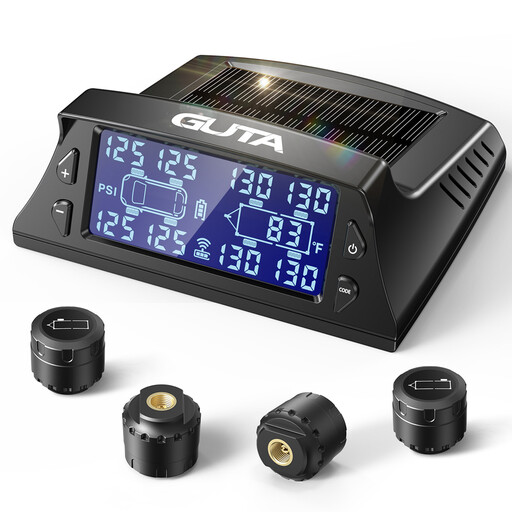
Why this product suits this user: This set offers a manageable number of sensors and an LCD display for caravans or smaller trailers with four wheels to monitor. According to the product description, it’s designed for vehicles up to 20 feet long; a repeater is recommended for longer combinations.
The set is clearly designed for four wheels, so you won’t need to buy more sensors than a small trailer requires.
0–13 bar according to the specifications, five types of alarm, automatic calibration, CR2032 sensor batteries and a USB-C charging port on the display.
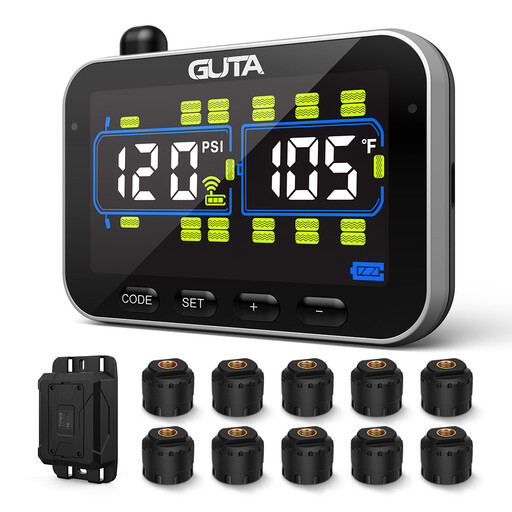
Why this product suits this user: The version with ten sensors is aimed at lorries, articulated trailers and long vehicle combinations where a large number of tyres need to be monitored individually.
The integrated signal booster addresses the common range issue with long vehicles. According to the product details, the sensors are labelled and paired at the factory.
Six types of alarm, 433,92-MHz communication, repeater, colour LCD and support for up to 24 tyres according to the product description.
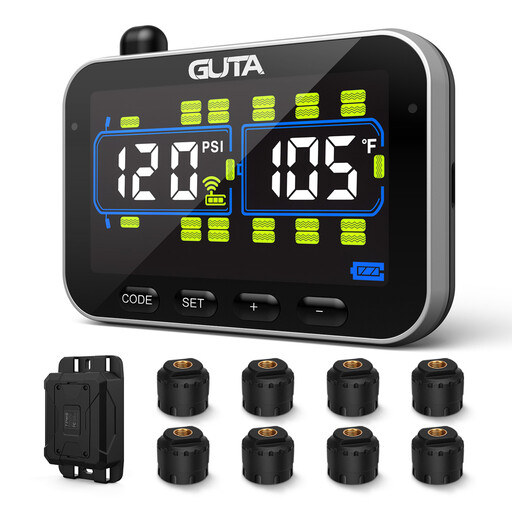
Why this product suits this user: Eight sensors are a good fit for users with multiple axles or a more complex vehicle combination. The set is designed for long vehicles and includes a repeater.
The combination of eight sensors and a signal booster reduces the risk of overlooking wheels when planning for a multi-part vehicle combination.
0–14 bar according to the specifications, temperature display from -40 to 105 °C, six types of warning and an automatic sleep function after more than ten minutes at a standstill.
Why this product suits this user: The six-sensor version suits many motorhomes with six wheels, as well as medium-sized vehicle combinations. The repeater helps transmit the signal over longer vehicles.
The six sensors cover six wheels, while the repeater addresses a common weak point when signals need to travel over long distances.
Colour LCD measuring 78 × 44,5 mm, six types of alarm, 850-mAh battery, automatic brightness adjustment and a stated sensor battery life of around four years.
We’ve put together a complete, regularly updated list of products that meet these strict selection criteria and the safety regulations in force in the EU.
External sensors are usually screwed onto the valves. Before fitting, check the valve threads, seals and fixings. Once fitted, each sensor needs to be assigned to the correct tyre position. Systems that are paired at the factory have this assignment set up in advance, but you should still check the display before setting off.
It depends on the battery type, temperature, use and storage. The stated battery life for the CR2032 sensor batteries in the GUTA models listed is around four years. This is a manufacturer’s estimate, not a guarantee for every use case. Before longer journeys, check for warnings, battery status and secure sensor fittings.
As well as the purchase price, the main costs are replacement batteries, any additional sensors and replacing damaged valve components. With a trailer tyre pressure sensor that has an external battery compartment, replacing the battery is usually easier than with built-in sensors. It’s therefore worth checking that replacement sensors and batteries are available, and deciding how many tyres you need to monitor over the long term.