
Lieferung heute & morgen

Qualitätsgarantie

Willkommens-Angebote freischalten: KOSTENLOSE Lieferung | Bis zu 80 % RABATT | Kostenlose 30-Tage-JoyPlus-Testphase
App herunterladen
A USB-C car charger should reliably power your smartphone, tablet or sat nav while you're on the road. In practice, however, high wattage ratings, unclear compatibility and poorly fitting housings often lead to the wrong purchase. Commuters, business travellers and families in particular should check which ports, charging protocols and vehicle voltages they actually need before buying.
A rating like 65 W or 100 W only describes the maximum possible output of a port. Your smartphone will only draw as much power as it, the charging protocol and the cable can support. So an iPhone, Samsung Galaxy or tablet can charge at different speeds even with a powerful Power Delivery car charger.
It's also important to know whether the total power is shared across multiple ports. With a dual-port car charger, the power can drop as soon as two devices are connected at the same time.
USB-C refers to the shape of the connector, not the charging standard it supports. For fast charging, look for terms like USB Power Delivery (PD), Quick Charge (QC) or PPS. A USB-C port without the right protocol can charge a device, but it may not deliver the charging speed you want.
The cable matters too: for higher power levels, you'll need suitable USB-C or USB-C-to-USB-C cables. With USB-A ports, the choice of compatible cables is usually wider, but the potential power output can be lower.
A 12-volt electrical system is standard in cars. Lorries, motorhomes and certain commercial vehicles often use 24 V. If you're looking for a 12V 24V car charger, you should find the input voltage clearly stated in the product specifications. A compatible charger can then be used more flexibly in cars, SUVs, vans or lorries.
Check before you buy whether the ports are built directly into the adapter or are on a separate cable. If you have multiple devices, also consider the total power output rather than just the power of the strongest port.
A fast car charger should support your device's protocol. For many current Android devices, USB PD, PPS or Quick Charge are suitable. Apple devices need a compatible USB-C charging profile and a suitable cable. The label "car charger for iPhone and Samsung" is only meaningful if the technical specifications clearly state the relevant charging methods.
Look for specific values like:
A car charging adapter should sit firmly in the 12- or 24-volt socket and must not obstruct the controls while driving. Protection against overcurrent, overvoltage, short circuits and overheating are important features. However, they don't replace proper use: avoid liquids, damaged cables and covering the charger.
Aluminium can dissipate heat differently to plastic, but that alone doesn't guarantee complete operational safety. What matters are the manufacturer's technical specifications, a clean socket and adequate ventilation. If you notice unusual heat, smell or smoke, remove the charger immediately.
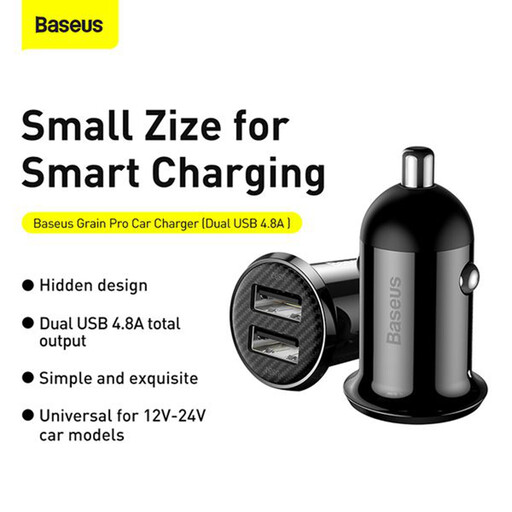
Why this product fits the profile: Two USB-A ports and a stated total output of 4.8 A cover basic charging needs for smartphones, cameras or power banks.
The product data states 12–24 V input voltage and specific 5 V outputs rather than an isolated, unclear wattage figure.
Two USB-A ports, compact design and stated protection against overvoltage, overcurrent, short circuit and overheating.
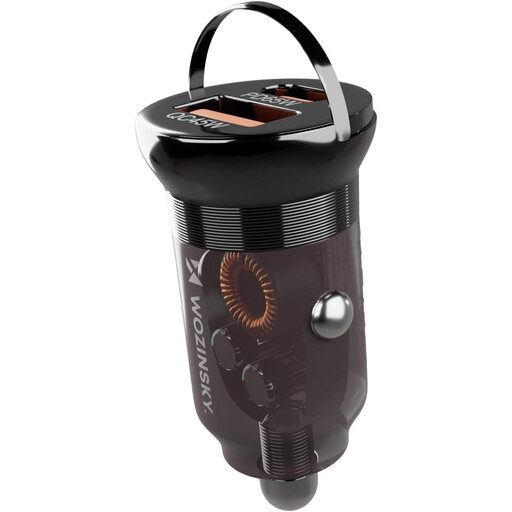
Why this product fits the profile: Commuters and business travellers get a USB-C PD port plus a USB-A port with QC 3.0 for different devices.
The specifications separate the power of USB-C and USB-A and explicitly state compatibility with 12 V and 24 V vehicles.
USB-C PD up to 65 W, USB-A QC 3.0 up to 45 W, dual-port use and aluminium-ABS housing according to the product description.
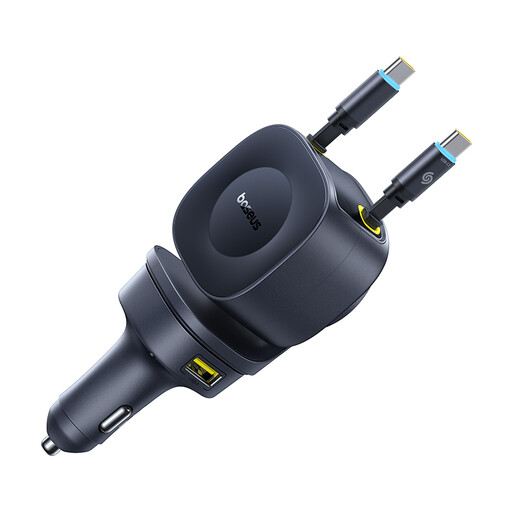
Why this product fits the profile: This model is aimed at travellers and families who need to charge multiple devices and want an integrated, retractable cable.
The port combination and maximum total power of 60 W are listed in the product data; the cable also reduces loose wires in the cabin.
Three USB-C ports plus USB-A, up to 60 W total power, retractable 1.5 m cable and adjustable orientation.
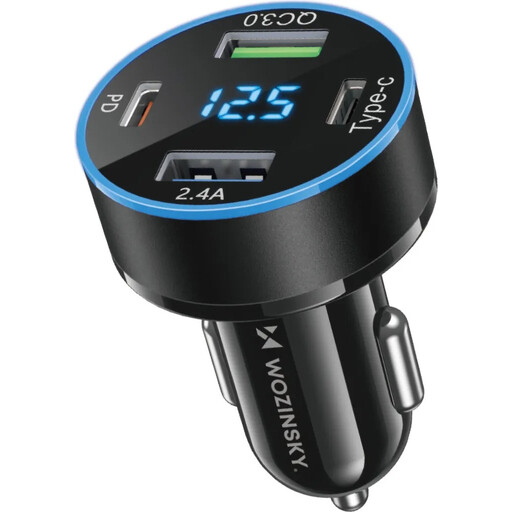
Why this product fits the profile: Families and heavy users can connect up to four devices while keeping an eye on the displayed vehicle voltage.
The four ports and power data are listed separately. This makes it easier to assess suitability for multiple devices.
Two USB-C and two USB-A ports, up to 50 W total power, plus display for voltage and charging status.
We've put together a complete, regularly updated list of products that fully meet these strict selection criteria and the safety regulations in force in the EU.
A wireless car charger or a phone holder with charging function is suitable if you want to charge your smartphone while it's visible for navigation and without a cable connection. The charging speed depends on Qi support, your smartphone, its case and the power supply. Metal parts or thick cases can interfere with energy transfer. Inductive charging also generates heat, which can affect charging speed.
If you need maximum flexibility for an iPhone, Samsung, tablet and power bank, a classic USB-C or USB-A connection is often more predictable. With a holder, you also need to check whether it obstructs the air vent, your field of view or the controls.
A model with USB-C Power Delivery is a good starting point for many current devices. For Samsung, PPS or compatible fast charging protocols may also be relevant. What matters most are your specific smartphone's specifications, the cable you use and the port's power output.
Yes, as long as the product data explicitly states DC 12–24 V or a comparable input voltage. If a charger is designed for 12 V only, you should avoid using it in a 24 V vehicle.
Many adapters still draw a small amount of standby power when plugged in. If your vehicle's socket is permanently live, it's a good idea to remove the charger during longer periods of non-use. This is especially important for older vehicles and for trips lasting several days.