
Lieferung heute & morgen

Qualitätsgarantie

Willkommens-Angebote freischalten: KOSTENLOSE Lieferung | Bis zu 80 % RABATT | Kostenlose 30-Tage-JoyPlus-Testphase
App herunterladen
Limescale builds up wherever water is heated. In bean-to-cup coffee machines, portafilter machines, capsule machines and kettles, it can affect water flow, heating time and dosage. However, if you want to remove limescale from coffee machines, you should not use just any cleaner. Your choice must be suitable for the machine, the product format and the dosage.
Products such as Viss POWER + SHINE, Bref Power Limescale & Dirt Cleaner and Antikal are intended for acid-resistant surfaces in bathrooms and around the home. They may contain fragrances, surfactants or other ingredients that are not intended for a coffee machine’s water circuit. Labels such as “removes limescale” therefore do not automatically mean that a product is suitable as a coffee machine descaler.
Only use products for the internal water circuit whose product description specifically mentions this application. Avoiding bathroom cleaner in the water tank is an important safety precaution.
A product described as “universal” may be suitable for several types of machine. Even so, the coffee machine manufacturer may have specified its own descaling programme, a particular concentration or a specific number of tablets. This applies, for example, to JURA, De’Longhi, Philips, Gaggia and Sage.
You should therefore check the user manual before buying. With a bean-to-cup machine, it is also important to know whether the appliance processes liquid, powder or coffee machine descaling tablets in the designated programme.
500 ml of liquid does not necessarily mean five applications. The recommended amount per descaling cycle is what matters. For example, a 100-ml bottle may be portioned for a single cycle, while a larger bottle needs to be measured out. When comparing prices, you should therefore consider the price per application, not just the price of the bottle.
Branded products such as Gaggia descaler, JURA descaling tablets, Sage descaler, De'Longhi EcoDecalk or Philips descaler should first be assessed according to the appliance compatibility explicitly stated. A well-known brand does not replace checking the user manual.
Liquid descaler can usually be measured out directly or is already portioned. With powder or tablet products, the specified amount must be fully dissolved. It is important not to increase the concentration yourself. A stronger solution does not automatically produce better results and may put greater strain on materials or seals.
Citric acid, lactic acid and other acids are used in various coffee machine descalers. The exact composition and safety instructions are shown on the label. The following points are particularly important:
Some products may cause serious eye irritation or eye damage. Wear safety goggles and gloves if this is specified on the label or in the instructions.
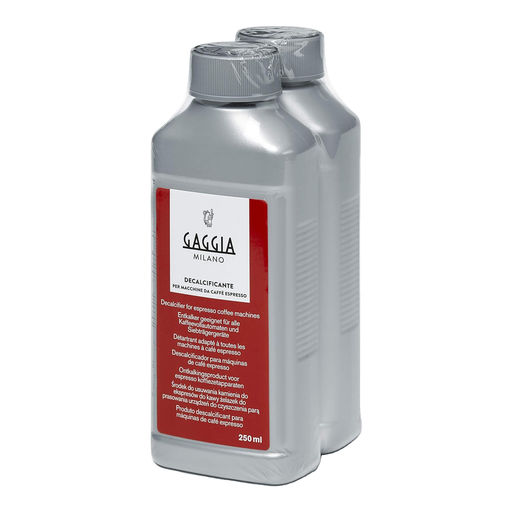
Why this product suits the profile: Two 250-ml bottles provide a manageable supply for the regular care of manual and automatic espresso machines. The liquid formula can be dosed according to the instructions.
The product description explicitly mentions manual and automatic coffee machines. This makes its intended use clearer than that of a general bathroom cleaner.
Citric acid listed as the main ingredient, an odourless liquid and 500 ml total contents.
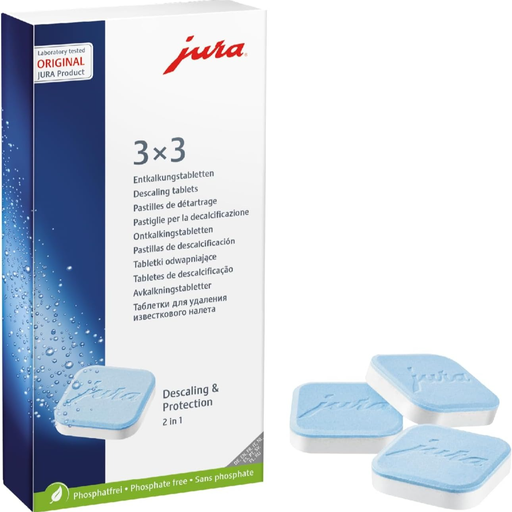
Why this product suits the profile: According to the product details, these tablets were developed for JURA bean-to-cup coffee machines and are intended for the descaling programme specified for them.
The solid format reduces the risk of measuring liquid inaccurately. Use must still follow the JURA instructions.
Nine tablets, a phosphate-free formula according to the product details and a stated two-phase action.
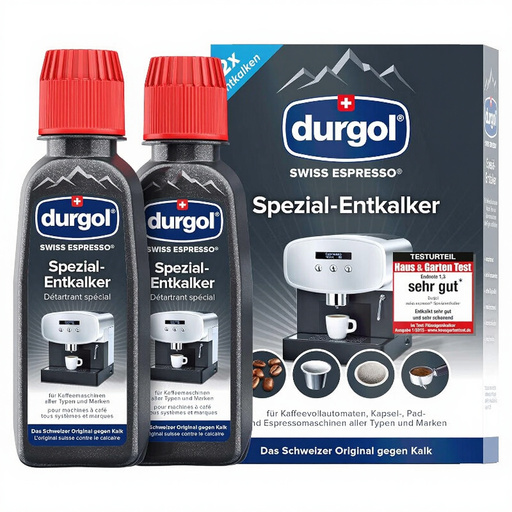
Why this product suits the profile: According to the product description, the pre-portioned bottles are suitable for bean-to-cup machines, portafilter machines, piston machines, capsule systems and coffee pod systems.
The individual portions eliminate the need to measure out larger bottles inaccurately. Use should nevertheless be checked against the machine instructions.
Two 125-ml portions, an odourless formula and bottles made from 100% recycled plastic according to the product details.
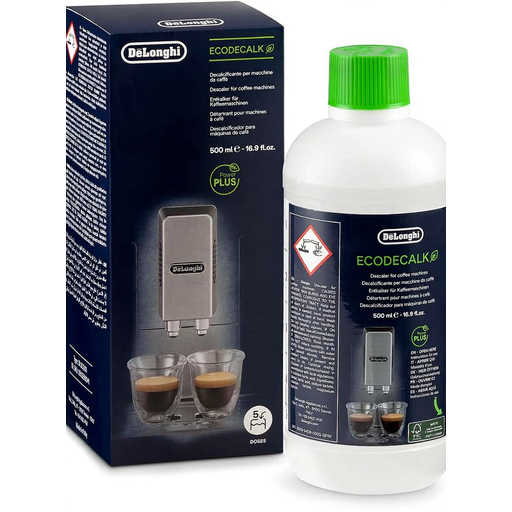
Why this product suits the profile: According to the supplier, the 500-ml bottle is suitable for all De’Longhi coffee machines and is dosed at 100 ml per descaling cycle.
The dosage markings make it easier to use than products without clear quantity guidance. This removes the need to use bathroom or household cleaners as substitutes.
500 ml contents and, according to the product details, up to five descaling cycles when dosed accordingly.
We have put together a complete, regularly updated list of products that fully meet these strict selection criteria and the safety regulations applicable in the EU.
The frequency depends on water hardness, how intensively the machine is used and the machine’s display. In areas with hard tap water, more frequent checks may be necessary. A water filter can reduce limescale build-up, but does not generally replace descaling.
A suitable product is one that is explicitly approved for the relevant machine type or recommended by the appliance manufacturer. For JURA machines, the specified descaling tablets are an obvious choice, for example; EcoDecalk is often recommended for De’Longhi appliances. For another brand, the compatibility information in the user manual should take priority.
There is no set interval that applies to every appliance. Water hardness, the number of drinks prepared and whether a filter is used all affect how often descaling is needed. The machine’s display, the user manual and visible signs such as longer heating times or reduced water flow are the key indicators.
Citric acid is an ingredient in some commercial descalers. However, pure citric acid should only be used if the machine manufacturer expressly permits it and specifies the dosage. A home-mixed solution may be unsuitable for certain components if the concentration or temperature is incorrect. You should therefore always follow both the product instructions and the appliance manual.