
Lieferung heute & morgen

Qualitätsgarantie

Willkommens-Angebote freischalten: KOSTENLOSE Lieferung | Bis zu 80 % RABATT | Kostenlose 30-Tage-JoyPlus-Testphase
App herunterladen
Steamy windows, musty basement air or laundry that takes ages to dry indoors: a dehumidifier can effectively reduce excess room humidity. To avoid making a poor purchase for your German home, however, you need to consider more than the stated litres per day and a tempting price.
As a Joybuy Product Recommendation Officer, I filter market information using clear, verifiable criteria. The most important factors are the intended location, dehumidification performance under realistic conditions, the option for continuous drainage and everyday noise levels.
Figures such as 10L/24h, 16L/24h or 20L/24h may appear straightforward. However, they refer to specific temperature and humidity conditions, often around 30 °C and 80% relative humidity, or even higher values. In a cool German basement, the actual amount of water extracted may be lower.
The daily extraction rate is therefore useful for comparison, but it does not guarantee a particular amount of water in every room. You should also check the recommended room area or volume.
A dehumidifier with a water tank will normally stop automatically once the container is full. A 1.35- or 1.4-litre tank will need emptying frequently when humidity is high. For basements, utility rooms or unattended operation, a dehumidifier with a drain hose is often more practical.
A larger tank, for example with a capacity of 2.5 to 4.8 litres, extends the intervals between emptying. However, it does not automatically replace continuous drainage if the appliance is intended to run for many hours without supervision.
A quiet dehumidifier is often advertised with a sleep mode. Check whether the stated noise level applies to this mode or to normal operation. Levels between 35 and 50 dB(A) can be perceived differently depending on the room’s acoustics.
For a bedroom, timers, automatic shut-off and clear humidity control are also important. A compressor model may produce noticeable operating sounds when starting, defrosting or equalising pressure.
Start by considering the room:
Manufacturer figures should be understood as measurements taken under defined conditions. Open doors, multiple rooms and very low temperatures can affect performance.
A dehumidifier with a water tank should have a visible water-level indicator, a full-tank alarm and automatic shut-off. For longer operating periods, a supplied drain hose is useful. The hose must run downhill to a suitable drain.
Before use, check that the tank is correctly positioned and that the drain connection is watertight. The appliance should be switched off and unplugged before emptying, moving or connecting the hose.
A dehumidifier with a timer can be set to run for a specific number of hours, for example while drying laundry. Automatic humidity control switches the appliance on or off according to the target level. Wi-Fi control can be useful if you want to monitor settings remotely.
Power consumption is the key factor affecting running costs. An appliance rated at 200 to 340 watts uses approximately 1.6 to 2.72 kWh over eight hours of operation. Actual consumption depends on the running time, room temperature, target humidity and operating mode. Automatic defrosting is important in cool rooms, as it can help prevent ice forming on the heat exchanger.
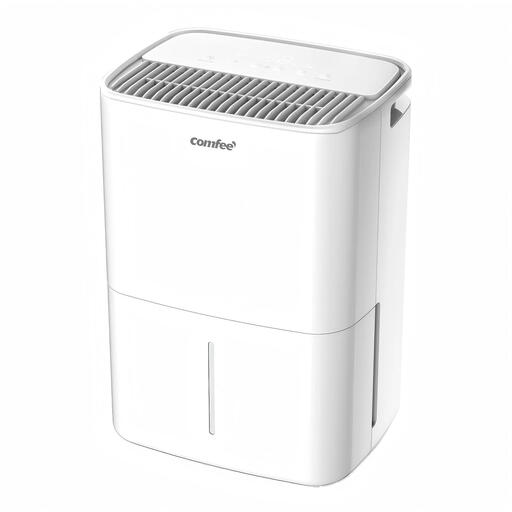
Why this product suits this profile: For smaller rooms of up to around 16 m², this model offers a manageable capacity, a 2.5-litre tank and three operating modes. According to the supplier, the sleep mode produces 36 dB(A).
The stated room size and automatic shut-off when the tank is full make it easier to assess whether the model is suitable. Automatic defrosting is also included.
2.5-litre water tank, 24-hour timer, child lock and laundry-drying mode.

Why this product suits this profile: This model combines 20L/day, a stated suitability for areas of up to 40 m², app control and a 2.5-litre tank. It is a good match for users who want to manage humidity from their smartphone and according to a schedule.
As well as using the tank, you can connect a continuous drain. Automatic defrosting and automatic internal drying address typical requirements for longer operating periods.
Wi-Fi app, 24-hour scheduling, laundry-drying mode and a stated sleep mode of 35 dB.
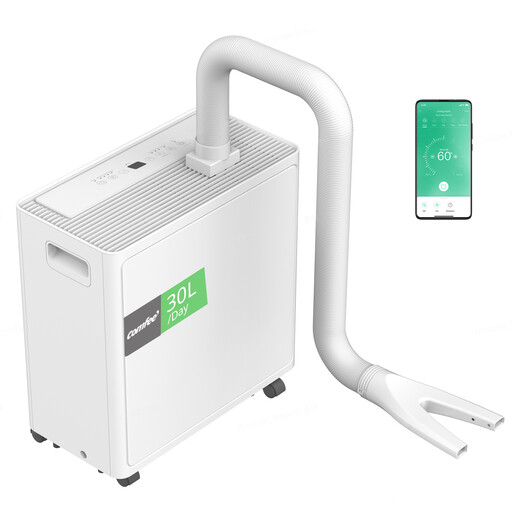
Why this product suits this profile: With a capacity of 30L/24h and a stated suitability for approximately 58 to 73 m², this appliance is designed for larger living areas, basements, bathrooms or utility rooms used regularly.
The 3.2-litre tank can be supplemented with a drain hose. This reduces the need to empty the tank manually so frequently.
Four operating modes, Wi-Fi control, 24-hour timer, automatic defrosting and child lock.
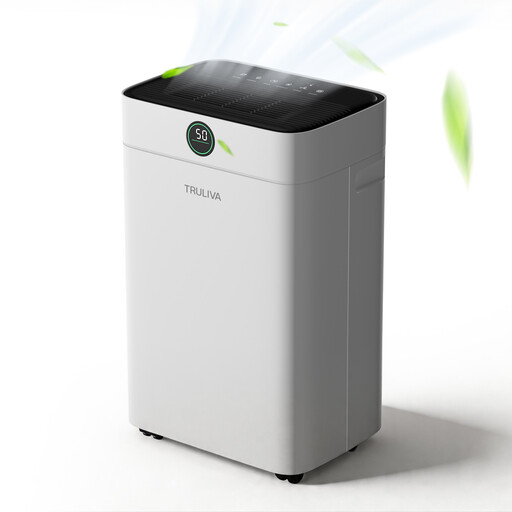
Why this product suits this profile: According to the product information, this appliance is designed for up to 25L/day and features a 2.8-litre tank and a drain hose. This makes it relevant for utility rooms, basements and frequent clothes drying.
The combination of a full-tank indicator, automatic shut-off, continuous drainage and automatic defrosting covers a range of practical operating situations.
25L/day, laundry-drying mode, 2.8-litre tank, drain hose and transport castors.
We have put together a complete, regularly updated list of products that fully meet these strict selection criteria and the safety regulations applicable in the EU.
Place the dehumidifier on a level, stable surface and leave sufficient space around the air inlet and outlet. Keep doors and windows closed wherever possible during operation, so that damp outdoor air is not constantly drawn in.
After transporting the appliance or tilting it significantly, the manufacturer will often recommend leaving it upright for around two hours before switching it on. Most compressor models are designed for temperatures of approximately 5 to 35 °C. Automatic defrosting is therefore an important feature in cool basement rooms.
Clean the removable filter regularly according to the instructions. The appliance must be switched off and unplugged before cleaning, moving or emptying it. A dehumidifier cannot replace investigating the cause of damp: if moisture is continually entering, there are leaks or there are structural problems, the underlying cause should be addressed separately.
This depends on the room size, starting humidity and target level. A timer set for a few hours may be sufficient for drying laundry. In a damp basement, longer operation with a drain hose is more practical. Automatic humidity control prevents the compressor from running continuously once the set target range has been reached.
The cost depends on power consumption, operating time and your electricity tariff. At 300 watts and eight hours of operation, the calculated consumption is 2.4 kWh. Actual consumption may be lower if the appliance switches off after reaching the target humidity. As well as checking the dehumidification performance, you should therefore also check the wattage.
A model with a sleep mode, timer and moderate noise level may be suitable for use in the bedroom. Do not place the appliance directly next to the bed, do not block any ventilation openings and follow the manufacturer’s stated noise levels for the relevant operating mode.