
Lieferung heute & morgen

Qualitätsgarantie

Willkommens-Angebote freischalten: KOSTENLOSE Lieferung | Bis zu 80 % RABATT | Kostenlose 30-Tage-JoyPlus-Testphase
App herunterladen
Damp air, condensation on windows or musty smells are typical signs of high indoor humidity. The right dehumidifier can help keep humidity within the desired range. However, models vary considerably in dehumidifying performance, noise levels, power consumption and water drainage options.
If you only look at the stated “litres per day”, you risk choosing an unsuitable model. The quoted performance is usually determined under specified test conditions, such as high temperature and relative humidity. In a cool basement or a heated bedroom, actual performance may be lower.
According to its product specifications, a 20L dehumidifier removes up to 20 litres of water within 24 hours. This does not automatically mean that this amount will be reached in every room and at every temperature. You should therefore also check:
A 10-litre model may be sufficient for small bedrooms or home offices. Larger basement rooms, utility rooms or living areas may benefit from models with a daily capacity of 16 to 30 litres.
A low-capacity tank needs emptying frequently when humidity is high. A dehumidifier with a drainage hose is more convenient, provided there is a suitable drain nearby. The hose must be installed with a downward gradient and must not be kinked.
An automatic full-tank shut-off, a clearly visible water-level indicator and a removable tank are also important. These features reduce the risk of water overflowing.
Noise levels are given in dB(A). A model rated at 36 dB(A) is quieter under the relevant manufacturer conditions than one rated at 47 dB(A). Even so, the compressor, fan and vibrations may be perceived differently depending on where the unit is placed.
For bedrooms or offices, a specified sleep mode, two fan speeds and a dehumidifier with a timer are useful. Place the unit on a stable, level surface and leave sufficient space around it for air circulation.
Do not base your choice solely on the maximum daily capacity. A model should suit the size of the room and the level of moisture:
A single unit is not always sufficient for several separate rooms. Closed doors restrict air exchange.
A dehumidifier for basements often runs for longer periods. A hose connection, automatic shut-off and an easily accessible filter are particularly practical here. The filter should be cleaned regularly according to the instructions; some models have a washable filter.
With a dehumidifier for bathrooms, you need to choose its location carefully. The unit must not be exposed to splashing water and should not be placed directly next to a shower or bath. Also follow the relevant manufacturer’s instructions regarding use in humid rooms.
Ice can form on the heat exchanger in cool basements. A dehumidifier with automatic defrosting pauses the compressor when necessary and then restarts it. This feature is particularly relevant at lower room temperatures.
Many of the models mentioned use R290 as a refrigerant. R290 is flammable. The casing or refrigerant circuit must therefore not be opened, heated or damaged. Observe the required safety clearances and only use the appliance in accordance with the operating instructions.
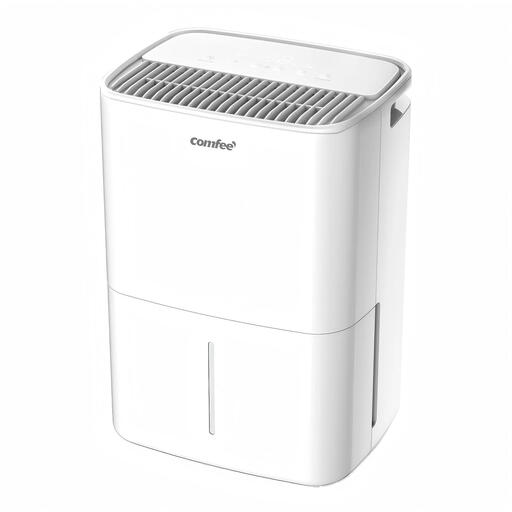
Why this product suits this profile: For rooms of up to around 16 m², the manufacturer states a maximum dehumidifying capacity of 10 litres per day. The 2.5-litre tank, 36 dB(A) sleep mode and castors make it suitable for occasional use in a bedroom, kitchen or small basement.
The room recommendation and specific noise rating make it easier to assess. The full-tank indicator with automatic shut-off prevents unattended overflow.
36 dB(A) in sleep mode; three operating modes, 24-hour timer, child lock and automatic defrosting.
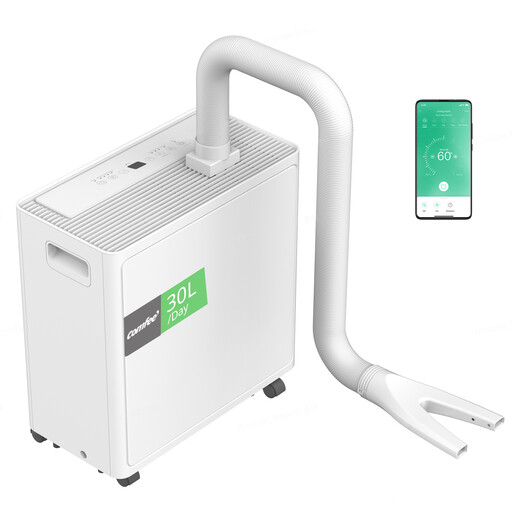
Why this product suits this profile: According to the product data, this model is designed for around 58 to 73 m² or up to 180 m³. It combines a high stated capacity with app control, four modes and the option of using either the tank or a drainage hose.
The manufacturer’s data covers more than just the daily capacity. It also specifies room size, airflow, power consumption and sound pressure level. This makes it easier to assess both the purchase and ongoing running costs.
30 L/24 h under the stated conditions; 3.2-litre tank, drainage hose, Wi-Fi app, laundry-drying mode and automatic defrosting.
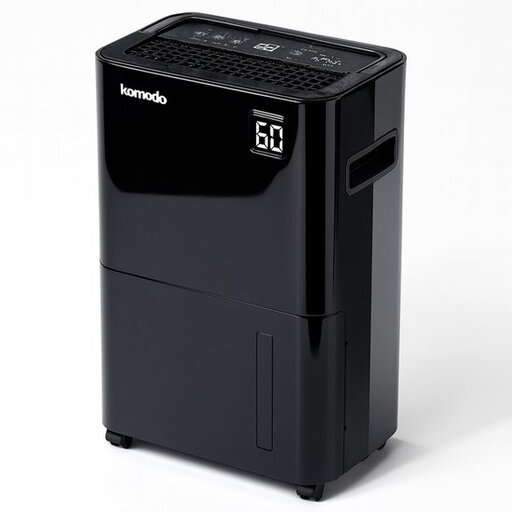
Why this product suits this profile: According to the description, this model is designed for rooms of up to 100 m² and has a 2.5-litre tank. The laundry-drying function, drainage hose and automatic defrosting make it suitable for regular use in basements, utility rooms or larger living areas.
The drainage hose means you do not need to empty the tank as often. The stated noise range of 40 to 45 dB and the timer are helpful during longer operating periods.
20 L/24 h, 2.5-litre water tank, three settings, child lock, washable filter and continuous drainage.
We have put together a complete, regularly updated list of products that fully meet these strict selection criteria and the safety regulations applicable in the EU.
Ongoing costs depend primarily on power consumption and operating time. A 300-watt model uses around 3 kWh after ten hours of operation. For a more accurate estimate, multiply the power consumption in kilowatts by the operating hours and the current electricity price.
If possible, keep the windows and doors of the relevant room closed while the unit is running. Do not block the air outlet and keep the filter clean. When drying laundry, clothes should not be dripping wet. A dehumidifier can regulate indoor humidity, but it cannot replace ventilation or address the underlying causes of penetrating damp. Visible mould should be professionally assessed and removed; the appliance will not eliminate existing mould growth.
This depends on the room size, initial humidity and the appliance’s capacity. Use a hygrometer reading and set a target humidity level. Timer or automatic functions can limit operating time. If humidity remains persistently high, you should also investigate the cause.
Calculate it as follows: Power in kW × operating hours × electricity price per kWh. A 200-watt model running for five hours uses 1 kWh in theory. Actual consumption depends on compressor operation and room humidity.
A dehumidifier can reduce high humidity and condensation, helping to limit conditions that encourage further mould growth. However, it cannot remove existing mould and is not a substitute for remedial work. The cause, ventilation and structural damp problems should be assessed separately.