
Lieferung heute & morgen

Qualitätsgarantie

Willkommens-Angebote freischalten: KOSTENLOSE Lieferung | Bis zu 80 % RABATT | Kostenlose 30-Tage-JoyPlus-Testphase
App herunterladen
A detail sander is designed for jobs where a large random orbital sander reaches its limits: narrow edges, inside corners, window frames, furniture profiles or small areas. Before buying, however, it is worth taking a close look at the technical specifications and accessories. High speeds alone reveal little about whether a tool is suitable for your application.
An electric detail sander with a high speed can produce a fine sanding finish. However, the material removal rate also depends on the grit used, the sanding stroke, the pressure applied and the working area. A high speed does not replace the right sandpaper for detail sanders.
A coarse grit can be useful for old layers of paint or rust. With veneered furniture or plastic, however, applying too much pressure risks damaging the surface.
An integrated dust collector or external extraction system can reduce the amount of dust, but it cannot prevent dust from being produced altogether. Especially when sanding furniture, safety goggles, suitable respiratory protection and good ventilation should be standard practice. Old coatings also require caution, as their composition may be unknown.
Check whether a tool only has a dust container or also features a connection for a vacuum cleaner. The hole pattern in the sanding sheets must also match the backing plate.
An affordable detail sander can quickly become impractical if suitable sanding sheets are difficult to find. Before buying, check:
Hook-and-loop sanding sheets enable quick changes. However, they must sit cleanly and flat on the backing plate so that they do not come loose during use.
The electrical power rating provides an indication of the motor size, but it is not the only measure of quality. A compact tool with 140 to 200 watts may be sufficient for detail work on wood, metal or plastic. According to the product description, the HYCHIKA sander operates at 200 watts and up to 14,000 revolutions per minute. This makes the model suitable for small areas, corners and edges.
Another HYCHIKA model is specified as having 140 watts and 13,000 OPM. OPM stands for “Orbits per Minute”, meaning oscillations per minute. These figures are not automatically comparable between different manufacturers, as measuring methods and construction can vary.
The grit determines how much material is removed:
Do not start with a coarser grit than necessary. On veneer, softwoods or plastic, an overly aggressive sanding sheet can leave visible scratches. Change the grit gradually and remove sanding dust between stages.
For particularly small areas, a multi-sander for wood may be more practical than a tool with a large sanding plate. A handheld detail sander, on the other hand, is better suited if you need to work away from a power supply or carry out very delicate tasks.
A sander for corners should sit securely in your hand and allow you to work with control. A soft grip can make longer jobs more comfortable. Weight is also important: a lightweight tool is easier to control when working overhead or on vertical surfaces.
A six-hole extraction system, as described for the HYCHIKA models mentioned, only works effectively when the sanding sheet and backing plate match correctly. A dust container saves space, while a vacuum cleaner adapter may be more practical for longer jobs.
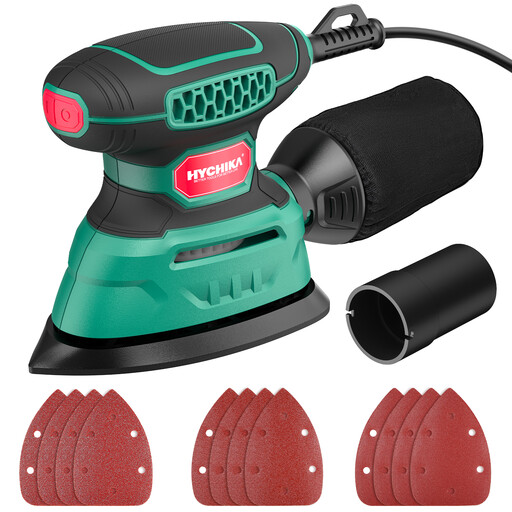
Why this product suits this profile: The compact specification is aimed at occasional work on wood, metal and plastic. The package includes twelve sanding sheets in P80, P120 and P240.
The three stated grits prevent the tool from being used only with coarse sheets. The dust bag and vacuum cleaner adapter provide two extraction options.
140 watts, 13,000 OPM according to the product information, hook-and-loop fastening and six extraction holes.
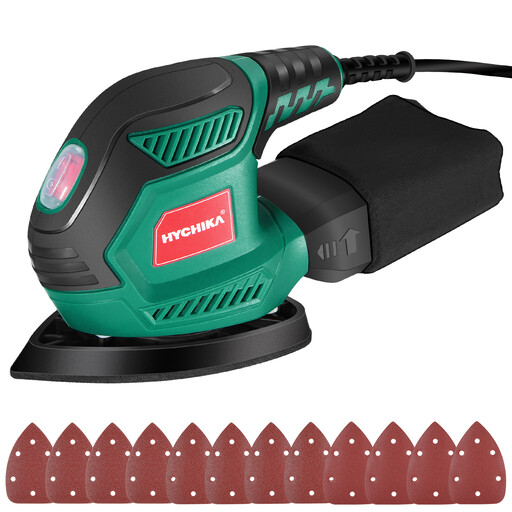
Why this product suits this profile: If you regularly work on furniture and want a tool with clearly stated performance figures, this 200-watt model offers a specified 14,000 revolutions per minute and accessories for several stages of work.
P80, P120 and P240 cover coarse, medium and fine work. The hook-and-loop attachment makes changing sheets easier when the grit needs to be adjusted for the next stage.
200 watts, 14,000 rpm according to the product description, integrated dust container and soft grip.
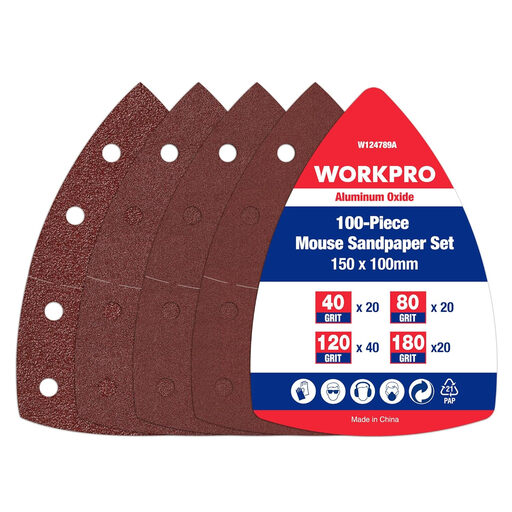
Why this product suits this profile: This set is suitable for users who regularly prepare different surfaces and need several grits. The triangular shape reaches corners and narrow detail areas.
The four grits P40, P80, P120 and P180 allow for a graduated approach. Before buying, make sure that the 105 × 152 mm size matches your sanding plate.
100 sanding sheets, aluminium oxide grit, hook-and-loop backing and 11-hole design for dust extraction according to the product description.
For large, flat surfaces, a sanding roll can offer greater flexibility. According to the product information, the WORKPRO rolls are 93 mm wide, five metres long and available in P60, P120, P180 and P240 grits. The material can be cut to size or used for hand-sanding work. For a detail sander, the cut shape must match the backing plate exactly.
A manual sanding block remains a useful addition for very small corrections. The 24-piece set contains one 165 × 85 mm block and sanding sheets in P80, P100 and P120. This allows you to finish edges without using a power tool.
For engraving, polishing or drilling, a mini rotary tool belongs to a different category from a triangular sander. According to the product description, the Fanttik F2 Master is supplied with five speed settings, up to 25,000 rpm and 35 accessories with a 2.3-mm chuck. It is therefore better suited to precision work and DIY projects than to sanding large areas of furniture.
We have put together a complete, regularly updated list of products that fully meet these strict selection criteria and the safety regulations applicable in the EU.
For firmly bonded paint, P40 to P80 can be used. Work with light pressure and check the surface regularly. Follow with medium and fine grits such as P120 or P180 to smooth the surface. With unknown old coatings, respiratory protection, safety goggles and good ventilation are essential.
Service life depends on frequency of use, workload, dust protection and storage. Do not allow the tool to run unnecessarily long without contact with the surface, do not apply excessive pressure, and clean the ventilation openings and dust collection system after use. Worn sanding sheets should be replaced in good time.
In addition to electricity consumption, the main cost is sanding sheets. Coarse grits wear more quickly on hard coatings, while fine sheets can become clogged by sticky paint residue. A set containing several grits reduces the need for repeat purchases, provided that the shape, hole pattern and fastening match your existing sander.