
Lieferung heute & morgen

Qualitätsgarantie

Willkommens-Angebote freischalten: KOSTENLOSE Lieferung | Bis zu 80 % RABATT | Kostenlose 30-Tage-JoyPlus-Testphase
App herunterladen
A sandpaper set can make renovation work easier, provided the grit, format and fastening method are right for the job. However, a large number of sheets or a wide range of grit ratings doesn’t automatically make a set a good choice. If you focus only on the number of sheets or a low price, you could end up with abrasives that don’t fit your existing tool or quickly clog when used on the surface you have in mind.
A set with 100 or 150 sanding sheets may look like good value at first glance. What matters, though, is how the grits are distributed. Grits 40 or 60 are used for removing material quickly, while 80 and 120 are often used for intermediate sanding. Grits 180, 240 or higher are generally intended for finishing.
If a sandpaper set contains mainly very fine sheets, it won’t be suitable for removing thick layers of paint. Conversely, coarse sanding sheets can leave unnecessary scratches on a surface that has already been smoothed.
Sanding discs and sheets must fit the backing pad exactly. For an orbital sander, for example, you’ll need a 125 mm diameter and the right hole pattern. An 8-hole design will only support dust extraction properly if its openings line up with those on the tool.
By contrast, triangular sanding sheets are generally used with multi-tools and detail sanders. Before buying, check the shape, dimensions and position of the fastening holes against your existing tool.
Hook-and-loop sandpaper is quick to change and holds securely when used with a compatible backing pad. However, hook-and-loop fastening won’t make up for the wrong size. If the sanding sheet is too small, part of the backing pad will be left uncovered. If it’s too large, it may overhang and come loose at the edges.
For a hand sander or sandpaper rolls used by hand, cutting to size, folding or clamp fastening is often more practical than a hook-and-loop system.
The grit number indicates the size of the abrasive particles. A lower number means a coarser finish and faster material removal; a higher number means finer sanding.
A set of sandpaper in grits 40, 60, 80, 120, 180 and 240 covers many stages of a job. Even so, choose the grits to suit the material. Wood grain, metal edges and dried paint don’t always need the same sequence.
For an orbital sander, the diameter and hole pattern are key. The WORKPRO set, for example, has a 125 mm diameter and 8 holes. A detail sander, on the other hand, needs a triangular shape. A 93 × 185 mm sanding sheet fits different tools from a round sanding disc.
For a drywall or wall sander, a larger backing pad and a suitable holder are important. For hand sanding, a sanding block with an ergonomic handle may be easier to control than a sheet without a firm backing.
Aluminium oxide is commonly used in sandpaper for wood, metal and paint. The details that matter more than a marketing label are the backing material, grit and fastening method. Paper backing is easy to cut to size; a more durable cloth or fibre backing may be better for heavier use.
With power sanders, the hole pattern should match the dust extraction system. When sanding paint, metal or plasterboard, safety glasses, suitable respiratory protection and adequate ventilation are essential. Secure the workpiece firmly, and don’t use damaged abrasives.
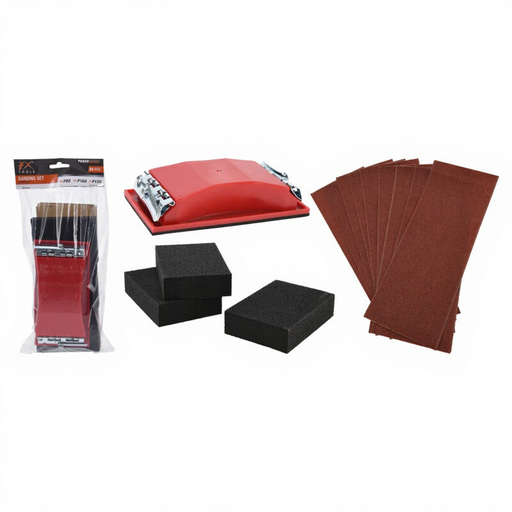
Why this product suits you: For occasional furniture care, minor repairs and hand-sanding, this compact sanding block offers a simple solution that doesn’t require power tools.
The sanding block dimensions and included P80, P100 and P120 grits are clearly specified. That means there’s no need to find a compatible power sander.
Ergonomic handle, 165 × 85 mm sanding surface and 24 sandpaper sheets.
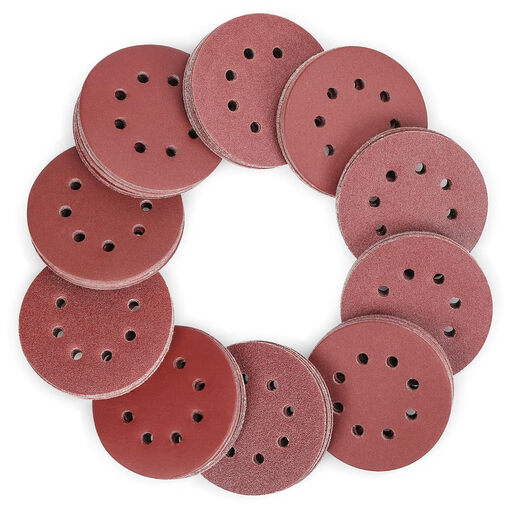
Why this product suits you: For regular use with a 125 mm orbital sander, this set offers a range of grits for everything from coarse to fine sanding.
The diameter, 8-hole design and hook-and-loop fastening are clearly specified. The grits range from 60 to 600, making the selection easy to understand.
150 sanding discs, nine grit grades and aluminium oxide abrasive.
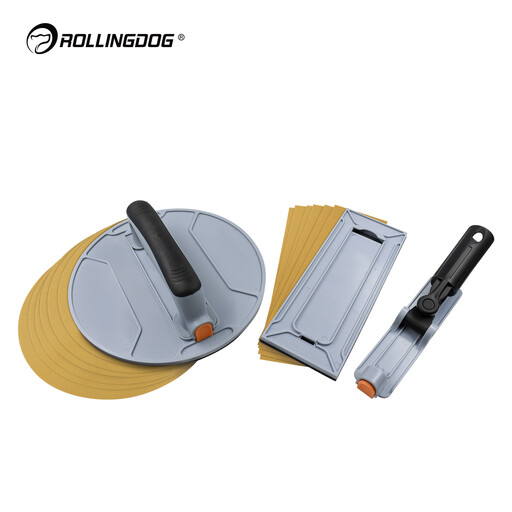
Why this product suits you: This set is designed for renovators, painters and drywallers working on large wall areas as well as edges and hard-to-reach spots.
Rather than relying on one format, the set includes a round 220 mm sander and a rectangular 225 × 85 mm sander. Grits 80, 120 and 240 are specified.
Two backing pad shapes, a push-button handle and a fitting for an extension pole.
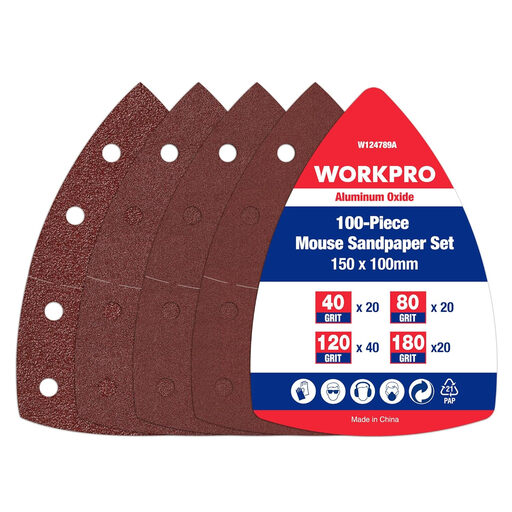
Why this product suits you: The triangular shape is designed for corners, narrow areas and detailed work on furniture or wooden surfaces.
The 152 × 105 mm format, 11-hole design and hook-and-loop fastening are clearly described. According to the product details, the sheets can be split.
100 triangular sanding sheets in grits 40, 80, 120 and 180.
Sandpaper rolls can be handy when you’re working on different pieces. The WORKPRO set contains four rolls, each measuring 93 mm × 5 m, in grits 60, 120, 180 and 240. According to the product description, the material can be torn off, cut to size or folded for use with a hand sander. Before using it with a tool, make sure the cut shape fits the backing pad exactly.
For small woodworking jobs or hard-to-reach areas, an electric detail sander such as the HYCHIKA-Sander may also be suitable. It comes with a 200 W motor, dust container and P80, P120 and P240 sanding sheets. The key considerations are still the tool’s power, a compatible backing pad and effective dust control.
We’ve put together a complete, regularly updated list of products that meet these strict selection criteria and fully comply with the safety regulations in force in the EU.
Grits 40 to 80 are often used to remove paint or material quickly. If you’re working on a delicate surface, test the coarse grit on an inconspicuous area first to check that it won’t cause damage. You can then move gradually to grits 120, 180 or 240.
How long it lasts depends on the material, pressure applied, amount of dust and size of the area being sanded. Replace a sheet when the abrasive grains look worn, the surface becomes clogged or it removes noticeably less material. Applying too much pressure shortens the sheet’s life and can put extra strain on both the tool and the workpiece.
No. Before buying, check that the diameter, hole pattern and fastening method match. If you’re using hook-and-loop sanding discs, the condition of the backing pad matters too. Compare the tool manufacturer’s specifications with the dimensions of the sandpaper set.