
Lieferung heute & morgen

Qualitätsgarantie

Willkommens-Angebote freischalten: KOSTENLOSE Lieferung | Bis zu 80 % RABATT | Kostenlose 30-Tage-JoyPlus-Testphase
App herunterladen
An electric ceramic fan heater can warm rooms temporarily without the need to install a fixed heating system. At the same time, unclear power ratings, missing safety features and consistently high electricity consumption often lead to unsuitable purchases. The key factor is therefore not just wattage, but how room size, thermostat, operating modes, noise levels and safety features work together.
A 2000W ceramic fan heater can provide maximum heating power, but at full output it can also use up to 2 kWh per hour of operation. Assuming an electricity price of 0.35 euros per kWh, that would be around 0.70 euros per hour. The actual cost depends on your tariff, operating time and how the thermostat regulates the appliance.
An ECO mode or precise thermostat can reduce operating time if the heater automatically turns down after reaching the desired temperature. However, broad claims such as “energy-saving” should always be checked against the specific power levels and control logic.
Claims such as “up to 25 m²” generally refer to conditions that depend on ceiling height, insulation, window area and outdoor temperature. A 1500W appliance may be sufficient in a well-insulated room, while a draughty older property may require more power. A fan heater is not a replacement for a permanent building heating system.
A remote control, timer and oscillation make operation easier. However, they do not mean that the appliance can be left running unattended for long periods. A fan heater with overheat and tip-over protection should be placed on a stable, level surface. Air vents must not be covered, and textiles, curtains and furniture should be kept at a safe distance.
With a PTC fan heater, a ceramic heating element warms the air flowing through the appliance. For smaller rooms and workspaces, selectable power levels of around 900 to 1500 watts may be suitable. Models offering up to 2000 watts may be worth considering for medium-sized rooms. More power does not automatically mean more even heat distribution.
Look for several heating levels, a fan-only mode and clear information about the recommended room size. Actual suitability depends on the building and room conditions.
An electric fan heater with a thermostat should allow you to set the target temperature as precisely as possible. A range of 5 to 35 °C covers frost protection, office temperatures and short-term supplementary heating. An ECO mode is useful when the appliance switches between higher and lower power levels instead of running continuously at full output.
Decibel ratings are useful for bedrooms and offices. A lower figure can make operation more comfortable, although the noise level depends on the fan mode and distance from the appliance. A quiet fan heater should also have a night or mute mode.
A fan heater with a timer allows you to limit how long it runs. With a fan heater with a remote control, the most important functions should still be accessible directly on the appliance. This is useful if the remote is misplaced or its batteries run out.
Look for overheat protection, a tip-over switch, a stable base and an undamaged cable. The CE mark is relevant for distribution within the EU, but it does not provide a blanket statement covering every usage situation. The instruction manual and manufacturer’s information remain the deciding sources.
A bathroom fan heater may only be used if the specific model is expressly designed for that purpose. An IP rating such as IP66 describes protection against dust and water under defined test conditions. It does not mean that the appliance can be immersed in water or placed arbitrarily close to a shower or bath. Follow the safety zones, socket requirements and manufacturer’s instructions.

Why this product suits this profile: This appliance combines 1800 watts with four operating modes, a remote control, oscillation and an adjustable thermostat from 5 to 35 °C. This makes it flexible enough for use in bedrooms, home offices or living rooms.
The 24-hour timer limits operating time. ECO mode and the four heating levels help prevent the appliance from running continuously at maximum output.
5–35 °C thermostat, 24-hour timer, remote control, plus overheat and tip-over protection according to the product information.

Why this product suits this profile: According to the manufacturer, this model is designed for 15 to 25 m² and offers 2000 watts, oscillation, a remote control, a timer and a temperature range of 5 to 35 °C.
The selectable power levels and temperature control help avoid operating exclusively at full output. According to the manufacturer, the stated noise range is 25 to 42 dB.
2000 watts, 70-degree oscillation, 12-hour timer and eight protection layers according to the manufacturer.
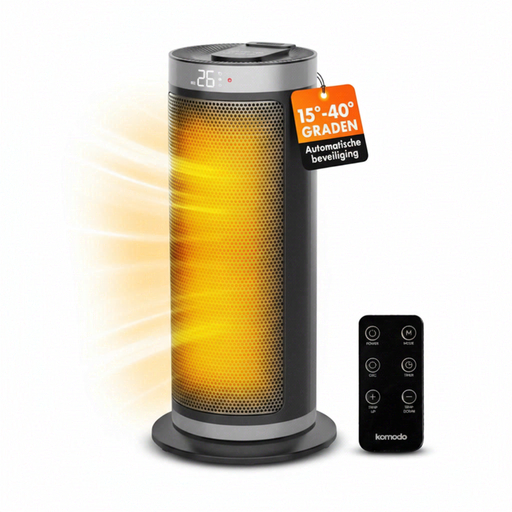
Why this product suits this profile: This model offers 750, 1500 and 2000 watts, 90-degree oscillation, a remote control and a thermostat from 15 to 40 °C. According to the product description, it is designed for rooms up to 25 m² and is rated IP66.
The three power levels allow you to adapt the appliance more effectively to the room and how it is being used. For bathroom use, however, you must still follow the manufacturer’s instructions and applicable installation regulations.
750/1500/2000 watts, ECO mode, 90-degree oscillation, plus overheat and tip-over protection according to the product information.
We have put together a complete, regularly updated list of products that fully meet these strict selection criteria and the safety regulations applicable in the EU.
A 2000-watt appliance uses 2 kWh per hour when operating at full output. Actual consumption may be lower when the thermostat, ECO mode or lower heating levels are active. For a rough cost calculation, multiply the power in kW by the operating time and your electricity price.
This mainly depends on noise level, thermostat and timer. Models with stated noise levels of around 25 to 50 dB may be more comfortable for many users than louder appliances. The fan heater should be placed on a clear, stable surface and must not be covered. A timer can limit operating time; continuous operation while unattended should be avoided.
Service life depends on operating time, dust exposure, storage and the quality of the cable, fan and controls. Clean the air vents according to the instructions, only move the appliance once it has cooled down and stop using it if the cable, housing or plug is damaged. Warranty terms, spare-parts availability and disposal as waste electrical equipment are also important practical considerations.