
Lieferung heute & morgen

Qualitätsgarantie

Willkommens-Angebote freischalten: KOSTENLOSE Lieferung | Bis zu 80 % RABATT | Kostenlose 30-Tage-JoyPlus-Testphase
App herunterladen
A matte surface can make visible layer lines less noticeable on 3D prints, giving models a smoother, less glossy appearance. The eSUN PLA-Matte 3D Printing Filament 1.75 mm 1 kg is aimed at users who want to create decorative objects, figures, prototypes or cosplay parts with an FDM 3D printer.
However, it is worth taking a close look at the technical specifications before buying. Product images and terms such as “High Performance” alone reveal little about whether a matte PLA filament is suitable for your printer, nozzle and intended application.
Filament with a matte surface can make layer lines appear less noticeable. However, it does not eliminate printing errors. Incorrect temperatures, insufficient bed adhesion, excessive speed or damp storage can still cause stringing, warping and inconsistent extrusion.
The matte texture is therefore an optical advantage, but it is no substitute for a suitable slicer profile and a correctly levelled print bed.
1.75 mm filament must be compatible with your printer’s extruder. Dimensional tolerance is also relevant, as greater fluctuations can affect material feed. For the eSUN PLA-Matte variants considered here, the product description states a dimensional accuracy of ±0.03 mm.
This is the supplier’s stated technical guideline and is not a guarantee that every print will succeed without adjustments. Before buying, also check that your printer actually uses 1.75 mm filament.
Vacuum packaging and desiccant can protect the filament from moisture during shipping. Once opened, however, PLA will absorb moisture again depending on the environment and storage time. An opened spool should therefore be stored in a sealed box in as dry an environment as possible.
Signs of damp material can include crackling during extrusion, an uneven material flow, small bubbles or increased stringing. The packaging is therefore an advantage, but it does not replace suitable storage.
The eSUN range consists of 1.75 mm filament on a 1 kg spool. This combination is designed for many popular FDM printers, including models from Bambu Lab, Creality Ender 3, Prusa and UltiMaker. Compatibility should nevertheless be checked against your own printer model and spool holder.
Key points include:
According to the available product descriptions, the eSUN PLA-Matte variants are said to offer good bed adhesion, low warping and a reduced tendency to crack. These properties are particularly relevant for larger cosplay elements, housings and decorative objects.
In practice, the result also depends on the print bed, first layer, room temperature and geometry. For large parts, it is advisable to test adhesion with a small model or a brim. PLA often does not require an enclosed printer, but the specific environment around the printer remains important.
Classic matte PLA produces a single-colour, diffuse surface. The eSUN Matte Dual Colour PLA variants, on the other hand, combine two shades, such as green-purple, red-blue, blue-purple or black-red. The colour transition depends on the model’s shape, orientation and wall thickness, and will not be equally visible on every object.
A colour gradient can be appealing for figures, decorative sculptures and selected cosplay details. For technical prototypes or parts that require a consistent colour, a single-colour PLA filament for FDM printers is generally easier to plan.
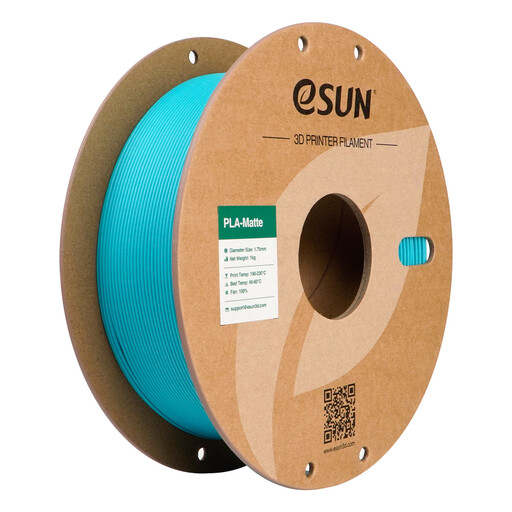
Why this product suits the profile: The single-colour Aqua variant offers an uncomplicated introduction to matte PLA filament and is suitable for figures, decorations, toys and smaller prototypes.
The clear specifications for 1.75 mm and 1 kg make it easier to check compatibility before buying. Packaging with a vacuum bag and desiccant helps reduce the risk of moisture-related problems when starting a print.
Single-colour matte surface, stated dimensional accuracy of ±0.03 mm and broad compatibility with popular FDM printers.
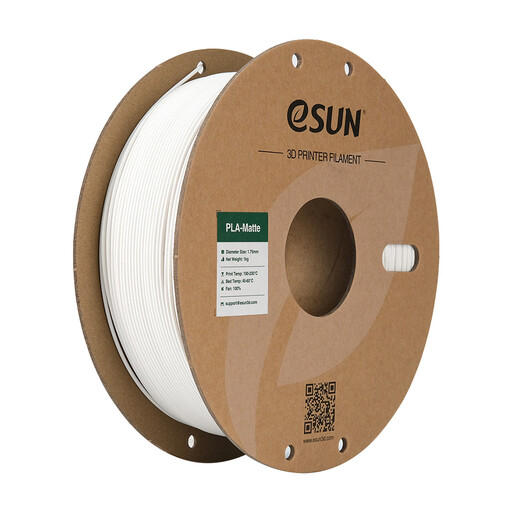
Why this product suits the profile: Milky White is well suited to minimalist models, architectural visualisations, housings and decorations where a calm, non-glossy surface is desired.
The stated dimensional tolerance helps when selecting the material. Vacuum packaging and desiccant address the common moisture issue, while the matte surface makes small lines less prominent.
1.75 mm filament on a 1 kg spool, a matte appearance and, according to the product description, low warping and reduced stringing.
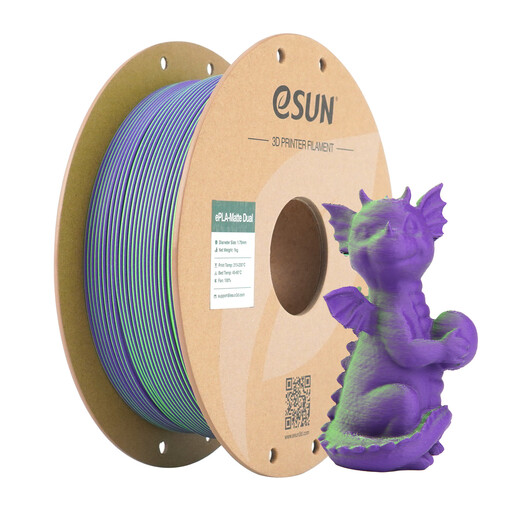
Why this product suits the profile: The two-colour variant is suitable for creative models, cosplay and decorations where visible colour changes are desired without the need for subsequent painting.
The product description states low shrinkage and vacuum packaging. Nevertheless, you should check the extruder pressure and material feed, as the recommended setting for this filament is an extruder that is not adjusted too tightly.
Two-colour surface, matte texture, 1.75 mm diameter and 1 kg of material per spool; according to the product description, it is designed for most FDM printers.
We have put together a complete, regularly updated list of products that fully meet these strict selection criteria and the safety regulations applicable in the EU.
According to the product description, the filament is designed for many FDM printers, including Bambu Lab, Creality Ender 3, Prusa and UltiMaker. The key factors are the 1.75 mm filament diameter, the spool holder and a suitable PLA printing profile. If your printer uses automatically detected spools or an RFID system, check whether additional identification is required.
This depends on the weight of the models, infill, wall thickness and support material. A model weighing 100 g in material requires roughly one-tenth of a 1 kg spool. To calculate the actual yield, you must also take support structures, purge material and potential failed prints into account.
Not every new spool needs to be dried immediately. According to the product description, the eSUN variants are supplied dried and vacuum-sealed. Once opened, the material should be stored in a dry place. If you notice crackling, bubbles or unusual stringing, drying it according to the manufacturer’s instructions may be advisable. Adjust the temperature and duration for PLA to prevent the filament from deforming.