
Lieferung heute & morgen

Qualitätsgarantie

Willkommens-Angebote freischalten: KOSTENLOSE Lieferung | Bis zu 80 % RABATT | Kostenlose 30-Tage-JoyPlus-Testphase
App herunterladen
Multi-colour models made from a single filament add variety to figurines, vases, decorative objects and gift ideas. When buying PLA Rainbow Filament 1.75 mm, however, it is not just the colour gradient that matters. The diameter, material properties, spool winding and actual colour transition length all determine whether the result is right for your planned model.
This buying guide is aimed at beginners and experienced FDM users in Germany. It explains which details matter before you buy, which marketing claims should be treated with caution and which PLA 3D printer filament may suit different usage profiles.
A gradient filament changes colour along the length of the entire spool. On small figurines, a model may therefore show only one or two shades, while a larger object reveals several transitions. With Dual-Colour PLA, Tri-Colour PLA and Quad-Colour PLA, the colour selection is usually more clearly defined, but the result also depends on the model size, layer height and orientation.
So check whether the product description refers to a colour gradient, two colours, or three or four shades. Product images often show an idealised example and do not guarantee that every printed object will have the same transition.
Silk PLA Filament has a shiny, silky-looking surface. This effect can make decorative 3D prints stand out, but it does not automatically hide layer lines or minor imperfections. Matte PLA Filament scatters light more strongly, creating a subtler appearance. Its surface may make layer lines less noticeable visually, but it cannot replace proper calibration.
For functional parts, appearance is usually secondary. For figurines, vases or display pieces, however, choose between glossy Silk PLA and a matt surface according to the look you want to achieve.
The specification PLA Filament 1 kg describes the amount of material, not the spool’s external dimensions. Before buying, check the available spool holder, the maximum spool diameter and its width. With enclosed machines, the interior space may also be limited.
It is equally important that a nominal diameter of 1.75 mm is compatible with the extruder and nozzle. 2.85 mm filament is not designed for a 1.75 mm filament path. The material specification “PLA” alone is therefore not enough to determine compatibility.
For an FDM printer with a 1.75 mm feed system, the filament should be explicitly listed as 1.75 mm. Consistent material diameter helps ensure steady feeding. Dimensional tolerance figures generally come from the brand or retailer description and should be understood as product information rather than independent testing.
Also check:
PLA is often processed at moderate temperatures. The exact setting depends on the formulation, print speed, nozzle and printer. For example, the supplied manufacturer’s instructions for a CaiLab Silk product specify a nozzle temperature range of 195 to 220 °C, together with a print-bed temperature of 60 °C for an open printer and 45 to 60 °C for an enclosed machine.
Start with a small temperature tower or test object. Excessively high temperatures can encourage stringing and visible differences in gloss, while temperatures that are too low can impair layer adhesion. For Silk PLA, the manufacturer’s instructions also recommend reducing the print speed if necessary to achieve a more even surface.
PLA can absorb moisture if stored in unsuitable conditions for a long time. Possible signs include inconsistent extrusion, bubbles, stringing or a rough surface. Store an opened spool in a resealable bag or filament box with desiccant.
According to their product descriptions, several of the products listed are vacuum-sealed and supplied with desiccant. This is helpful for storage, but does not replace airtight repackaging after opening. If the filament already appears damp, dry it according to the manufacturer’s instructions.
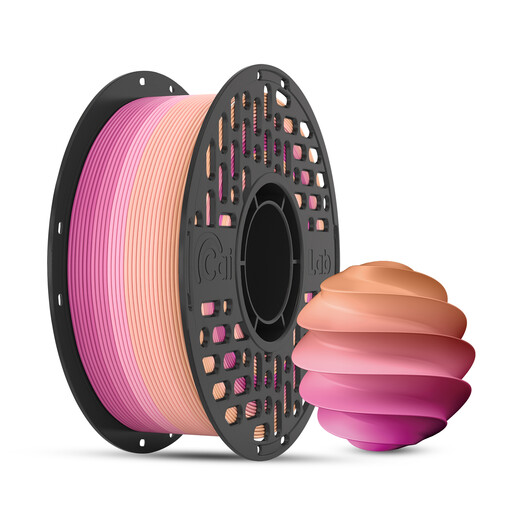
Why this product suits the profile: The Rainbow Gradient version is ideal for first colourful decorative objects, figurines and small creative projects with a 1.75 mm FDM printer.
The product name specifies PLA, Rainbow Gradient and 1.75 mm. This makes it easy to check the material type, colour transition and feed system before buying.
PLA material for FDM printers; colour gradient without changing between multiple spools.
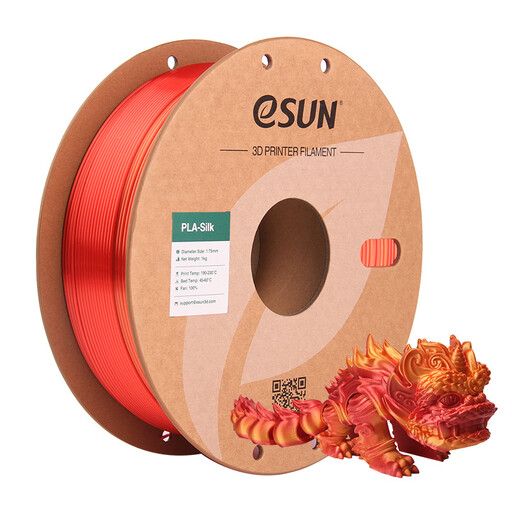
Why this product suits the profile: The 1 kg spool with a Silk finish is designed for decorative vases, figurines and larger objects with colour gradients.
The product details explicitly specify the material, diameter, spool quantity and Silk texture. This means the key selection criteria can be checked before buying.
1.75 mm PLA Silk filament; 1 kg spool; vacuum-sealed with desiccant according to the product description.
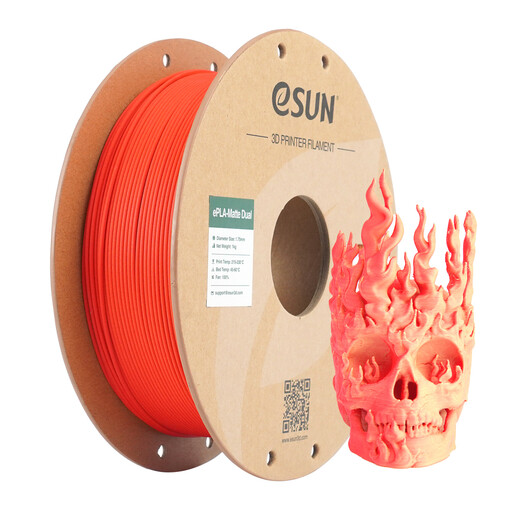
Why this product suits the profile: The Dual-Colour version with a matt finish is ideal for repeat prints where a defined two-colour effect and understated appearance are required.
The matt finish is not confused with a glossy effect. The product description also mentions a softer formulation, so the extruder should not be set too tightly.
1.75 mm filament; 1 kg spool; matt two-colour effect in red and yellow according to the product name.
We have put together a complete, regularly updated list of products that fully meet these strict selection criteria and the safety regulations applicable in the EU.
First, read the information on the product page and begin with a small test model. With multi-colour 3D printer filament, the following points are also useful:
With large models, a colour change within a single object may appear differently from the product photo. A greater layer height and a larger model often make transitions more visible, but they do not guarantee a particular colour distribution.
It is generally suitable for FDM printers whose extruder and hot end are designed for 1.75 mm filament. Before buying, compare your printer manufacturer’s specifications with the material type, temperature range and spool dimensions.
This depends on the model weight, infill, layer height, support structures and failed prints. A 1 kg spool does not automatically provide a specific number of models. Slicer software usually shows the estimated material consumption before printing.
Silk PLA is designed to produce a shiny, silky-looking surface. Matte PLA has a more diffuse, understated finish. Both remain PLA filaments for FDM printers; the choice mainly depends on the appearance you want and the recommended print parameters for each variant.