
Lieferung heute & morgen

Qualitätsgarantie

Willkommens-Angebote freischalten: KOSTENLOSE Lieferung | Bis zu 80 % RABATT | Kostenlose 30-Tage-JoyPlus-Testphase
App herunterladen
Choosing the right filament is crucial for the success of any 3D print. Especially with a specific colour choice like green, there is a multitude of options that vary significantly in shade, finish, and material properties. However, not every filament labelled "green" delivers the desired result. Many users invest in spools that prove to be unusable, falling victim to common pitfalls. This guide highlights the most frequent problems and explains which technical parameters you should pay attention to.
Before you make a purchasing decision, it's important to understand the typical issues that can lead to frustration and wasted material.
Matte PLA Filament Green has an unwanted sheen, or a Silk PLA Green appears dull because the print parameters do not match the material.High Speed PLA. However, not every filament so labelled is capable of ensuring constant extrusion at high speeds. Using an unsuitable filament in a fast printer often leads to underextrusion, poor layer adhesion, and mechanically weak parts.To avoid these problems, you should check three core technical parameters before buying. These provide information about compatibility and the expected print quality.
The standard for most FDM 3D printers is a filament diameter of 1.75 mm. However, the specified tolerance, for example, ±0.02 mm, is crucial. A low tolerance is a mark of quality and ensures that the material flow through the nozzle remains consistent. Larger deviations in diameter can lead to clogging or uneven extrusion, which manifests as visible defects on the surface of the printed object. A precise PLA Filament 1.75mm Green is the foundation for reliable printing results.
The term "PLA" is an umbrella term for various material blends with different properties.
Green 3D Printer Filament. It is easy to print, has a low tendency to warp, and is suitable for a wide range of applications, from decorative objects to simple prototypes. It is considered a biodegradable filament under industrial composting conditions.The finish has a significant impact on the aesthetics of the final object.
Based on the parameters mentioned, we have compiled a selection of products for different requirements.
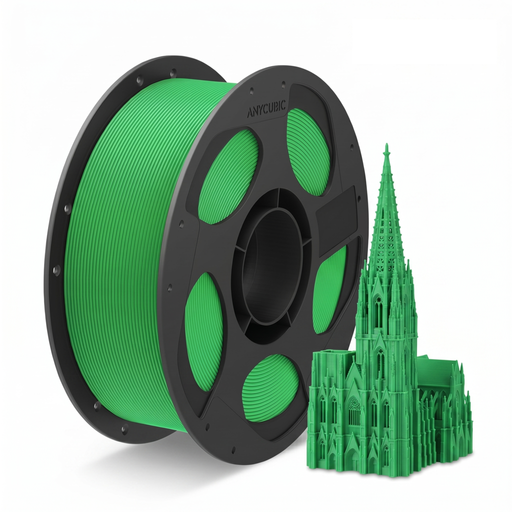
Why it's a good fit: Ideal for users looking for a straightforward and reliable standard filament for everyday projects. It is formulated for easy printing with minimal warping, making it well-suited for beginners and for printing prototypes or hobby models.
As a standard PLA, it sets clear expectations for finish and colour, minimising the risk of colour discrepancies. The collaboration with an established brand like Anycubic suggests more reliable quality control for winding.
Offers a balanced combination of easy handling and consistent print quality for a wide variety of standard applications.
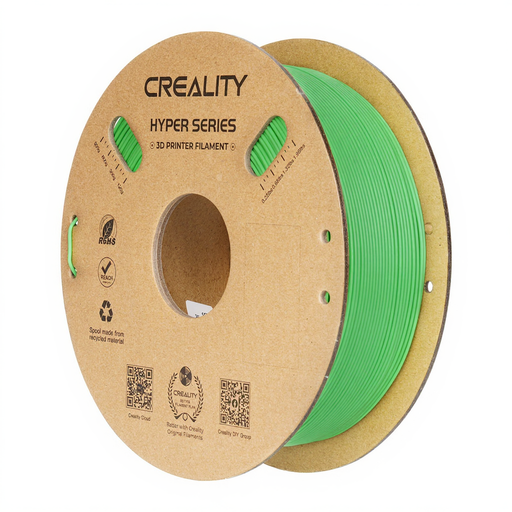
Why it's a good fit: Designed for users of modern high-speed printers who want to significantly reduce their print times. According to the manufacturer, it is optimised for speeds of up to 600 mm/s.
This filament specifically addresses the pitfall of misleading "high-speed" labels, as it is specially formulated for a high flow rate. This reduces the risk of underextrusion during fast prints. The precise tolerance of ±0.02 mm also supports trouble-free operation.
According to the manufacturer, it enables significantly higher printing speeds compared to standard PLA, which increases productivity when creating prototypes or larger series.
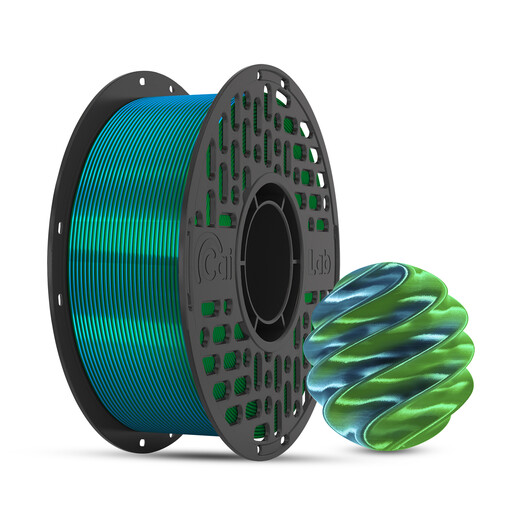
Why it's a good fit: Perfect for creatives who want to produce visually stunning objects with a dynamic colour-shifting effect and a silky sheen. Ideal for vases, figures, and other decorative prints.
The product description sets a clear expectation for the dual-colour silk gloss effect. Specific temperature recommendations are provided to avoid the pitfall of a dull finish, which can be caused by overheating the silk additives.
Creates a unique, shifting colour gradient between blue and green with a distinct silk gloss that cannot be achieved with single-colour filaments.
We have compiled a complete, up-to-date list of products that fully meet these strict selection criteria and relevant safety standards.
PLA is hygroscopic, meaning it absorbs moisture from the air. A moist filament spool leads to brittle material, crackling sounds during printing, and poor surface quality. Therefore, always store the spool in an airtight bag or box, ideally together with the supplied desiccant (silica gel).
Standard PLA is the base material, ideal for beginners and decorative prints. PLA+ is a modified version with additives that make it tougher and more impact-resistant, suitable for functional parts. High-Speed PLA is optimised for modern, fast printers and has a higher flow rate to ensure clean extrusion even at high speeds.
Yes, multi-colour filaments like the featured dual-colour or tri-colour PLA are designed for use in standard FDM printers with a single nozzle. The colour-shifting effect is created by the way the different colours are co-extruded in the filament strand. The effect is more pronounced on larger objects, as more filament is used and the colour gradient becomes more visible.