
Lieferung heute & morgen

Qualitätsgarantie

Willkommens-Angebote freischalten: KOSTENLOSE Lieferung | Bis zu 80 % RABATT | Kostenlose 30-Tage-JoyPlus-Testphase
App herunterladen
A narrow shoe cabinet can help keep a small hallway tidy, but it does not automatically take up little space. It is often not the advertised claim of being “space-saving” that matters, but the actual depth, interior layout and secure fixing. Before buying, households should therefore check carefully whether the furniture suits the layout, shoe sizes and everyday use.
With a shoe cabinet, the depth is particularly important. A piece of furniture 90 cm wide can be suitable for a narrow hallway if it is only 19 cm deep. Conversely, an apparently compact shoe cabinet with a depth of 30 cm can noticeably narrow the passageway.
You should therefore measure:
A shoe cabinet 19 cm deep is particularly suitable for narrow entrance areas. However, depending on the flap mechanism, the interior may be limited for large men’s shoes, boots or shoes with a high shaft.
A shoe cabinet with 3 or 4 compartments distributes shoes upwards to save space. However, the actual capacity depends on the compartment height and the shape of the shoes. Trainers and flat everyday shoes usually fit more easily than boots or shoes with thick soles.
Before buying, check:
A white shoe cabinet with a smooth surface often suits bright hallways and modern hallway furniture. However, its appearance says little about how stable it is. Narrow, tall furniture should have wall anchoring or anti-tip protection, particularly in households with children or pets.
Also look out for:
For a narrow hallway, depth is usually the most important parameter. A low shoe rack for the hallway requires less wall height, but often provides less enclosed storage. A tall shoe cabinet makes more efficient use of the wall space, but must be securely fixed.
As a practical guide:
MDF boards with an E1 classification are often used for interior furniture. This designation describes the formaldehyde emission class of the material and should not be taken as a statement about the overall product quality. Bamboo elements can provide a natural contrast to a white front when used as a visible shelf or frame.
A lightly damp cloth is usually all that is needed for care. Wet shoes should not be stored directly in a completely enclosed compartment, as moisture and odours can put strain on the interior surfaces.
A shoe cabinet with flaps conceals footwear and keeps the hallway looking uncluttered. An open shoe rack, on the other hand, provides quick access and is suitable for shoes worn every day. If jackets, bags or scarves also need to be stored, a freestanding coat stand with a clothes rail can complement your shoe storage.
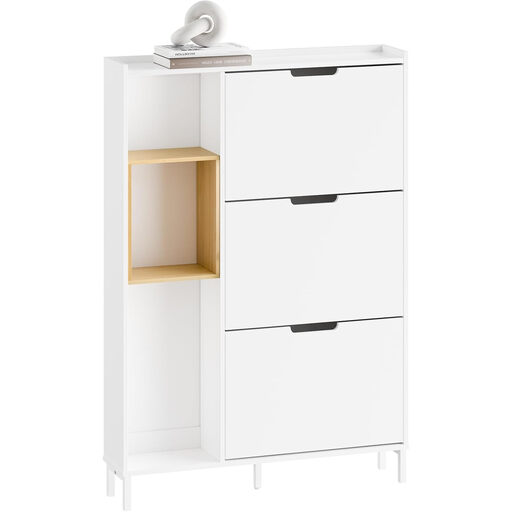
Why this product suits this profile: Measuring 90 × 19 × 129.5 cm, this model combines a shallow depth with three flaps and an open frame for small accessories.
The 19 cm depth is clearly stated. The open frame means that the entire shelf area does not consist solely of difficult-to-access enclosed storage.
MDF and carbonised bamboo; according to the product details, space for up to 9 pairs of shoes.
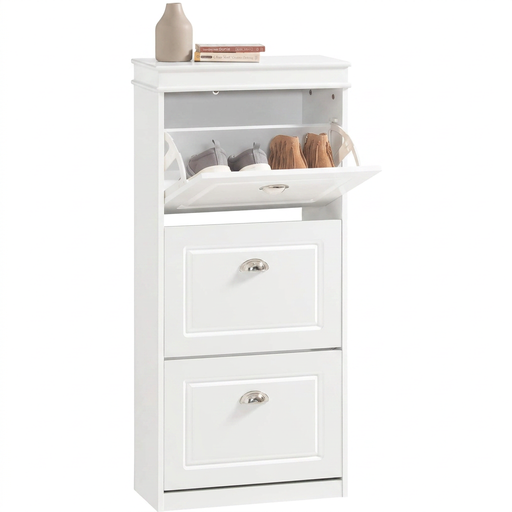
Why this product suits this profile: Its compact width is ideal for narrow sections of wall, while three angled flaps keep the storage neatly enclosed.
Anti-tip protection and the option of wall mounting address the stability issue associated with a 117 cm-high piece of furniture.
FSC-certified MDF according to the product description; designed for floor and wall mounting.
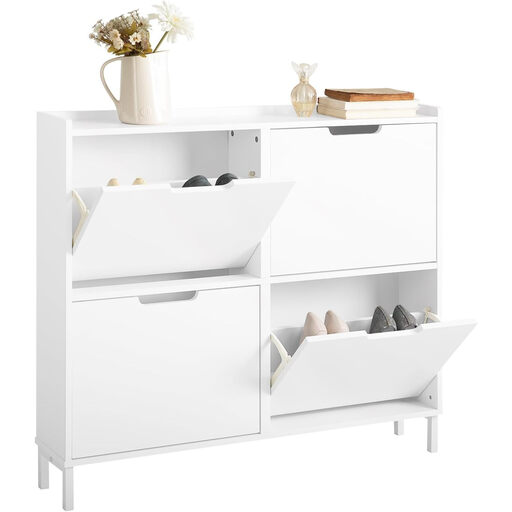
Why this product suits this profile: Four flaps and a width of 100 cm provide a practical solution for couples or families with shoes that are used regularly.
The stated depth of 19 cm reduces the space required. Anti-tip protection and the assembly instructions support safe installation.
Four quiet flaps; MDF construction; usable top surface for keys, post or decorations.
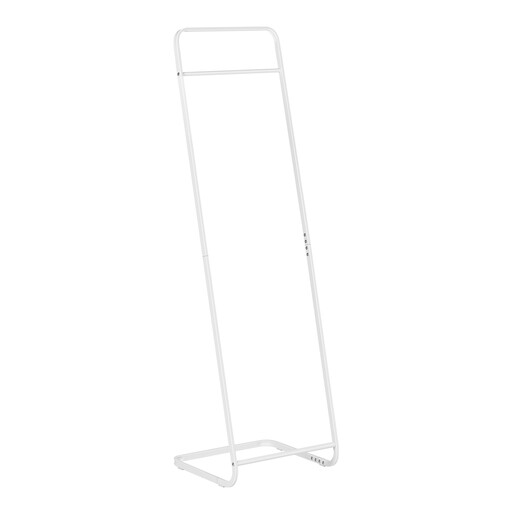
Why this product suits this profile: For homes where drilling is not possible, this freestanding coat stand provides space for jackets and bags; the area underneath can be used for shoes.
According to the product details, the construction does not require permanent wall mounting. The 10 kg load limit should be observed.
L-shape for corners; metal tubes with a painted finish; assembly accessories and instructions included.
A narrow shoe cabinet should stand on a level surface. With tall models, anti-tip protection should be fitted before first use. Check beforehand whether the wall is suitable for wall plugs and screws. In rented properties, drilling holes or the position of the furniture may be important considerations.
For a longer service life, we recommend:
We have put together a complete, regularly updated list of products that fully meet these strict selection criteria and the safety regulations applicable in the EU.
For narrow hallways, a depth of around 19 to 24 cm is considered particularly space-saving. The important thing is that the flaps open fully and the remaining passageway remains comfortable to use. Measure including skirting boards and door frames.
This depends on the internal width, compartment height and shape of the shoes. Flat shoes can usually be arranged more efficiently than boots or high-top trainers. Manufacturers’ stated pair capacity should therefore be treated as a guide rather than a universal capacity.
For tall or narrow furniture, securing it with anti-tip protection is advisable and is expressly required for some models. Before use, follow the assembly instructions and take account of the wall condition and maximum load.