
Lieferung heute & morgen

Qualitätsgarantie

Willkommens-Angebote freischalten: KOSTENLOSE Lieferung | Bis zu 80 % RABATT | Kostenlose 30-Tage-JoyPlus-Testphase
App herunterladen
A narrow shoe cabinet can provide plenty of hallway storage without making the passageway unnecessarily tight. However, its suitability for everyday use depends on more than just its shallow depth. Poorly designed tilt compartments, unsuitable shelf heights or missing anti-tip fittings can make a piece of furniture difficult to use, despite its compact dimensions.
This buying guide explains what to look out for before you buy, whether you live in a small flat, a house with a narrow hallway or a home with a compact entrance.
A shallow depth sounds practical at first. But with a hallway shoe cabinet, it’s the internal layout that matters. Compartments divided by tilt fronts, central supports or fixed shelves may not fit larger trainers, ankle boots or shoes with higher shafts.
As well as the width, height and depth, check:
A claim such as ‘stores up to 24 pairs of shoes’ also depends on shoe size, style and the compartment layout.
Tall, narrow furniture makes efficient use of wall space, but it can tip over if the weight inside is unevenly distributed. An anti-tip wall fixing shouldn’t be treated as an optional extra. Make sure the cabinet stands on a level surface and secure it according to the assembly instructions.
In households with children, make sure the cabinet isn’t used for climbing or playing. Never exceed the stated weight limit.
Painted MDF or chipboard surfaces can usually be cleaned with a slightly damp cloth. However, prolonged exposure to moisture, wet shoes and strong cleaning products can still damage the finish. A raised plinth or metal legs make it easier to clean the floor, but don’t replace the need to keep the cabinet somewhere dry and care for it regularly.
Models around 23 to 28 cm deep are particularly worth considering for narrow entranceways. Measure your hallway in several places and take skirting boards, radiators, doors and walking space into account. A slim shoe cabinet with tilt fronts needs enough room in front for the compartments to open fully.
A space-saving shoe rack can work well in a very compact space, as it doesn’t have tilt fronts that swing out. However, open racks offer less protection from dust, and shoes are more visible when the rack is full.
A shoe cabinet with adjustable shelves can be adapted to different types of footwear. Removable shelves make room for taller shoes, while smaller compartments can help you make better use of the available space.
A shoe cabinet with tilt compartments is often particularly shallow. Check that the compartments open wide enough and that your shoes won’t be squashed together inside. A shoe cabinet with a drawer also provides extra storage for keys, shoe-care products, gloves or other small items.
MDF and chipboard are commonly used for hallway furniture. What matters is the quality of the construction, the fixings and the stated weight capacity. If you’re considering a model with a metal frame or metal legs, check the maximum load for each level too.
Read the assembly instructions before you buy, particularly if the cabinet is designed to be fixed to the wall. If you rent your home, also check whether and how you’re allowed to attach it to the wall.
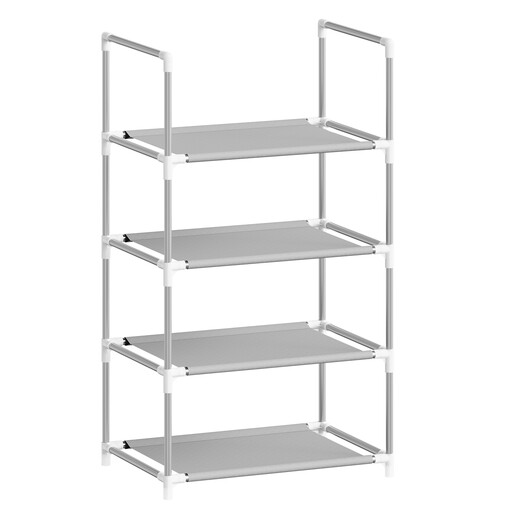
Why this product suits this profile: Measuring around 41 x 28 x 72 cm, this open rack is ideal for smaller households, rented homes and areas where you want shoes to be easy to reach.
The open design means tilt fronts won’t take up extra space in a narrow passageway. The tiers are removable.
The metal frame, four tiers and light weight make it easy to position wherever you need it in the hallway or living room.
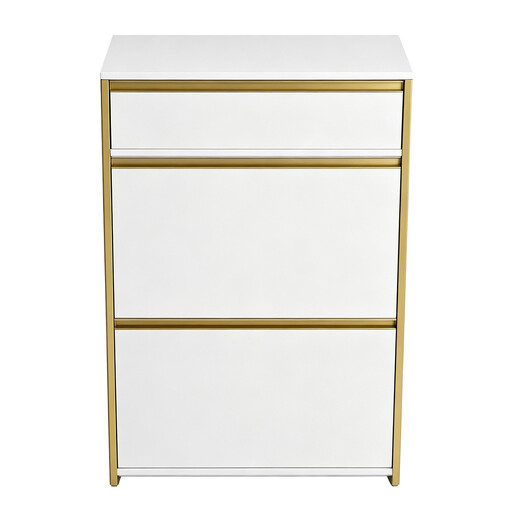
Why this product suits this profile: Measuring around 60 x 24 x 104.5 cm, this model combines enclosed storage, a drawer and adjustable shelves for the hallway or living space.
The removable, height-adjustable shelves reduce the risk of the compartments only being tall enough for one type of footwear.
It has four adjustable tiers, a drawer and an anti-tip fitting. According to the product details, it can hold up to 12 pairs of shoes.
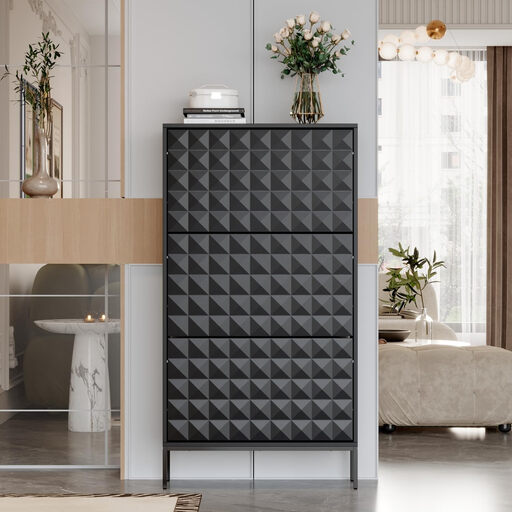
Why this product suits this profile: Around 24 cm deep, 70 cm wide and 131.5 cm high, this model is designed for households with several pairs of shoes and limited floor space.
The three doors and adjustable or removable central dividers let you adapt the compartments to different shoe sizes.
According to the product details, the cabinet holds up to 24 pairs of shoes and has 15 cm-high legs and an anti-tip fitting.
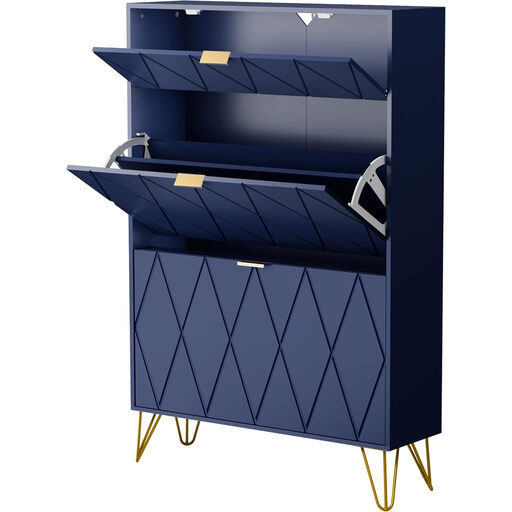
Why this product suits this profile: Measuring around 80 x 24 x 120 cm, this model combines enclosed shoe storage with a striking colour and extra surface space.
The two tilt compartments and a removable shelf make it easier to accommodate shoes of different heights. The anti-tip fitting must be secured to the wall.
According to the product details, the two lower compartments hold up to 16 pairs of shoes. The maximum load is stated as 10 kg.
We’ve put together a complete, regularly updated list of products that meet these strict selection criteria and fully comply with the safety regulations in force in the EU.
A depth of around 23 to 28 cm may suit many narrow hallways. Before you buy, though, measure the largest shoes you own. Also check that the tilt fronts or doors can open fully without blocking the passageway.
Capacity depends on the compartment height, shoe size and design. A model with open tiers may hold several pairs, while a shoe cabinet with tilt compartments divides the storage space more tightly. Figures such as 12, 16 or 24 pairs should therefore be treated as a guide to the product, not as a standard capacity for every type of shoe.
Place the cabinet on a level surface and use the anti-tip fitting provided. For wall fixings, make sure the wall type, wall plugs and screws are suitable for the surface. Follow the assembly instructions in full and observe the stated weight limit.