
Lieferung heute & morgen

Qualitätsgarantie

Willkommens-Angebote freischalten: KOSTENLOSE Lieferung | Bis zu 80 % RABATT | Kostenlose 30-Tage-JoyPlus-Testphase
App herunterladen
If you’re looking for a STAEDTLER Lumocolor Non-Permanent Marker, you’ll usually want to write on film, glass, plastic or other smooth surfaces and remove the marks later. But it’s easy to end up with the wrong marker: you might choose one that isn’t suitable for the surface, pick a line width that doesn’t suit the task, or assume that ‘non-permanent’ means it can be removed without a trace from any material.
This guide explains what pupils, students, teachers, office workers, planners and presentation users should consider when choosing a marker.
According to the product information, water-soluble ink can be wiped off film and many non-absorbent surfaces with a damp cloth. However, the ink can soak into paper, card, textiles, untreated wood and other porous materials. An erasable marker for film is therefore intended primarily for smooth, non-porous surfaces.
Before writing on a large area for the first time, it’s a good idea to test the marker on an inconspicuous spot. This is particularly important with sensitive plastics or coated surfaces.
A broad marker can be easy to see on a presentation slide, but may not be suitable for small labels. Conversely, fine lines may be harder to read on larger boards or when projected. The F, M and B designations give you a useful starting point:
The Lumocolor Non-Permanent versions use water-soluble ink. According to the product description, it dries quickly on the surface, but is designed to be removed with moisture. Water, condensation or damp hands can therefore affect a fresh mark. If you need permanent labelling, look for a permanent marker rather than an erasable marker.
For overhead projector film, glass, plastic, metal or laminated plans, smooth, non-absorbent surfaces are essential. A universal marker may be suitable for several of these materials, but shouldn’t be used on sensitive or porous surfaces without testing it first.
For presentations and conferences, visible colours such as red, blue, green, yellow, orange or purple are practical choices. If you’re using coloured film, make sure there’s enough contrast too.
The Lumocolor F 0.6 mm models are designed for precise lines. The Lumocolor M 1.0 mm versions are a good all-round choice for notes and labels. The Lumocolor B 1.0/2.5 mm models have a broad, chisel-shaped tip that can produce lines of different widths, depending on the angle.
When choosing a marker, compare the line width with the space available and the viewing distance. For a large projection, a bolder line is often easier to read than a very fine one.
Several STAEDTLER versions are listed as compatible with a matching refill station. For F models, the Refill Station 487 15 is specified; for certain M models, the Refill Station 487 17 is listed. Before buying a refill, check which station is compatible with your model range.
After use, close the cap fully to stop the tip from drying out. Storing the marker horizontally or keeping it in its original box can help keep the ink evenly distributed.
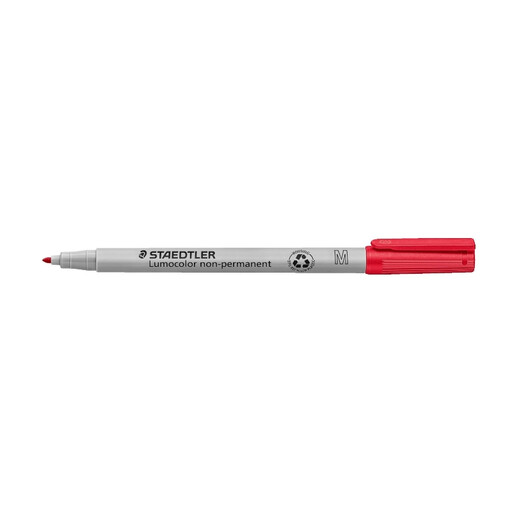
Why this product suits you: The medium line width of around 1.0 mm is ideal for everyday writing and marking at school, at home and in the office. The red ink is great for highlighting information clearly.
The water-soluble ink is designed for temporary marks on film and smooth surfaces, and can be removed with a damp cloth.
M tip with a line width of around 1.0 mm, water-soluble ink, PP barrel and refillable design, listed as compatible with Refill Station 487 17.
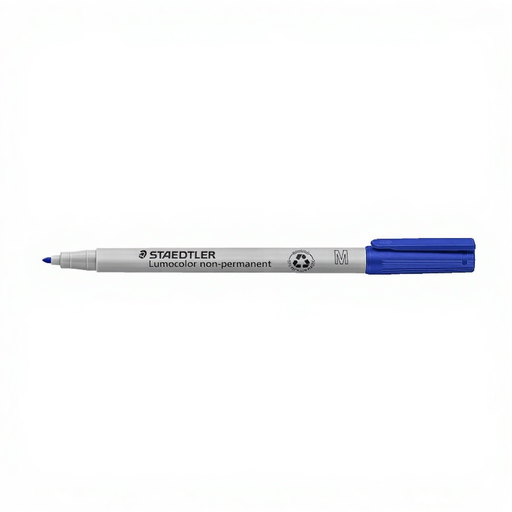
Why this product suits you: The blue M version combines a practical line width with versatility for use on film, glass, plastic and presentation materials.
The product information specifies quick-drying, water-soluble ink that can be removed from suitable smooth surfaces with a damp cloth.
Synthetic tip with a line width of around 1.0 mm, high visibility according to the product description, and refillable design compatible with the specified 487-17 station.
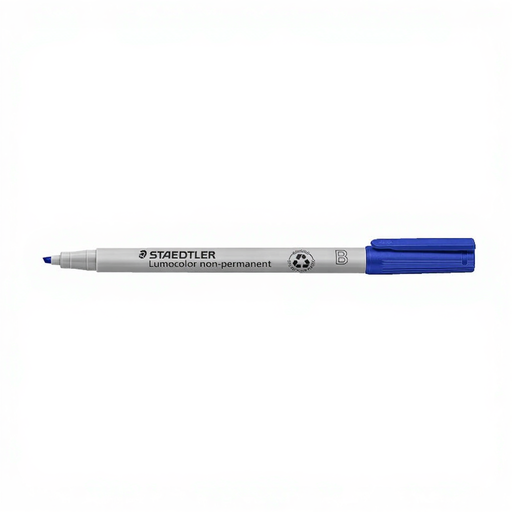
Why this product suits you: The chisel tip, with a line width of 1.0 to 2.5 mm, is well suited to presentations, overhead projector film and marking tasks that call for variable line widths.
The variable tip means you’re less likely to need a different marker width for every task. The mark can be wiped off for temporary uses.
B chisel tip with two specified line widths, water-soluble ink and suitability for smooth surfaces and overhead projections.
We’ve put together a complete, regularly updated list of products that meet these strict selection criteria and fully comply with the safety regulations in force in the EU.
For paper, notes, schoolwork or planners, erasable gel pens are a different product category. Models such as the M&G So Many Cats Erasable Gel Pens and the Deli Erasable Gel Pen use heat-sensitive gel ink and a 0.5 mm tip. You can erase the ink using the integrated rubbing or erasing surface.
These pens aren’t designed as a substitute for an erasable marker for film. The gel ink is intended for paper, and heat can affect the visibility of your writing. For glass, plastic and overhead projector film, a suitable non-permanent marker remains the more practical choice.
The product information recommends using a damp cloth on film and suitable smooth surfaces. Depending on the surface and the amount of ink, a dry cloth may be less effective. If you’re using the marker on a sensitive material, test it on an inconspicuous spot first.
There’s no set lifespan that applies to every marker. It depends on how much you write, the line width, how the marker is stored and whether the cap is closed fully. Compatible models can be refilled using the specified refill station. Check that the station number matches your model.
For general labelling, an M tip of around 1.0 mm is a good all-round option. For particularly fine details, consider F at around 0.6 mm. If you need bold or variable lines, choose B at around 1.0/2.5 mm. The viewing distance, film size and contrast you need are all important factors.