
Lieferung heute & morgen

Qualitätsgarantie

Willkommens-Angebote freischalten: KOSTENLOSE Lieferung | Bis zu 80 % RABATT | Kostenlose 30-Tage-JoyPlus-Testphase
App herunterladen
A stainless steel kitchen strainer is one of those kitchen utensils you can use every day: for washing salad, draining pasta, rinsing rice or draining fruit. Even so, many models are impractical in everyday use because important details only become apparent after purchase.
Typical buying and marketing pitfalls include:
For stainless steel, specific details such as 304 stainless steel or 18/10 stainless steel are more meaningful than general advertising claims. The designation 18/10 refers to an alloy containing approximately 18 per cent chromium and 10 per cent nickel. This can help support good corrosion resistance, but it does not replace proper care.
A stainless steel strainer should be dried completely after cleaning. Salt, acid or cleaning-product residues should not remain on the surface for long periods. Scouring pads and wire wool can cause scratches. With a coated colander, you should also check whether the coating is dishwasher-safe.
For individual portions or small amounts of fruit, a compact strainer with a handle is usually sufficient. A model with a capacity of around 0.5 litres is easy to store and suitable for berries, herbs or a small portion of pasta.
Families who regularly drain pasta, potatoes or vegetables will generally need a pasta colander with a larger diameter. A wide rim and integrated side handles make it easier to hold securely over the sink. If you prepare different quantities, a strainer set with several sizes may be more useful than a single colander.
The hole pattern affects which foods remain in the strainer. Fine mesh is suitable for straining small ingredients or sifting dry foods. Evenly distributed, larger openings allow water to drain quickly from pasta and vegetables.
A stable base prevents the draining strainer from standing directly in liquid. With an expandable model, you should also check that it rests securely on the rim of the sink. A collapsible kitchen strainer saves space, but it should remain sufficiently stable when extended.
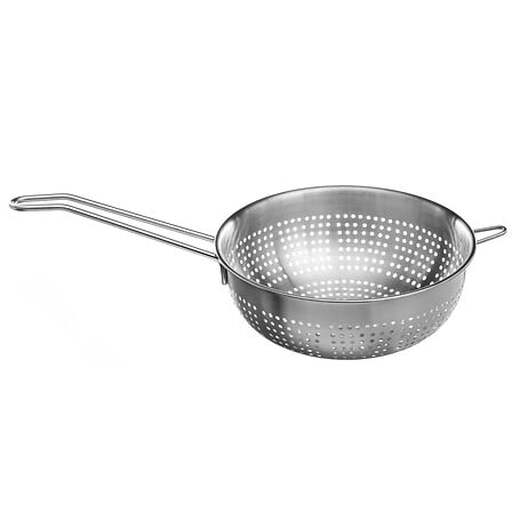
Why this product suits this profile: The compact 0.5-litre capacity is suitable for small portions, berries, herbs or individual quantities of food. The long handle makes it easy to use and store in a confined space.
Its small size clearly indicates what it is designed for. This avoids buying a large, difficult-to-store strainer for small quantities.
Compact design, stainless steel construction, fine drainage openings and an integrated handle.
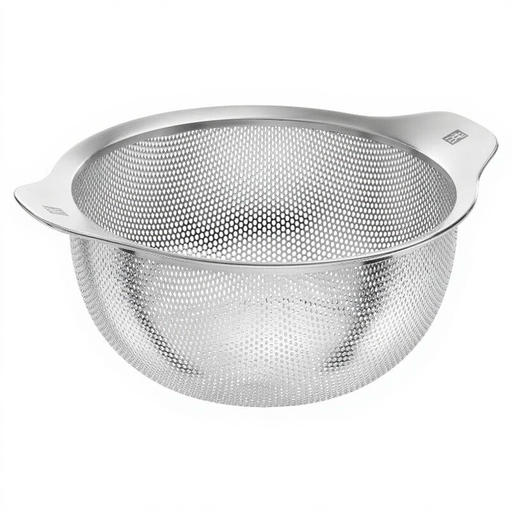
Why this product suits this profile: The 20 cm diameter, flat base and stated dishwasher suitability make it a good match for households looking for a versatile strainer for washing, draining and storing food.
The technical specifications clearly state the material, diameter, base and dishwasher suitability. This makes it easier to check the details before buying.
18/10 stainless steel, satin finish, flat base, stackable design and dishwasher suitability according to the product specifications.
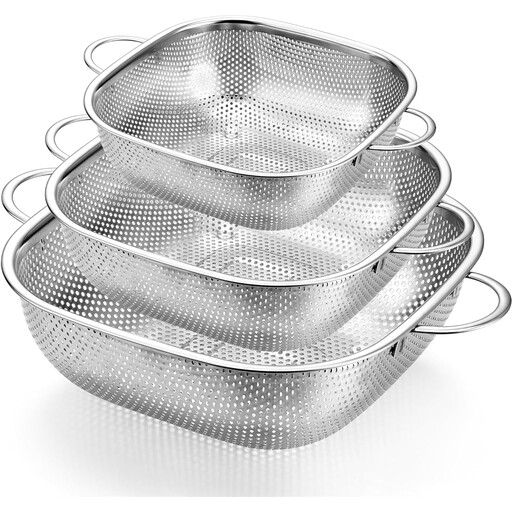
Why this product suits this profile: Three sizes – 20, 24 and 28 cm – provide options for small portions, vegetables and larger quantities of pasta. This is practical when several people in the household prepare different amounts.
The different diameters avoid having to compromise by using a pasta colander that is too small or too large for every task.
Three sizes, stainless steel construction and side handles for a range of kitchen tasks.

Why this product suits this profile: The expandable design is intended for larger quantities and sinks of different widths. With a capacity of 3.6 litres, it is suitable for pasta, vegetables and fried food.
Before buying, compare the width of your sink with the stated dimensions of 53.5 × 24.7 × 10.5 cm. This helps prevent an unsuitable fit.
3.6-litre capacity, expandable design, stainless steel construction and ergonomic handle.
We have put together a complete, regularly updated list of products that fully meet these strict selection criteria and the safety regulations applicable in the EU.
Before first use, every stainless steel kitchen strainer should be cleaned with warm water and mild washing-up liquid. For models intended for hot liquids or oil:
A small diameter is often sufficient for individual portions. For family-sized portions of pasta or larger quantities of vegetables, models from around 20 cm are more practical. It is also important to check whether the colander rests securely in the sink or on a saucepan.
No. Stainless steel can generally be easy to care for, but its suitability depends on the surface, handles and construction. The product description should clearly state whether it is dishwasher-safe. Allowing it to dry completely after the dishwasher cycle is advisable.
The terms are sometimes used interchangeably in everyday speech. A fine sieve is also suitable for straining small particles or dry ingredients. A colander or draining basket is usually larger and has bigger openings, making it particularly suitable for draining pasta and for vegetables and fruit.